
Let’s Go! To Japan
Designed by: Josh Wood
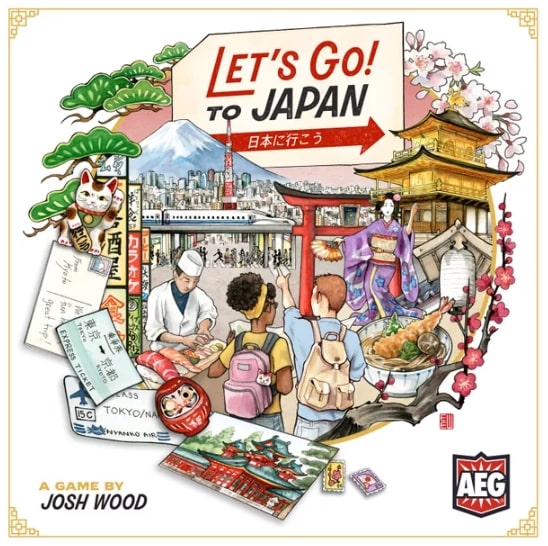
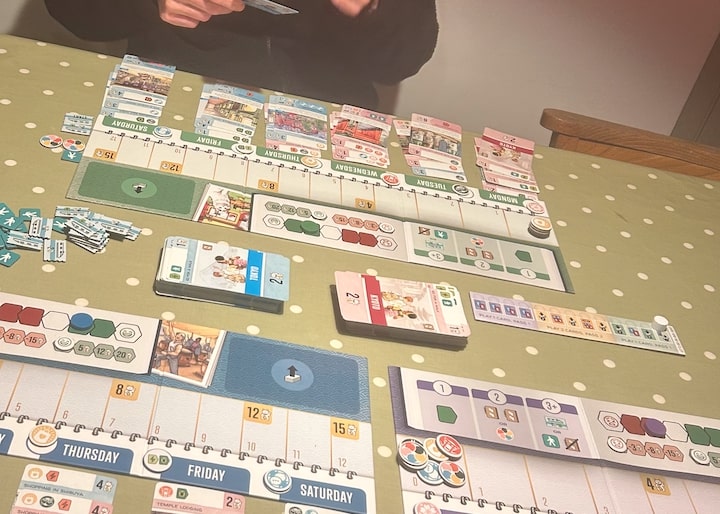
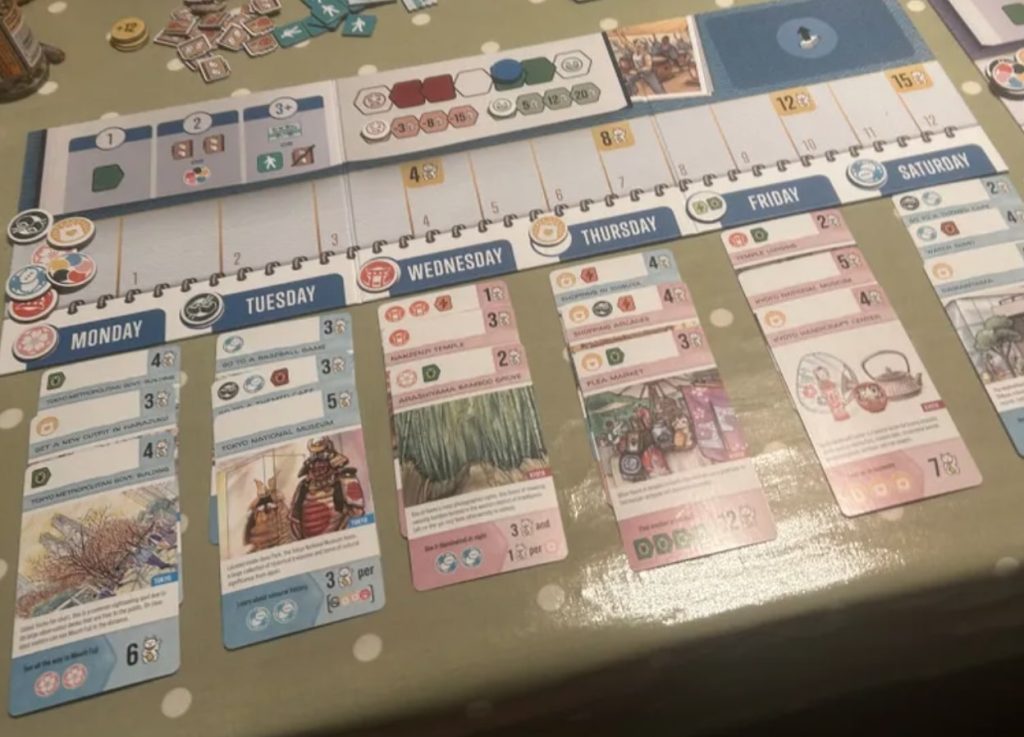
In Let’s Go! To Japan players are planning a trip to the country in question – or more specifically, Tokyo and Kyoto.
Everyone has their own player board which represents a week in the calender which they will spend sightseeing. Over twelve rounds you’ll draw cards from two decks – Kyoto and Tokyo – which represent tourist activities. In each instance you have a choice of which activity to add to your calendar: each day has room for three such activities, and you can add a card on top of ones already present, or slide it underneath them – bear in mind that the top card (ie the one entirely visible) has a potential scoring benefit on it.
The cards you don’t use are passed on to your neighbour. In each game the days in the trip have a favourable condition: these are food, shopping, temples and so on. Matching the symbols on the cards (eg eating sushi on the day where the favourable condition is food) gets you helpful benefits: the instant any day is completed by adding the third and final activity to it, check how many symbols on the card match the day’s favourable condition, and receive the benefit: this might be improving your mood, getting an extra activity (-a card played face-down to a day you’ve just completed) a wild ‘experience’ movement, a research token you can cash in for extra card choices, or a train ticket for travel. All of these will make sense when your trip is concluded below!
After everyone has played their final card it means your trips have been exhaustively planned – now it’s time to go to Japan! This is essentially a scoring round that players can do at the same time as each other, but thematically we’ve found it fun to talk through our vacations as the rulebook suggests: either way, you work through the trip sequentially, moving experience markers matching the symbols on the cards up the score-track on your calendar: for example, if you visit three temples on Monday, you might be moving your temple experience marker several times along the track.
Each card scores points – a kind of experience value – but the top card on your stack shows your ‘highlight of the day’ and will hopefully score you more points, depending on where your experience markers are. This is where your wilds can be cashed in: moving a marker of your choice up the track so you trigger the day’s highlight and haul in the points for it.
So each day scores you a number of points in this way. Any cards played face-down can now be revealed and you choose whether to keep them face-down or reveal them.
As you play ‘through’ your trip, some cards will worsen your mood (by costing a lot of cash, or tiring you out). Others improve your mood by being cheap or relaxing. This mood is tracked on your board as well: each time you hit the top of the mood tracker, it triggers the point-scoring happiness tracker: points! Conversely, hitting the bottom triggers the stress-tracker: minus points! Every time you move between Tokyo and Kyoto (blue cards and red cards) you must do so by train. If you’ve gathered trains as benefits you can use these to do so (for improved mood and bonus points) and if you don’t have the trains you need you simply take them from the supply – but they’re played face-down and cost -2 points each.
Finally, you also score points for how far your experience markers have moved along the track. Scores are totalled up and the player with the most points is the winner!
Sam says
I generally prefer games with a little more shared focus and interaction than Let’s Go! to Japan, where I am paying very little attention to what my opponents are doing. But it’s such a neat little puzzle and so lovingly presented that I have a soft spot for it – it’s one of those games where you can feel the passion of the creator (who, in fact, designed it when the lockdown of 2020 forced the cancellation of his Japan trip). I think it’s best for 2 or 3 players, and if you know the game well it can rattle along surprisingly fast. It is not the most intuitive to learn, as it only fully comes into focus when you score at the end, but that first play was enough for us to ‘get’ it – and we instantly wanted to play again.
-

Take That!
Cards are drafted – ie, passed around the table – so there is an outside possibility of minor interference: for example, I could pass you only Tokyo cards knowing you need Kyoto cards. But generally players are too focused on their own trip to think this deviously – and players are always allowed to discard a card to play another (from either city) face-down anyway. So the take-that here is minimal at best.
-

Fidget Factor!
It’s a little too abstracted for younger kids to grasp easily and the game’s structure makes it a little less accessible than some. But a couple of plays makes things familiar enough that you can blast through a game with 2 or 3 players in a half-hour or so.
-

Brain Burn!
On a first play it can seem overwhelming, with a fistful of icons and a mouthful of terminology. But you can just fling the cards out almost randomly and 20 minutes later – when your trip scores terribly! - understand it. Essentially you play three cards to each day of the week, match the card activities to the day’s favourable condition and try to make sure each day scores it’s bonus.
-

Again Again!
A huge deck of cards for each city means each game will have different combinations and different challenges.


