
Around the World in Eighty Days
Designed by: Michael Rieneck
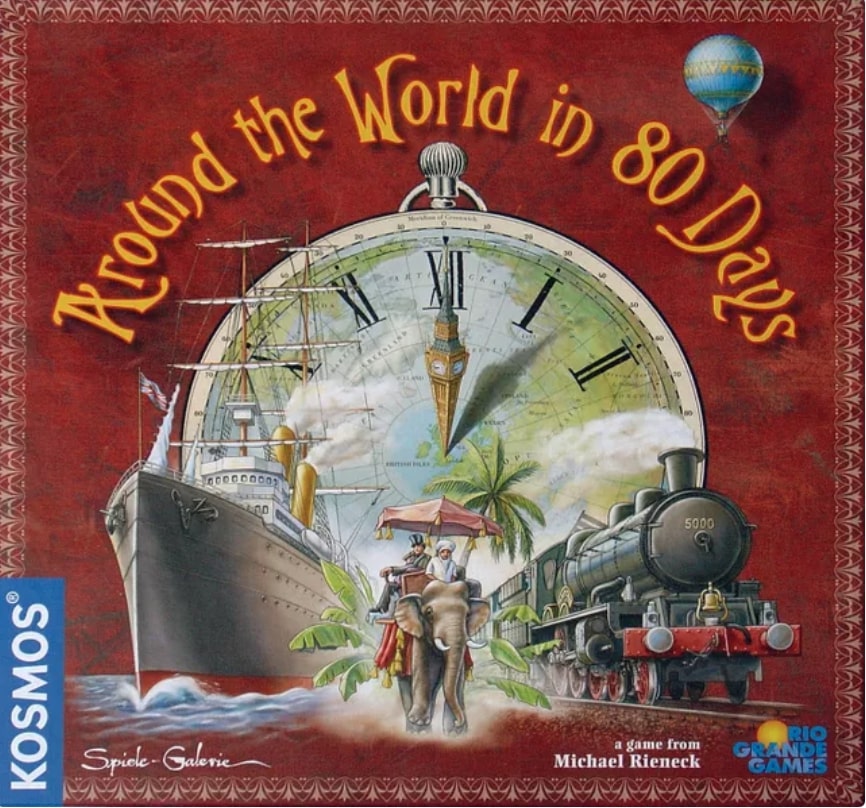
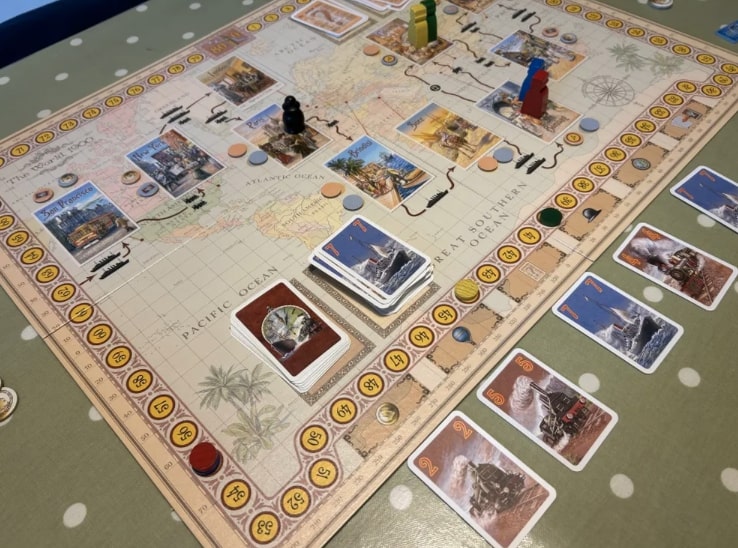
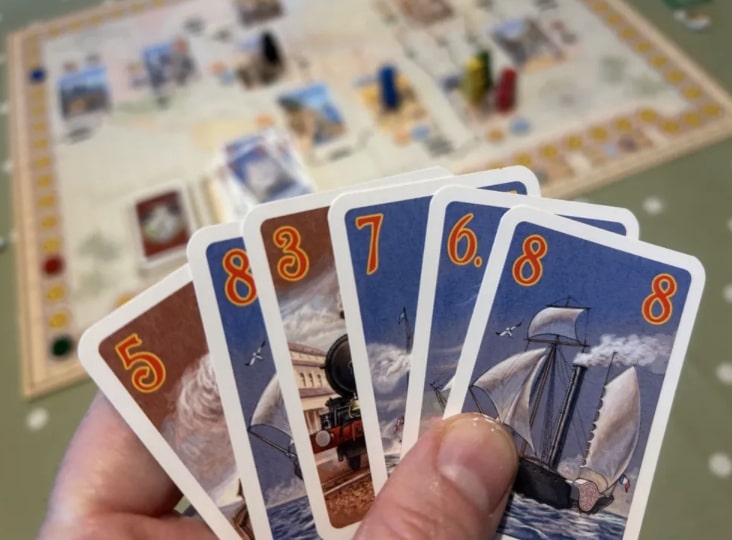
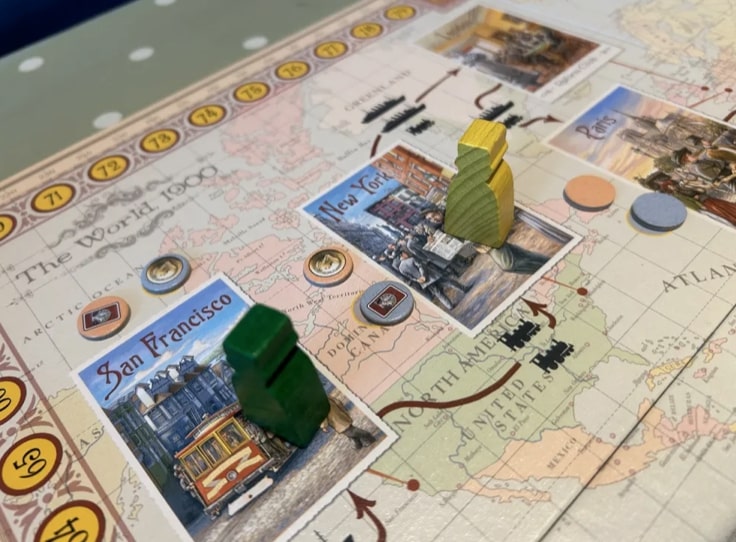
Inspired by Jules Verne’s fictional novel of the same name, Around the World in Eighty Days sees the players each take on Phileas Fogg’s challenge of completing the trip in 80 days (or less). These days are tracked around the edge of the board, but take heed: the first player to reach the destination of London may not necessarily win – it’s the player who does so in the fewest days!
Players place their pieces on the board in London, which is both start and end point of the trip, and get a hand of Travel cards to begin plus one gold coin. The journey is mapped out for you, showing the route you’ll take and whether it’s by ship or train (sometimes both) and moving from destination to destination will cost you travel cards. But you don’t always have to move, as we’ll see – sometimes you may not want to, thanks to the interfering Detective Fix!
In each round each player will get one turn. A turn consists of taking a single travel card from a face-up array, then optionally moving: discarding train and/or ship travel cards and ‘paying’ the number of days they represent by moving your marker along the track around the board that many spaces. If you need to pay two ship or two train cards and both your cards have the same value, you only pay the price of one. But which card you take also gets a potential benefit: a gold coin, an event card, use of the balloon, move the detective (more on him in a moment), take the starting player marker for the next round, or trade travel cards.
Let’s look at the balloon first: if you move this turn, you must pay travel cards as per normal but the cost of one card can be replaced by the roll of a six-sided die. Gold coins can be used either to re-roll the die if you don’t like the result, or you can pay two coins to take another travel card (from the top of the deck). Moving the detective can save you and hamper others: anyone ending their turn in the same place as the detective immediately loses two travel days! Event cards – except for two negative ones – are added to your hand and can be played on this or a future turn. The catch here is the two negative cards – Storm and Delay – both add days to all the players and claim everyone’s event cards back into the (reshuffled) event deck – clinging on to events for too long can really backfire. After your turn, you must discard down to a six card limit, and at the end of each round the card array refills again.
As soon as someone reaches London they no longer take turns, there’ll be one less card in the array for each subsequent round. Every other player still moving pays one extra travel day at the start of each round until the last-but-one player arrives, which triggers the end-game: this will now be the last round. The player who used the fewest days to reach London again wins, unless nobody used 80 or less! If that happens, the player who reached London first is the winner.
Sam says
Considering it’s somewhat beige and muted appearance I’ve found this to be a surprisingly fun and breezy game, suitable for adults and kids both. We’ve covered almost all the rules here (one or two exceptions, like the rewards in each city for arriving first or last) and while it might feel slightly counter-intuitive – arriving first not meaning you automatically win – it’s still pretty simple to get your head around, and can be played as a gentle race or – using the detective and some shrewd card selections – as a more combative affair. Good fun!
-

Take That!
Yes, definitely a factor and if turns are being taken to their maximum effects, a necessary one. But parents for example can duck these elements and play with a less feisty approach.
-

Fidget Factor!
It’s a pretty fast-moving game once you’re in the door/balloon
-

Brain Burn!
There are two things to think about: moving your piece around the world, and getting in the way of the others – mostly with the detective.
-

Again Again!
If the overall vibe remains much the same, there’s enough built-in variability to give each visit unpredictability, and the tension of the endgame is always fun – can someone pull off a surprise victory?


