
Astronauts: The Ultimate Space Game
Designed by: Uncredited
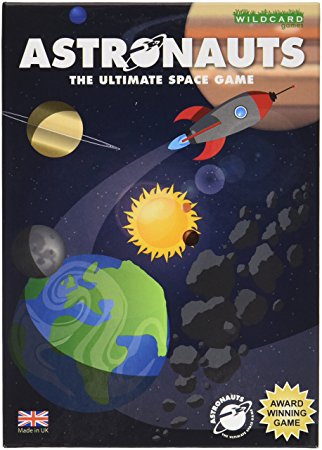
Astronauts is a children’s game where players launch missions into space, but in order to score points, they must return safely to Earth.
Six cards are dealt to each player, and on your turn you play a card to the table, then replenish your hand up to six cards.
Cards on the table go in three places. The first is your space mission: You can begin or continue a space mission by placing a Planet card in front of you. Planet cards are sequential, and for the game’s purposes that sequence goes from the sun outwards (rather than from Earth). If you’ve already passed Saturn, for instance, you can’t go back to Venus, but must continue onwards, towards the edge of the solar system.
You can play a Special card onto someone else’s mission, disrupting them in some way. Or you can simply discard a card without activating it.
Play will continue until the cards run out, but points are only scored for missions that make it home safely: to do this, you must play a Return to Earth card to your mission stack, then role the planet number (or higher) of the last planet you reached. Because Mercury is a 2 and Neptune a 5, this means that the further you go in space, the harder it is to return to Earth. You do at least get a return to Earth roll on every turn, but you can’t start a new mission until this one is safely home.
When the cards run out, points are tallied and most points is the best astronaut.
Sam says
Perhaps Astronauts does itself a disservice with that sub-heading of ultimacy. It feels a bit too long for what it offers, and for us, relies too much on luck: what cards you get, whether you’re targeted, what you roll on the die. Considering its target market Astronauts is also surprisingly combative. I’ve often noticed how publishers seem to equate luck-heavy games with children and I’ve found – in an admittedly tiny research pool – that children can actually find them quite frustrating compared to games where you have more control: even as a parent, it can be frustrating watching kids get hit by poor draws and unlucky rolls – for the official 45-minute playtime, it can turn into a grind. But it’s not an awful game: nicely presented and with a strong education element for youngsters.
-

Take That!
Actually, quite a bit. Some of the cards are pretty disruptive, and you can be stymied by poor dice rolls too.
-

Fidget Factor!
Very low. Each tuns is imply play a card, maybe of which don't have an attendant action but just represent exploration.
-

Brain Burn!
Again, very low. It's luck-pushing, really.
-

Again Again!
It's pretty easy to teach and cards and dice ensure randomness.


