
At the Gates of Loyang
Designed by: Uwe Rosenberg
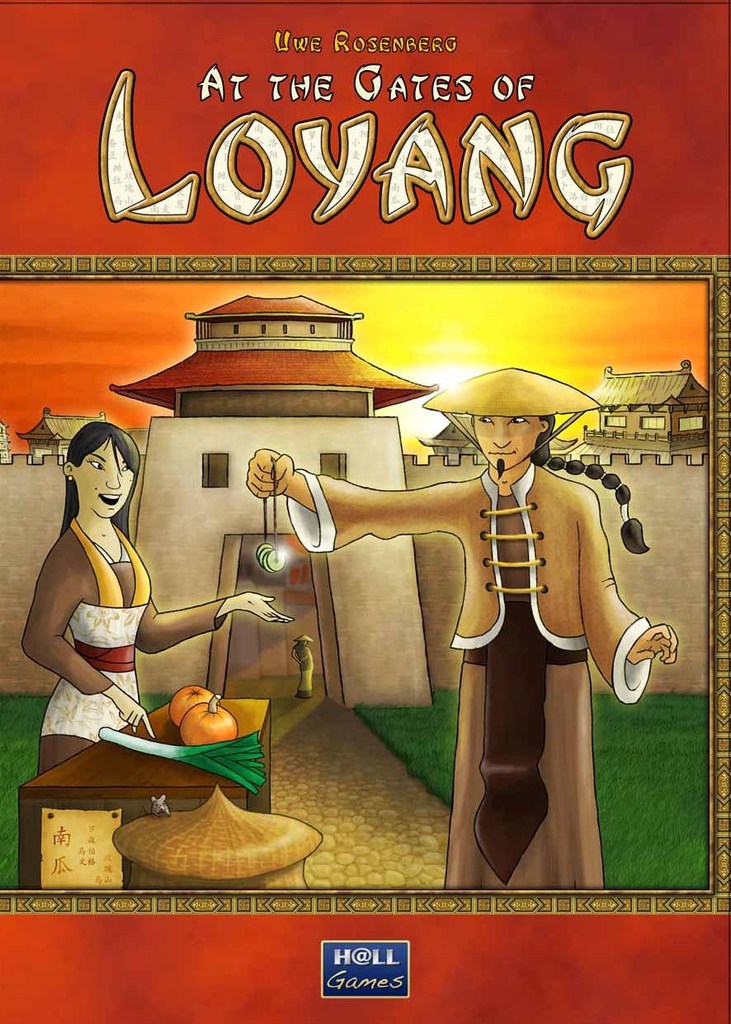

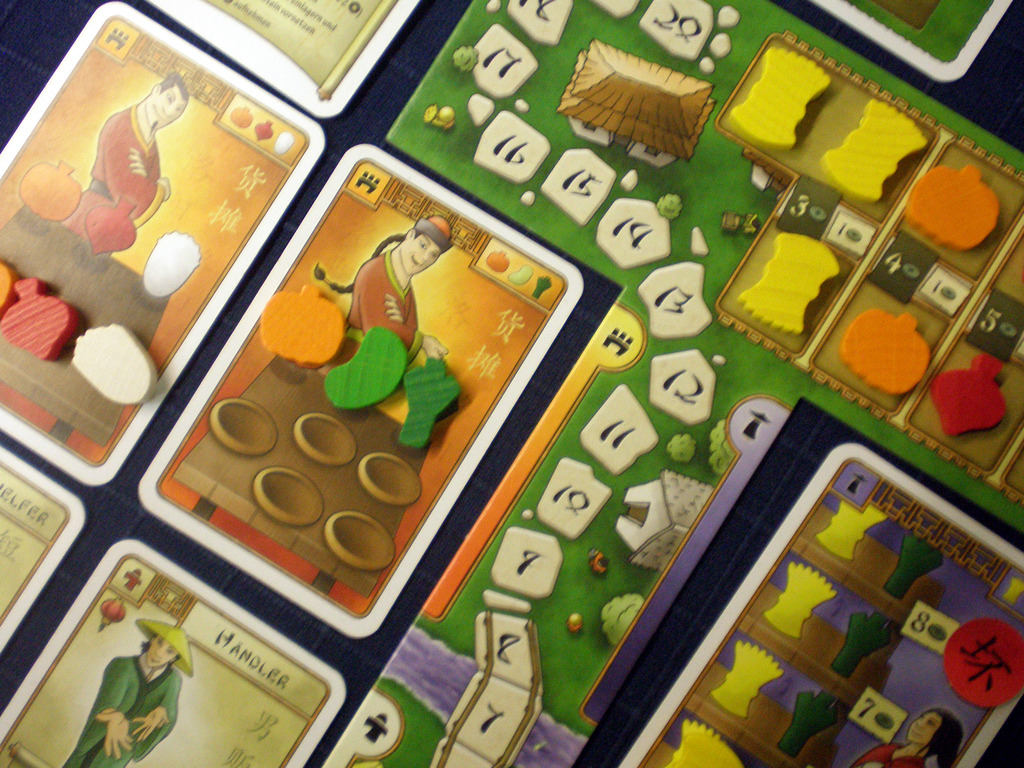
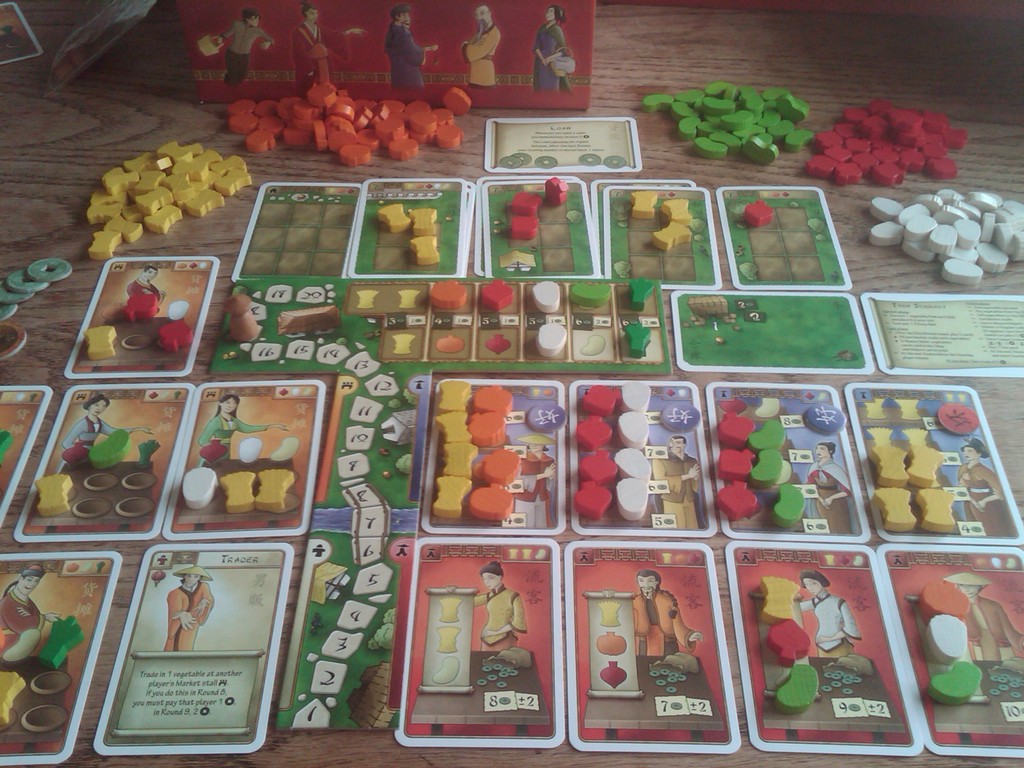
At the Gates of Loyang is a game where the players compete to be the best trader at the eponymous Chinese city.
Players each begin the game with a player mat, and some cards: representing a field, a cart, and a shop. At the start of the game you plant a crop in your field, and begin a process of harvesting, selling, trading, and generating customers.
Each round is broken up into phases: there’s a harvest phase where you take a vegetable off each of your fields. Then a distribution phase where each player is dealt four customer cards from the deck, and the starting player chooses one to put face-up on the table. This is the courtyard, and each subsequent player has a choice – to add a card from their hand to the courtyard, or to take a card and add it to their player area, in which case their turn is over. So there’s a balance here in that the longer you wait to claim a card the better the choices will become, but the less cards you’ll have in your hand. After every player has chosen a card, the final phase is planting, buying and selling. You can now buy from the shops and sell to your customers – the cards you gathered in the distribution phase. You can also plant vegetables in your own fields at this point, and some cards have trading opportunities that allow you to trade in several commonplace vegetables for harder-to-get ones. Your customers come in two types – one-off customers who demand a big order but are happy to wait, and regular customers who want the same thing every round – if you let them down more than once, you lose points… finally, some of the cards are helpers who can assist you in some way: usually self-evident from the card text.
At the end of each round you buy points using money – 1 money always moves you one place up the victory point track, but after that initial move, if you wish to go further you have to pay the numeric value on the track itself, which in turn increases the higher it goes. The game ends after 9 rounds and the player with the most points wins.
Sam says
It all looks and feels lovely, and is mechanically rather clever. But I have found it slightly repetitive and just a little long for the experience it offers, especially if played with more than two, which I’d argue is the ideal number for this game. As there’s virtually no interaction and each round is essentially a puzzle, 4 players can turn what feels like a little trading game into an interminable epic. But I’m generally a fan of this designer’s games, so maybe I’m being more critical than usual. I’d certainly happily play it again with a keen opponent.
-

Take That!
Almost none. There's not an awful lot of player interaction in Loyang, outside of the distribution phase.
-

Fidget Factor!
Don't sit down with a 10 year-old to read the rules; they're not brilliantly written and it needs a first play to get your head around the game. But after that Loyang speeds up exponentially and if you get 3-4 games under your belt you'll find it speeds along.
-

Brain Burn!
There's some juggling of customer expectations and minimal maths, but it won't exhaust you.
-

Again Again!
The cards are random and minor variations in strategy at the start will change the game experience for you. You do however have to be ok with a gaming experience that is sometimes referred to as 'multi-player solitaire', as interaction in the game is fairly minimal.


