
Aton
Designed by: Thorsten Gimmler
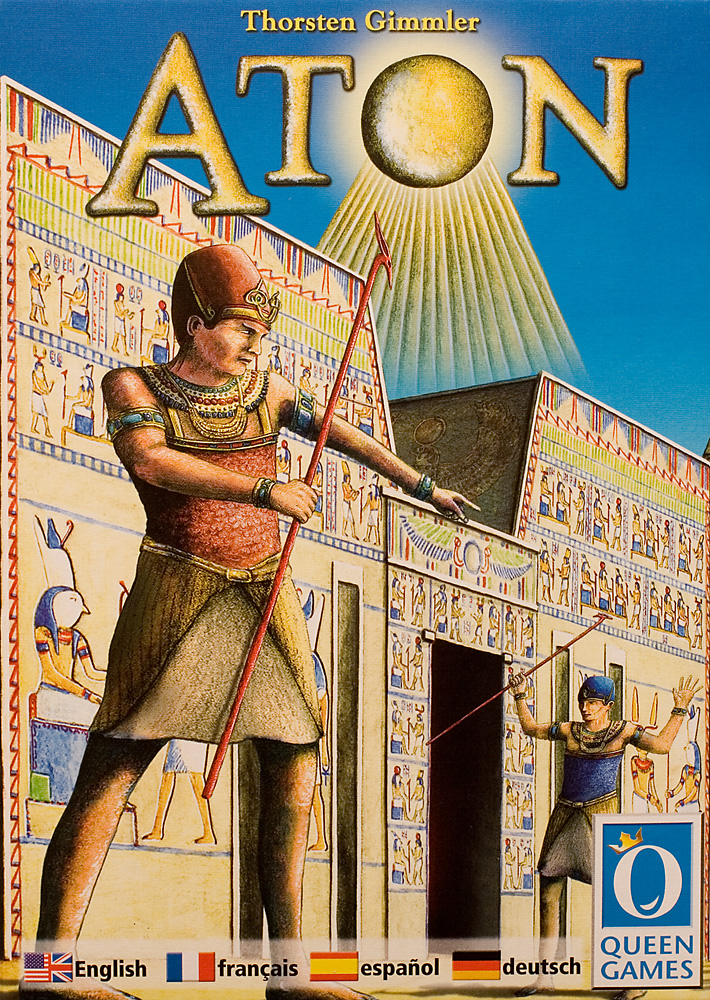
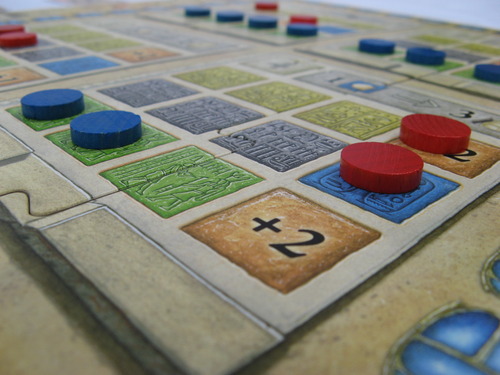
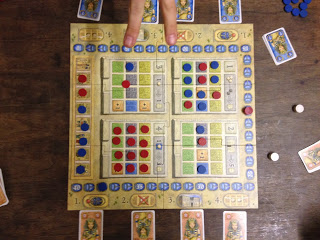
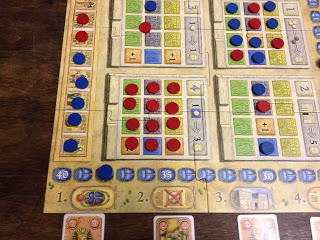
Aton is a strictly two-player affair, and a very abstract one at that. The theme is of battling Egyptian deities, and this manifests in placing counters in four different temples (-areas on the board), and removing your opponent’s counters from the same. When a scoring round is triggered, the player with the majority of counters in each of the four areas scores points. A few counters are removed, and play continues. Once someone hits 40 points, they win.
But Aton is more than the sum of its parts. Every turn, each player deals themselves four cards from a deck of 36 cards all numbered one to four. You might get four fours; you might get four ones. Players then secretly assign their four cards to four spaces on their side of the board. Then cards are revealed, and dictate the actions for the turn, including who gets to go first. The numbers you’ve assigned to each space dictate how many counters you can place in which temples (one to four). And also how many counters you must remove – these might be your own if you only had a number one card to play, or two of your opponents if you played a precious four. Any counters removed go into a separate track, and when that’s full a scoring round occurs.
Deciding which of your four cards to play where is an agonising decision, and requires careful second-guessing of your opponent’s plans. Of course, you’re at the mercy of the cards you’ve been dealt, but you also get one ‘gimme’, so you can discard that hand of all ones at least once in the game.
Games of Aton, once both players are up to speed, are real ding-dong battles. It may be that one player speeds towards the 40 point target, and the other feels there’s no way to catch up, but there are three instant-win criteria, which allow the trailing player to put the pressure on right up to the end. Abstract it may be, but Aton is an extremely clever and rewarding game for two.
Sam says
It’s a tricky, tactical game where you have to roll with the punches of the cards you’re dealt, but be aware of an unexpected – and not necessarily welcome! – ending. Not a game dripping with theme, but an immersive battle all the same, and one that I’ve played a lot.
-

Take That!
As with most two player games, you're directly battling your opponent. It's not destruction per se, just removal of pieces, but confrontational just the same.
-

Fidget Factor!
Choosing where to put your four cards can be agonising, but both players do this simultaneously and there are limited permutations - the rest of the game will fly by.
-

Brain Burn!
No maths to speak of - each temple contains 12 spaces so it's easy to see who's in the lead.
-

Again Again!
A game of Aton can be over in ten minutes if one player takes their eye off the ball, but between two players of equal experience 20 or 30 mins is more likely. And ann immediate rematch will doubtless be requested by the loser. The only random element is the order in which your cards come to you, but this game is all about the players, so if you find an enthusiastic opponent you'll return to it again and again.


