
Black Forest
Designed by: Uwe Rosenberg
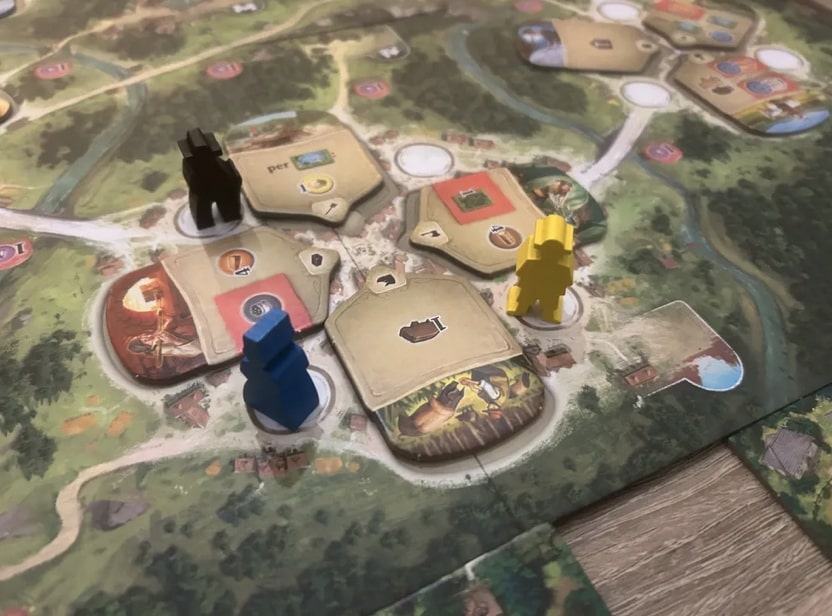
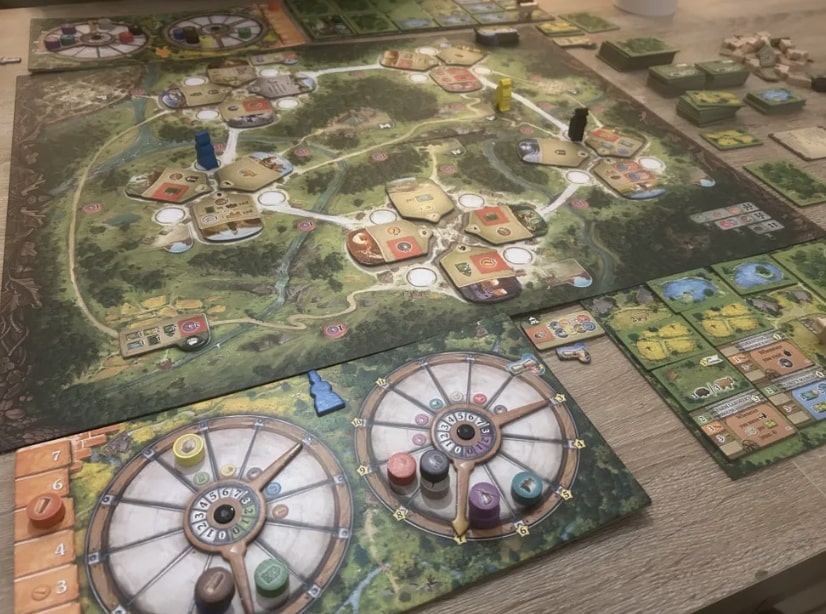
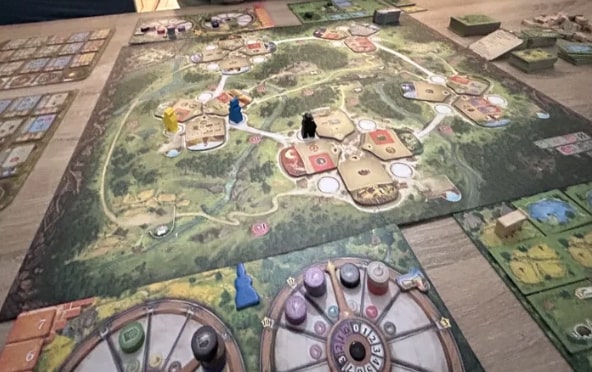
Black Forest is a game where players are Bavarian glass-blowers of the past, beavering away in the titular forest. In the main, your goal is to gather resources to build buildings to score points. But how you go about these undertakings is the puzzle the game presents – and it is a puzzle!
Each player begins with a domain board representing a part of the forest where they’ve established their glass-blowing hut. You also have a board with two resource wheels on, which we’ll return to shortly. The shared board shows five ‘villages’ where you interact with tradespeople during the game, and on each turn you essentially move your piece on the board from its current spot to a new one, and then take one or both of the tradespeople actions you’re adjacent to. You must move, if you move to a new village you must pay a provision for the journey, and if there are other players in the village on arrival you must also pay them a basic resource each! Glass-blowing was clearly a business that attracted the extortionate type.
The tradespeople are mostly very easy to understand – get a cow, get a pig, turn brick into charcoal, turn trees (on your domain board) into wood (on your resource wheel). You might increase the productivity of your glass-blowing, which will enlarge your domain – adding an extra board to it – or harvest porridge from your cows. There’s a build action too, which is key to winning: spending resources on buildings – which must also fit on your domain board – gives you both points but also in-game special powers or advantages.
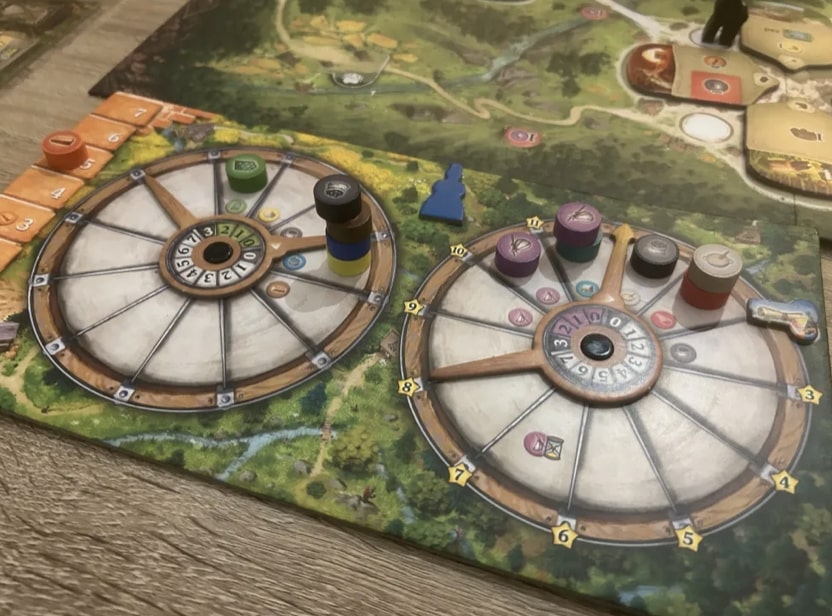
But let’s look at the resource wheels (also used by this designer in Glass Road) as they’re such a specific aspect of the game. In the pictures you’ll see two wheels: the one on the left is glass production and the one on the right is the cooking wheel. Whenever you receive resources from a tradesperson, you move the matching marker up the wheel. The needles, likewise, will move clockwise: and whenever they can move, they will: representing both the human desire for sustenance (cooking wheel) and your pathological love of making glass (production wheel) this means that you are constantly losing basic resources (in the large section of the wheel) but when you do so, you gain the advanced ones (glass, provisions, and commodities). Glass is helpful for buying buildings, provisions are helpful for getting around the board, and commodities allow you to strike a deal with the travelling merchant.
On every single turn of the game, no matter where you are in the villages or where the travelling merchant is, if you have a commodity, you can spend it to gain two of any basic resource – when you take this action, all other players get one of that resource. As the travelling merchant loves to travel, you then swap their current position on the board with any other tradesperson – the upshot of which the geography of the villages is shifting throughout the game.
Whenever any players’ needles pass the hourglass symbol on the bottom of their cooking wheel, the end of the game is triggered – players all take one more turn, and then points are totted up: most points wins.
Sam says
Black Forest is a strange combo of simple at heart (-get resources; build buildings) and complex (the mechanics of the wheels, the changing dynamics of the villages) that when I first played it I missed the comparative simplicity of the same designer’s Caverna, where the overwhelm was more about a proliferation of abundant choices than the clicking cogs: there, there is no movement of workers or traders or merchants, and a simple rhythm of getting-stuff to do-stuff. But despite the conceptually woolly nature of Black Forest, I have still enjoyed it multiple times: it strikes a deft balance between puzzling you with its elusive ‘best moves’ and rewarding you for almost everything you do. As long as you don’t run out of provisions and find yourself stuck somewhere, the constant influx of cows, pigs, porridge charcoal and glass et al mean each turn feels beneficial. Now – how best to use them?
-

Take That!
Consequential, but not excessively so, is the fact that arriving in villages already occupied costs you resources.
-

Fidget Factor!
Because of the nature of the game, we’d say players probably need to make their peace with a relatively leisurely pace.
-

Brain Burn!
Moderate on rules, but high on implementation: you can play fairly scattergun, but the winners in Black Forest will often be the long-term planners: the engine-builders, strategists and connectors. This despite the fact the game can often feel tactical.
-

Again Again!
There’s huge variety in set-up, a decent variety in the buildings, and always the conundrum of figuring out where the ideal opportunities lie.


