
Castle Combo
Designed by: Grégory Grard, Mathieu Roussel
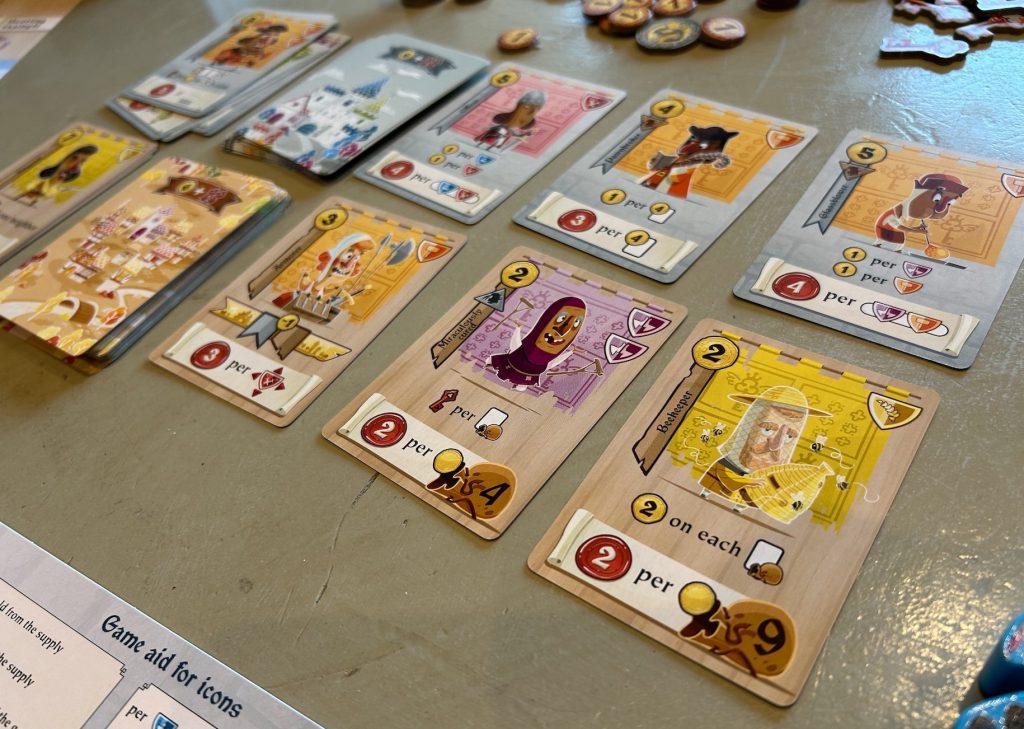
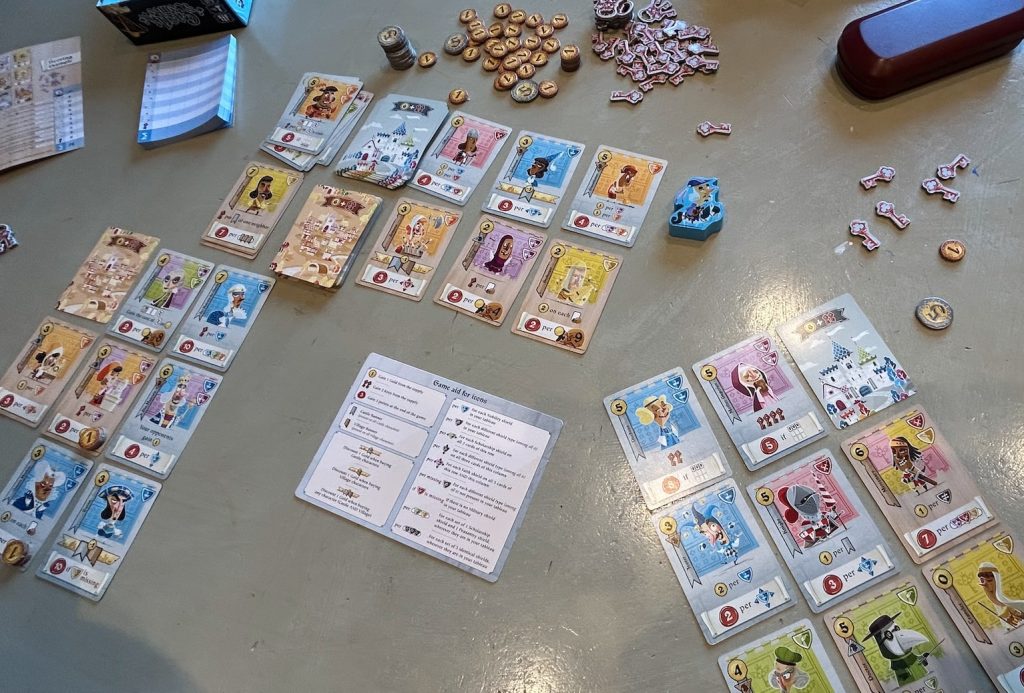
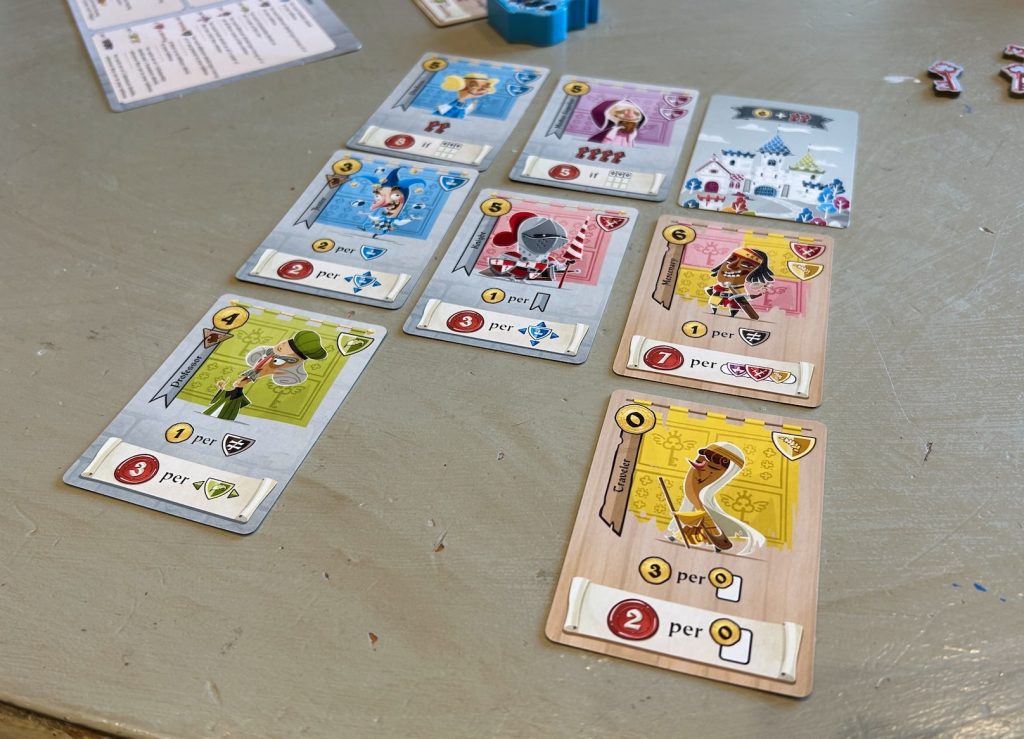
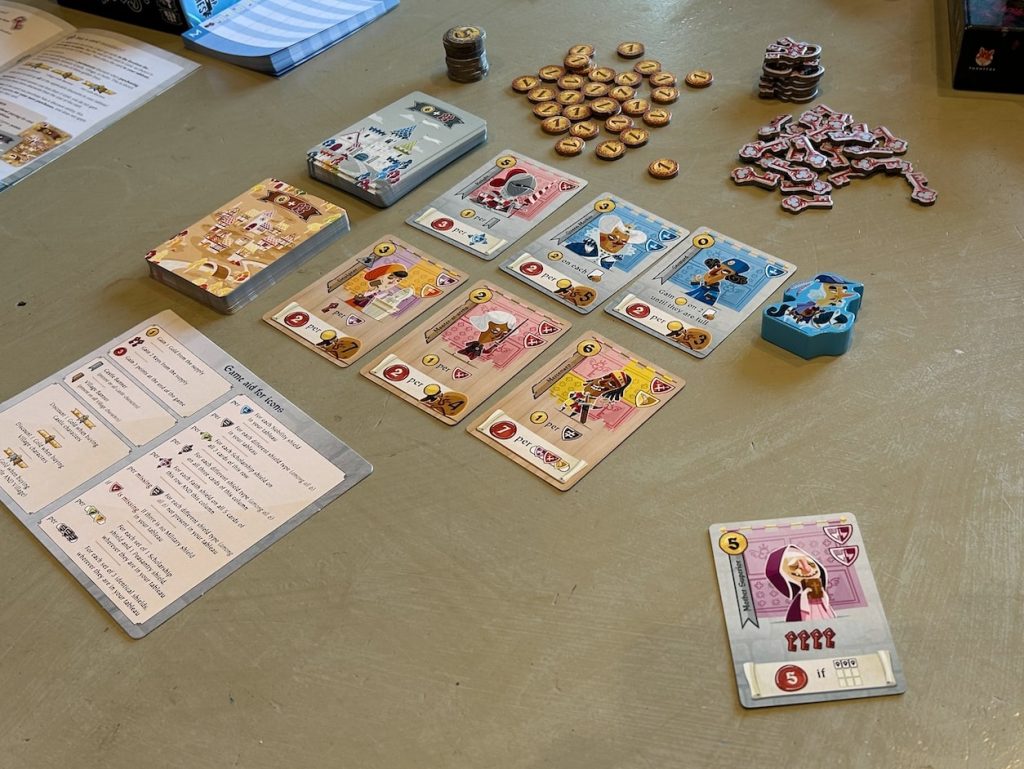
Castle Combo is a game of nine rounds. In each round, players add a single card to their ‘grid’ of 3×3 cards, and at the end of the game they will score based on various things: their position in the grid, whatever criteria they ask of the cards around them, and any gold they have in their ‘purse’.
Players begin with 15 gold and two keys, and central on the table three cards are dealt face-up from both the Village deck (brown cards) and the Castle deck (grey). The Messenger piece begins next to the village cards, and this means the first player can buy a card from the village. They – now and throughout the game – may spend a key to move the messenger to the castle cards instead (or vice versa) and then purchase a card from wherever the messenger is. (You can also pay a key to refresh the cards in the village or castle, but you can only spend one key per turn).
Once you’ve bought a card it’s added to your grid, and – after the first card – must be placed adjacent to a previously-placed one. Some cards bring instant rewards in the form of gold or keys, and some give ongoing abilities such as making future purchases cheaper. All have some possibility of endgame scoring to them: the Mother Superior, for example, will score five points if she is in the top row of your grid. The Princess will score three points for every blue shield in her row – most cards have a shield or two on them, including the Princess herself. The Mercenary will score for sets of shields (purple/red/yellow) in all of your grid. And many cards have a purse at the bottom of them, with room for gold. If you still have gold at the end of the game it can be deposited in these purses for points.
Gold can be tight in the game, but you can optionally place any card face-down on your grid to generate six gold and two keys. The down-side of this is you’re sacrificing the cards’ positive side and won’t get any of the rewards on it, now or later. Once everyone has placed their ninth and final card, scores are tallied and the player with the most points is the winner.
Sam says
Castle Combo feels like a more accessible version of Village Green to me: in that game you build a 9×9 tableau of cards as well, but the way they score is rather more brain-burning: here, the game dispenses with Village Green’s row-and-column scoring and hands that job to the cards themselves in a way that – apart from going a little liberally on the iconography – is more open and welcoming to younger players, for example. Although the theming is pretty much nonsense – not even the rulebook attempts to explain what you’re doing thematically – the fact every card is a character does make Castle Combo feel less abstracted, I feel, than it would have been without them. It’s not the kind of game I actively seek out, being pretty much a 20 minute puzzle of next-to-no interaction, but I enjoy it regardless and I’m very happy to play it – especially with two, where I think it’s best – if someone suggests.
-

Take That!
Players can deliberately take a card that's obviously good for someone else, but the main focus is maximising your own returns (and making sure you don't run out of gold)
-

Fidget Factor!
With two players the game is pretty speedy. As the play-count goes up, so does the downtime, but it's never going to be epic.
-

Brain Burn!
Largely a tactical sense of engagement: you only have six choices each turn - or three, if you're unable to move the messenger - so really it's a puzzle of putting together scoring options in the best possible way.
-

Again Again!
Although the puzzle is always the same challenge, the cards are numerous with no duplicates and the game is breezy enough to merit multiple visits without feeling tired.


