
Castles by the Sea
Designed by: Jon Benjamin, Michael Xuereb
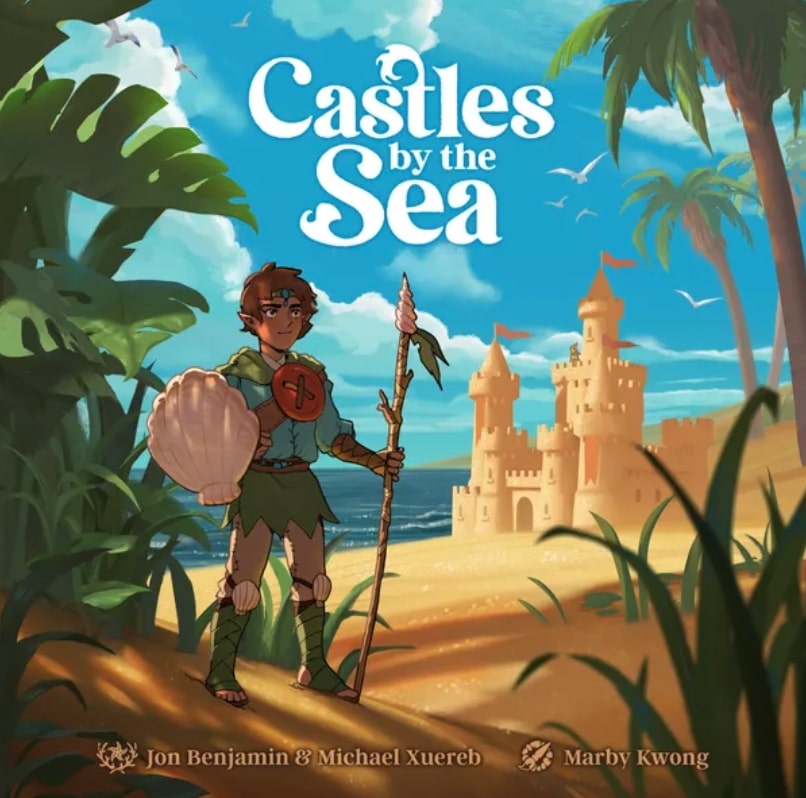


In Castles by the Sea players take on the role of the fictional ‘shorelings’ – tiny people who live in sandcastles. Everyone contributes to the building of the castle, but the player who does so most effectively will be crowned winner…
The shared board is the beach, where you’ll build the castle, populated by the odd stone and bit of seaweed. Each player has a set of cards with matching pieces on them – elements of the castle or its inhabitants – that are laid out before you. Turns follow a series of phrases: first, you gain sand blocks. Then, you use them to build on the board, keeping to the building rules: all blocks you place on a turn much touch another block you placed this turn. Then you add pieces, which might be more blocks (for example, doors or towers) or characters such as guards, archers, or the princess. The pieces can only be placed on or adjacent to blocks you placed this turn as well. Having done so, you gain income: every piece placed in the castle shows how much income you get in the vacated card space: both archers out in the castle, for example, mean your archer card will reward you with two ‘sand dollars’.
The last thing you do on each turn is address the Threats. Because we shorelings are tiny, the threats to our castle come in the form of things that might trample our castle: a toddler for example, or a dog. These threats circle the castle, waiting for an opportunity to do damage! You choose one threat to move on to the next threat-space – there are three on each side of the board – and the others will activate: this is as simple as flipping the top card from the matching Threat cards. Some threat cards have hazard symbols on them, and when the flipped cards of a particular threat reach three or more hazards, that threat attacks. Each threat does damage in a different way, but the key thing is to try an avoid your built parts of the castle being effected, as damaged pieces will be returned to you – and diminish your income.
That’s pretty much it for the basic game, except that each player also has three secret bonus cards that you can reveal for extra dollars when you’ve achieved the objective stated on them. There are a set number of rounds depending on the number of players, then one final round that involves no building but only threats and income. The player with the most sand dollars will be the winner.
Sam says
I like Castles by the Sea, but it’s a strange mix. The sandcastle theme, chunky blocks and cutesy illustrations suggest a lighthearted family game. The numerous phases of turns and spatial puzzle of the building is more dense and thinky. And the threats are random enough to feel mostly arbitrary: a luck factor that seems at odds with the tactical challenge of the castle construction. But despite the disconnect, it all kind of works: at least, enough to hang on to its theme so that the stomping baby or diving kite feel almost comically catastrophic when they arrive and wipe out half the local populace. I think it’s probably too oddball a game to become a firm favourite with many sandcastle-builders, but if it stands up to the first wave of bemusement, this gamer’s game in Hawaiian shorts may well give you some lovely holiday-style memories.
-

Take That!
There's quite a bit of destruction at the hands of the threats, but players only control them up to a degree. While you can try to target others with them, you may find yourself more focused on staying out of their way.
-

Fidget Factor!
Despite the child-friendly theming and cosy look, the building part of each turn really is a puzzle, and though it's not a long game it doesn't exactly move at a high-octane pace.
-

Brain Burn!
The phases of each turn are relatively simple, but as noted above, the building part of the game involves some spatial puzzling - and factoring in the threats.
-

Again Again!
There's plenty of different building cards and


