
Cat in the Box
Designed by: Muneyuki Yokouchi
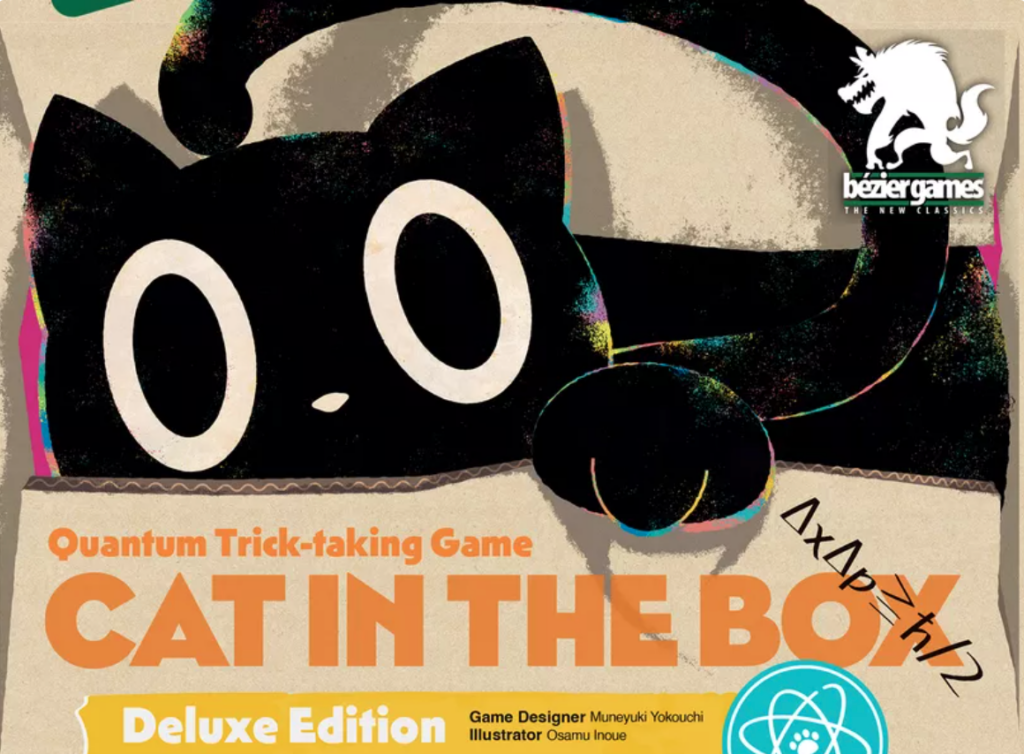
Schrodinger’s Cat is a relatively (ha) famous theory regarding quantum physics from Irwin Schrodinger. Is the cat in the box with a vial of poison alive, or dead… or both? Cat in the Box takes this thought experiment as the basis for a game: there are cards valued 1-9 in four suits (red/blue/yellow/green), but which card is which suit? You only know once it gets played.
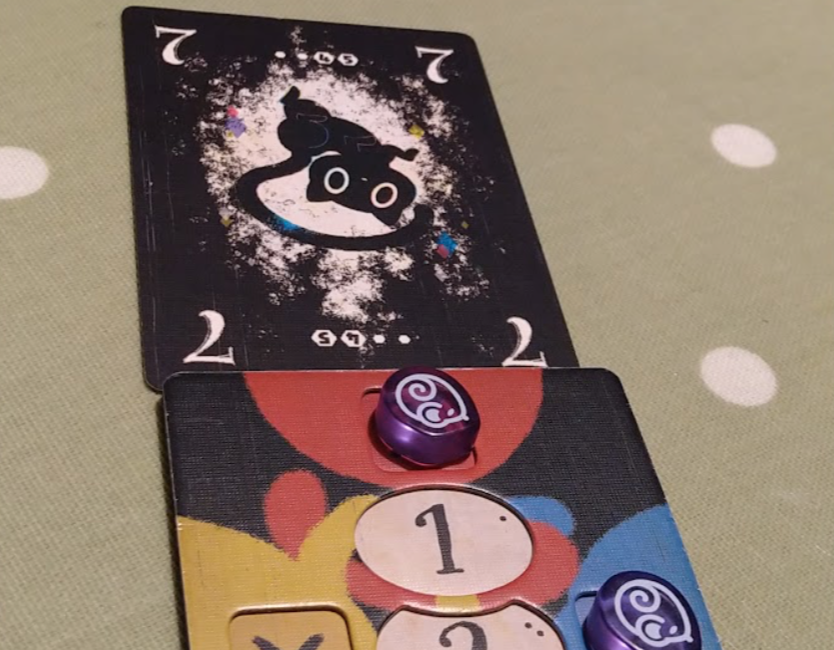
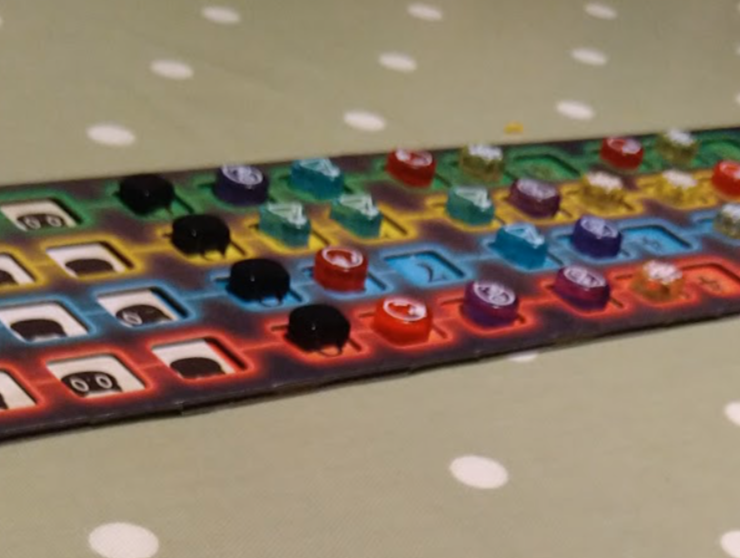
Everyone is dealt x number of cards (some are removed if playing with less than five players) and a board is placed face-up on the table showing each value of each suit (see pics). In front of each player is their own player board: the cards you play get assigned to a different side of the board depending on what suit they are, and on the board itself are four markers – one for each suit – plus a fifth denoting how many tricks you think you’ll win in a given round: one, two, or three.
The starting player plays a card and announces which suit it is by placing a marker on the shared board: that number in that suit now exists, so nobody else can play it. The other players can – and probably will, at least at the start – follow suit by playing cards of the ‘same’ suit and allotting markers to the board in the same way. Whoever played the most powerful card (see trump suit below) – wins the trick, and gets to start the next one.
The trump suit – by default, more powerful than the other three – is always red. If someone plays a blue and you don’t want to (or can’t) play blue, you can either announce your card is green or yellow (and not win the trick) or red (and potentially win it, as long as nobody plays a higher trump). Bear in mind however, if you don’t follow the led suit, then you can no longer play that suit for the rest of the round.
So far, so relatively (ho) straightforward, even whilst slightly bananas. There are two considerable catches, however, one of which relates to the scoring and the other to the very inscrutable heart of quantum physics itself. At the end of each round, players score a point for each trick they won but if you hit your target – eg you pledged to win two tricks, and did exactly that – you also score a point for each orthogonally-adjacent marker in the largest connected group you have on the shared board. So you can score a lot of points whilst winning just one trick if you manage to connect a lot of your played cards together via adjacent numbers and suits.
If that’s not bonkers enough, watch out for the paradox. Each round consists of nine tricks, and of course central board is rapidly filling up with ‘played cards’. If you ever find yourself in a position where you can’t play a card, you’ve been caught in a paradox. The round instantly ends and you score a minus point for each trick you have. After everyone has had a turn starting a round, the game ends and the player with the most points wins.
Sam says
Bananas. Somehow, Cat in the Box stays true to its inspiration, with micro-realities suspended as your plan to play a yellow six gets harpooned when someone else does. There can be only one yellow six, so now your six card has to be a different colour – and, as can happen, if all the sixes have been claimed, that card will be worthless: you’re on step closer to the dreaded paradox! If you like trick-taking games, and feel like the madder they are the better, then this – along perhaps with Nokosu Dice and Ghosts of Christmas – is your go-to title. All three represent trick-taking games with weird, outlandish ideas implemented in fascinating ways. I’m lucky in that I enjoy them – particularly the very engaging stream of designs that have emerged from Japan over the last few years. Excellent stuff.
-

Take That!
As each round closes out, the possibility of a paradox gets perilously closer, and certainly players may have a clearer idea of what cards the others have at this point - and cause problems for each other.
-

Fidget Factor!
Pretty low
-

Brain Burn!
Despite Cat in the Box's air of derangement, the rules aren't particularly heavy. The goal is to navigate yourself into a place where you've made your trick goal but can see out the round paradox-free.
-

Again Again!
If you like the quirky nature of the game, repeat visits will still be fun. The game flavour doesn't change, but it's always a tense, tactical battle


