
Champions of Midgard
Designed by: Ole Steiness
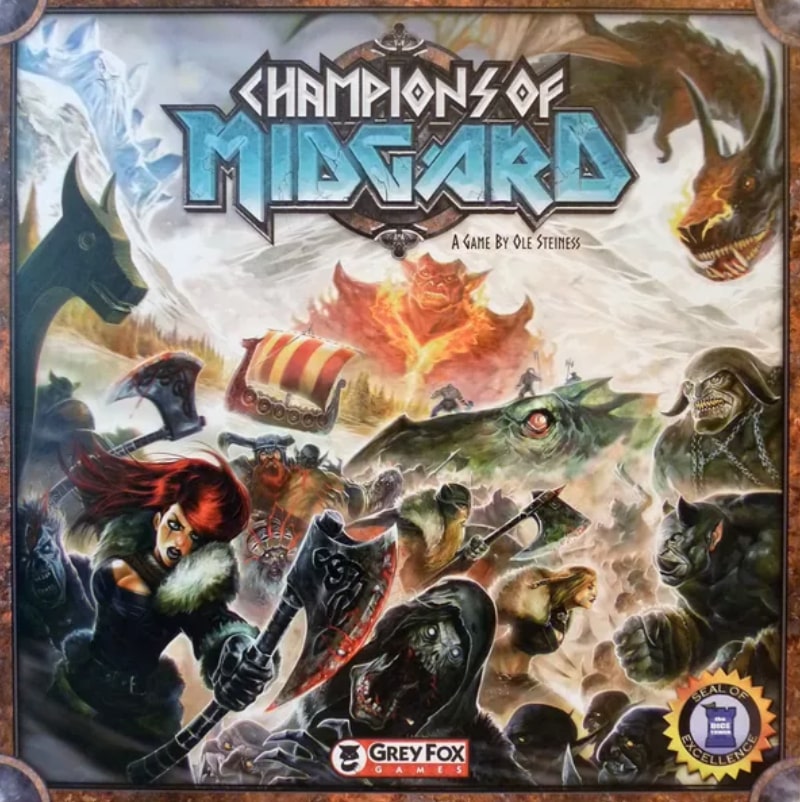
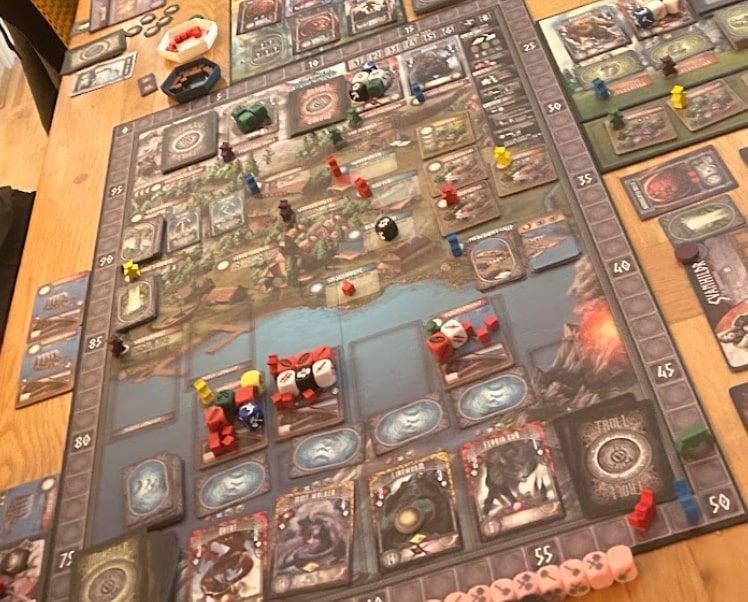
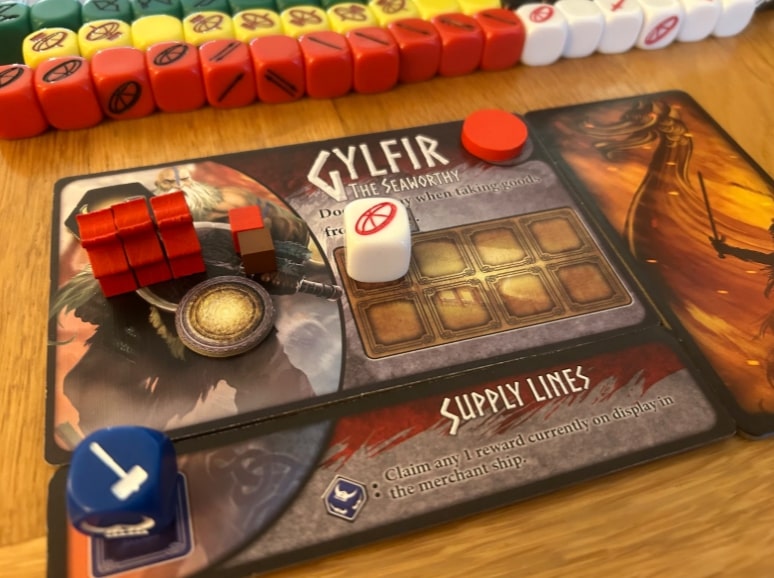
In Champions of Midgard, the players are Viking-esque warriors, in a fantasy world plagued by monstrous threats they must defeat. Not only the neighbouring trolls, but the far-flung beast-of-many-letters, each and all of which can only be seen off using dice.
While the theme is both visceral and epic, the game’s cycle is comparatively simple: gather dice and roll them to defeat monsters. On your turn, you send out one of your workers to a board space and gather whatever resource it offers – dice, wood (to build ships, for fighting the distant and more rewarding monsters) or food (to feed crew when they sail there). You can also of course assign a worker to a battle space, as though announcing that everyone else should leave this beast to you. There is no collaboration in the battling: players are basically engaged in a series of punch-ups, trying to prove they’re the toughest fantasy viking cookie in the box.
At the end of each round, the battles take place, starting with the local beasties, then working through to those across the oceans, reached by boats. Whomever is fighting first assigns dice to all their fights – representing your warriors – then each battle is resolved, one at a time. When you roll dice, certain sides will do damage to the monster and some sides (on some dice) will defend against it. Each monster takes a certain amount of damage to defeat it, at which point you claim any surviving warriors back and score ‘glory points’ on the scoretrack.
Defeated dice are lost, but in their place you receive a kind of memorial chit that can be cashed in for a special power, now or later. After the eighth and final round of the game, the player with most glory wins.
Sam says
There’s a couple of things we’ve glossed over here, like snatching the first-player token, the slightly arbitrary blame tokens that can be cast around (-minus points!) or cards that can be scored at the end of the game if, for example, you have defeated the most trolls or something like that. But the essence of the game, despite its visually dramatic presentation, is fairly simple. I should acknowledge here that I’ve played Midgard just the once and it was with five players – and I think a couple of expansions included, which added the fifth player and some time – but I found what would have been a fun 30-60 minutes beginning to considerably pall after we sailed past three hours. There’s very little interaction here outside of blocking spots on the board, so we’re essentially busy with our own puzzles, with no real building narrative or drama and a slightly draggy sense of repetition. I have friends who enjoy it, but it’s not a go-to for me.
-

Take That!
Present, but not really enough to dominate the experience
-

Fidget Factor!
It’s reasonably quick moving, although there can be a lot of turns with a lot of players of course!
-

Brain Burn!
Around the central tenet of grab dice, go battle are a few other considerations. The most rewarding monsters are further afield, so you might want to factor in wood/food to get those fighting ships launched. Whomever defeats the troll can cast blame on another player, which costs them glory at the end of the game.
-

Again Again!
Monsters always come out randomly – to some degree at least – and dice are famously uncompromising on that front as well.


