
Civolution
Designed by: Stefan Feld


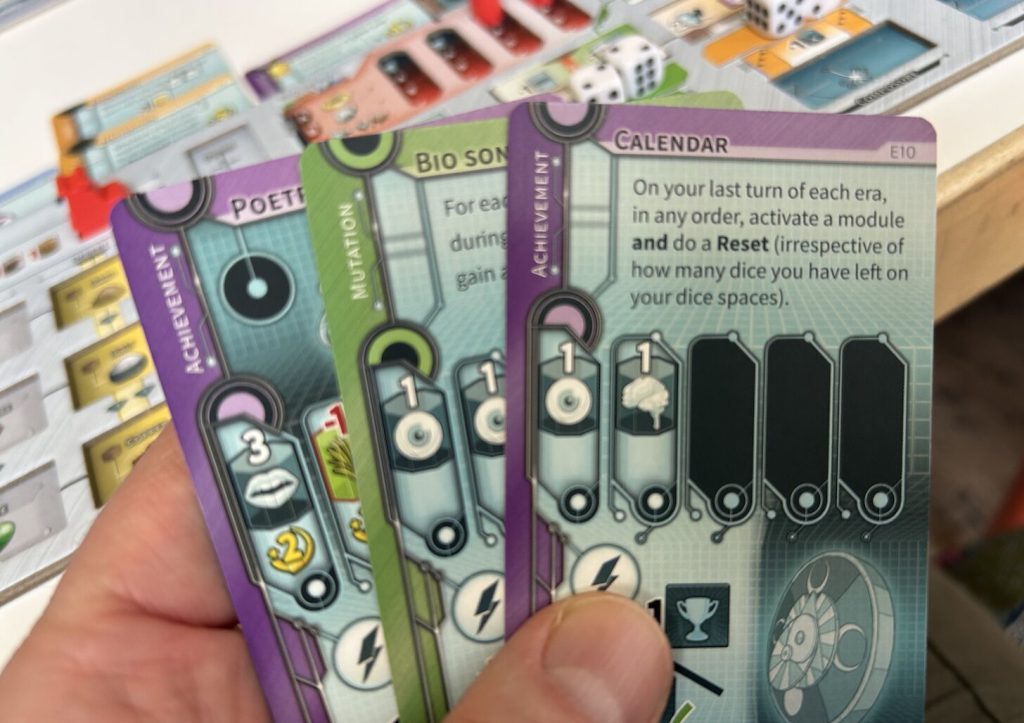

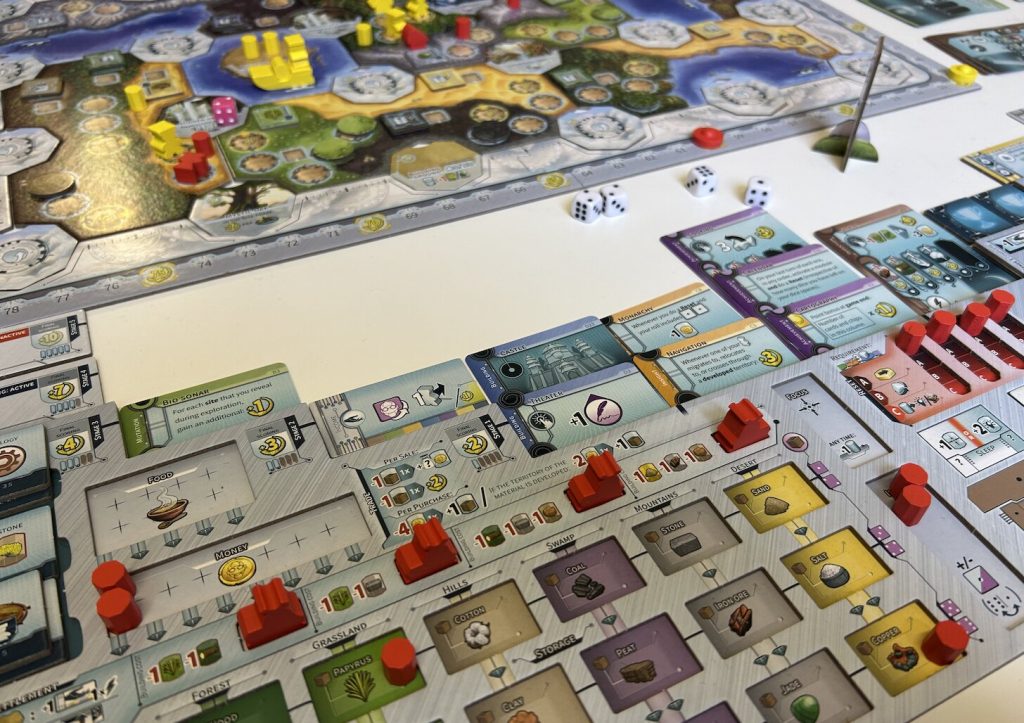
Civolution is a civilisation-building game with a huge host of strategic and tactical options. The rulebook imagines you as aliens sitting a final exam in the Academy of Creation, but really the only time the exam theme comes through is in the scoring. The pressure of doing well, however – that’s another story.
Civolution is a complex game in a number of different ways. It gives you a huge area to explore in terms of strategy and tactics (and to a lesser extent, geography) but it asks you to navigate these spaces using dice to select Activities. The activities are numerous – over twenty – and they can be upgraded to be made more powerful. But they’re also limited, not only by what dice you have at your disposal, but also the number of ‘resets’ you have, where your spent dice all come back to you and get re-rolled.
In a little more detail then – although please bear in mind this is extremely far from an encyclopaedic guide to the game – each player has a Console board which shows you all your available activities. Each activity requires two dice of specific numbers to activate it (shown on the console). Many are relatively straightforward: move your Tribe pieces (-you start with two) around the board, grow your tribe, generate resources, transport the resources from the main board to your console where you can then spend them. Most likely the spending of resources allows you to play Research cards (-an activity!) from your hand to above your board: you begin with a hand of Research cards and get more (the getting is an activity, of course) and the more cards you play, the more benefits you get: some give you an instant reward, others an ongoing benefit, some give you points at the end of the game. They may also move your markers up the many tracks on the Progress board.
The Progress board is a marker – or series of markers, across multiple criteria – for how your civilization is developing. Technology, prestige, knowledge, culture, construction… all five have an individual track with a marker for each player, and as you push upwards on these tracks you trigger bonuses, such as making your standard actions more powerful or scoring points.
There’s another board too – the Sequence board, which you may be relieved to know is largely a guide to take you through the phases of the four rounds, although it does have one or two other things like Events (start of a round) and bonuses (end of a round), plus another track: the Favour of Agera, which represents, thematically, an alien religion – and mechanically another way to score points, depending on how many Statues you build.
You might build statues in the same way you might also build Settlements or Farms or Boats, all of which benefit you in different ways – although none by themselves are absolutely critical to victory. You can ignore buildings entirely in one game, and focus on them heavily in another: if the downside of Civolution is the sense of overwhelm in how much stuff there is, the upside is that it’s a place you can explore just by trying things out: nothing is terribly punishing, the game gives you some resources and cards to begin with, and it’s more about finding the most productive paths through the teeming multitude of options. Do bear in mind that your tribes need feeding at the end of each round (Sustenance is, naturally, an activity!) and the fact that after the fourth round there’s a final scoring that we won’t attempt to fully convey here except to say the number of rows you’ve filled above your board (with cards, bonus tokens and completed goals) plays a key role in scoring, as does your advancement up the various progress tracks. You’ll also score for your presence on the main board: your number of tribes, and how widely spread they are.
There is more going on than we can go into here – 38 pages of rules for the basic game! – but you won’t really understand all the cogs and gears at play in Civolution without actually sitting down and playing it, maybe 2-3 times before all the ins and outs come into focus. After the fourth and final round, the player with the most points is the winner.
Sam says
One thing I should add is that if the dice-rolling makes Civolution sound like a game of luck, it’s absolutely not that. Edges of fortune, for sure, but unless you have an incredibly bad run with the dice, there are Idea tokens that change their value, Focus tokens that can be any die value at all, and basically just lots of tactical options for almost every situation. As I write I’ve played the game only once (two players; a 45 minute teach from my opponent who knew the game, and three hours to play) and much of those three hours were spent scratching heads and cursing my dice: but even as I did so I could sense that I was playing – understandably – badly, and not yet at the point where I can sense the opportunities and carve a path from subsistence to something more ambitious. And that foggy space is exactly what Civolution offers: you can do so many different things, but what is the best thing? It feels like repeat visits will never completely solve that question, which is what makes the game engaging – for a certain type of player, obviously. It’s a puzzle, and fairly dense-feeling one, albeit that density is – even on a first play! – more about choices than rules. If you have the dice to do it. you can (usually!) take the action. If you have the resources to pay for it, you can play a card. It’s all very do-A/get-B on the surface, with the caveat that there are several other aspects at work on the side: the tracks, the goals, the various end-game scoring criteria. It’s not for the faint of heart, but the big of <strategic> brain may well get a big kick out of it.
-

Take That!
Fairly - there is competition for spaces on the board and tribes can push each other about a bit, but it's not so much combat as a few flailing arms in a sandpit
-

Fidget Factor!
Moderate to high with two, climbing to biblical with the full complement of four (which we wouldn't recommend). When you're unfamiliar with the game, there's thinking time to figure out what's possible. When you're familiar, you need time to figure out what's best.
-

Brain Burn!
High, unless you're the sort of person who likes to juggle firesticks whilst completing a tax return
-

Again Again!
If you're the sort of player who enjoys this complexity, there is absolutely a tonne to explore here. It's one of those games where you can never do all the things you want to, and puzzling it all out is the joy of it


