
Dandelions
Designed by: Takashi Sakaue
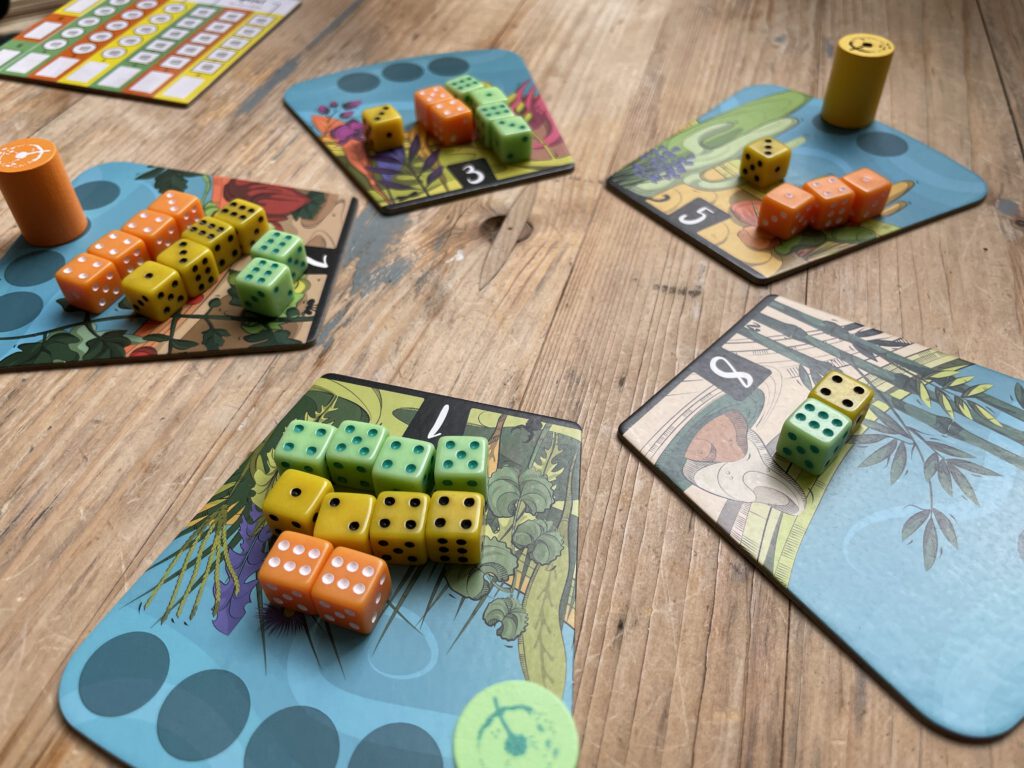
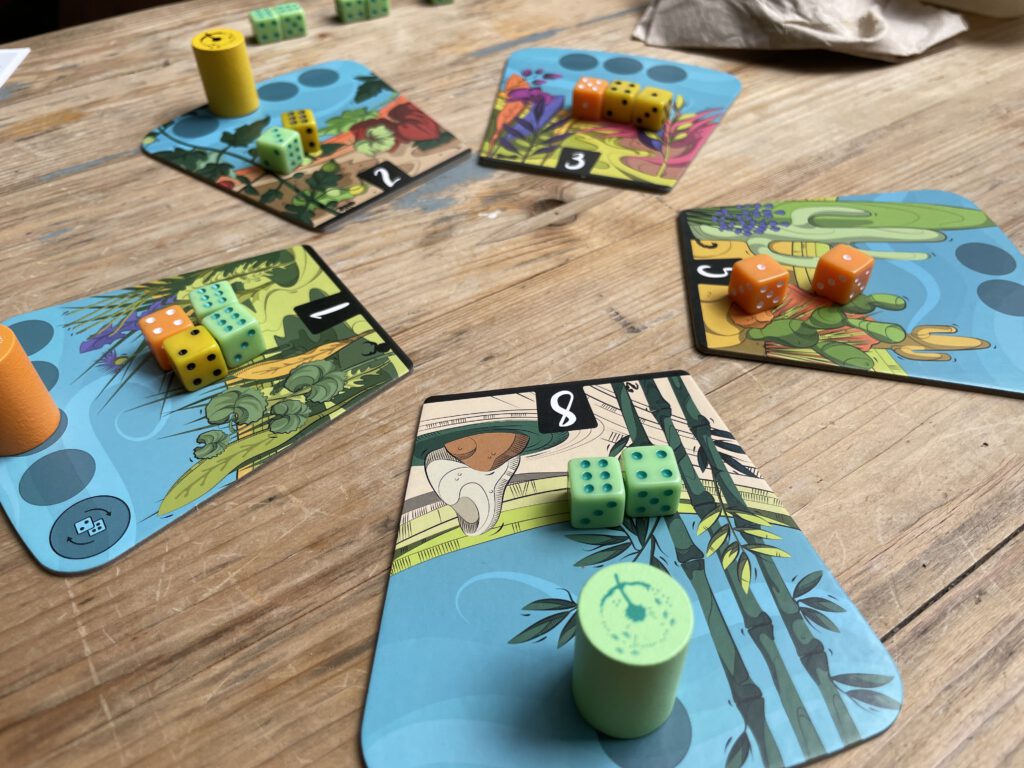
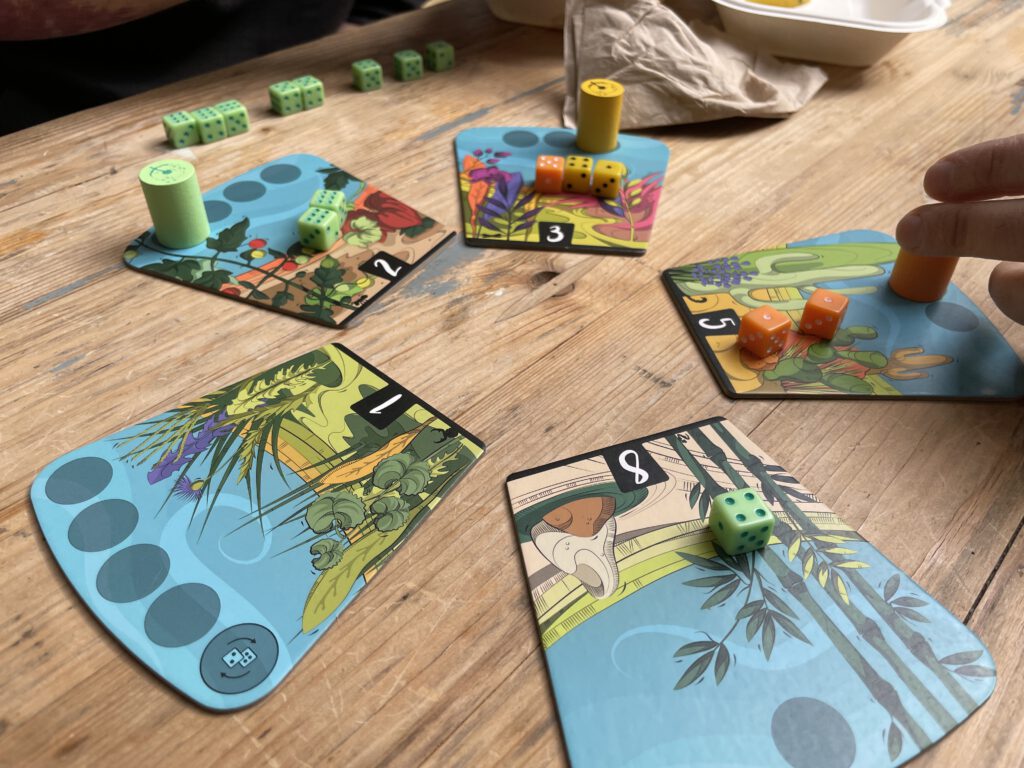
Dandelions is a dice-movement game for 2-3 players, probably best with three. In theory, everyone is planting seeds in a circle of gardens. In actuality, it’s a fairly abstract game of trying to have the most presence in particular gardens, and pushing each other out of the way to do so.
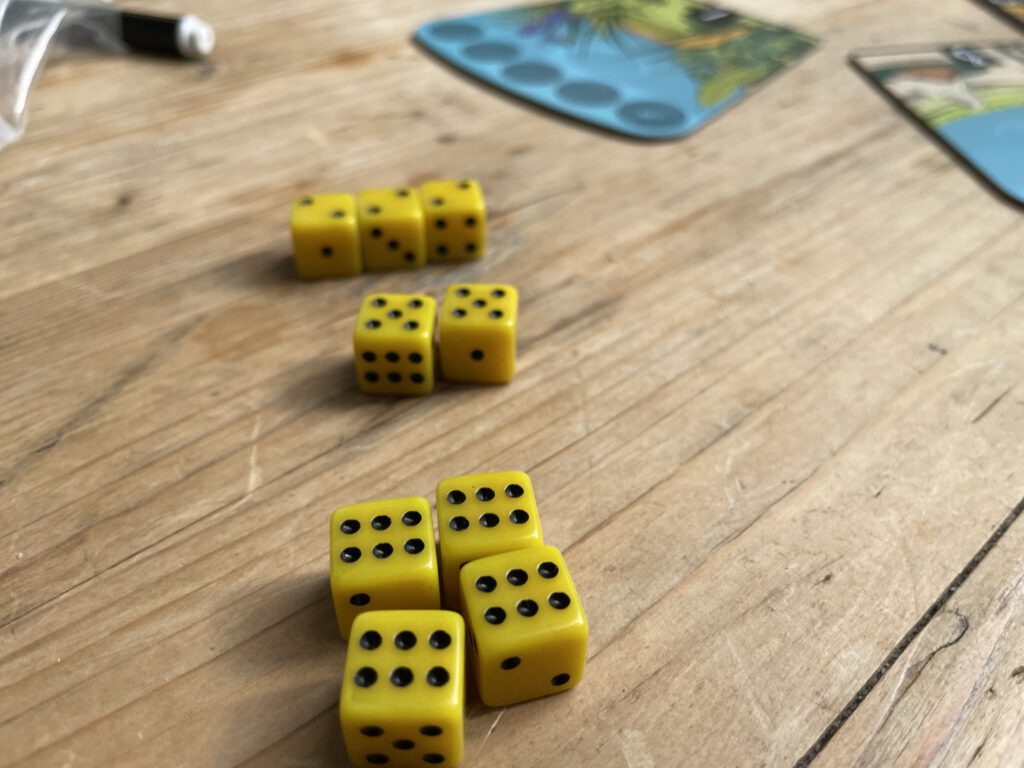
The gardens themselves form a track around which the players markers will move. At the start of the game, you roll all of your dice. Then on every turn, you choose one die to activate: you move your marker that many spaces along the track, and drop the die off in the garden it stops in. Mechanically, it’s as simple as that, although there are one or two wrinkles to consider when choosing how far to move…
Firstly, if you ‘stop’ on another player’s marker, you bounce on ahead the same amount again, turning a three for instance into a six. Second, if you drop off a die in a garden with opposition dice of the same number, you get to bump them all out and into an adjacent garden. Third, if you end your marker back at the start of the circular track, you re-roll all your unused dice. But fourth and most important is how the dice score at the end of the game. Each garden has a value (from 2 up to 8) and all your dice present in that garden will score it. If you have the most dice in any garden, you also score the pip value of the dice themselves. If two players have the same number of dice in a garden, then the player with the lowest pip value will decide the tie.
When all players have used all their dice, the game ends!
Sam says
A puzzly game that can play two but is probably best with three, unless you’re a fan of calculated optimisation over chaotic fun (not that there’s anything wrong with that). I enjoy Dandelions just fine, without getting massively excited about it. Dice-chucking games, for me, should be silly and Dandelions is that. But because there’s rarely any actual dice-chucking after the initial roll at the start, even with the more opportunistic flavour of three players it can feel like an exercise in navigating to whatever fate dealt you at the outset, rather than wrestling with your destiny. I think it succeeds in what it looks to do – I just find it leans to far into thinky to be the fun that it looks like.
-

Take That!
You can have dice bumped out of gardens and suddenly find your 14pt single die is suddenly worth 2pts instead...
-

Fidget Factor!
Really depends on how and who plays. With two, there a numerous calculations to be made as Dandelions can feel almost chess-like in the potential ramifications. With three there's still some thinking, but as you don't know what the next two players will do, it stops the brain from getting lost in the forest of if-this-then-that speculation. It's probably best played at a clip anyway.
-

Brain Burn!
See above! You *can* play in brow-furrowing calculation, or you can play on the hoof.
-

Again Again!
The dice are rolled randomly to start each game, and player decisions also overlap and interact in different ways as a result


