
Décorum
Designed by: Charlie Mackin, Drew Tenenbaum, Harry Mackin
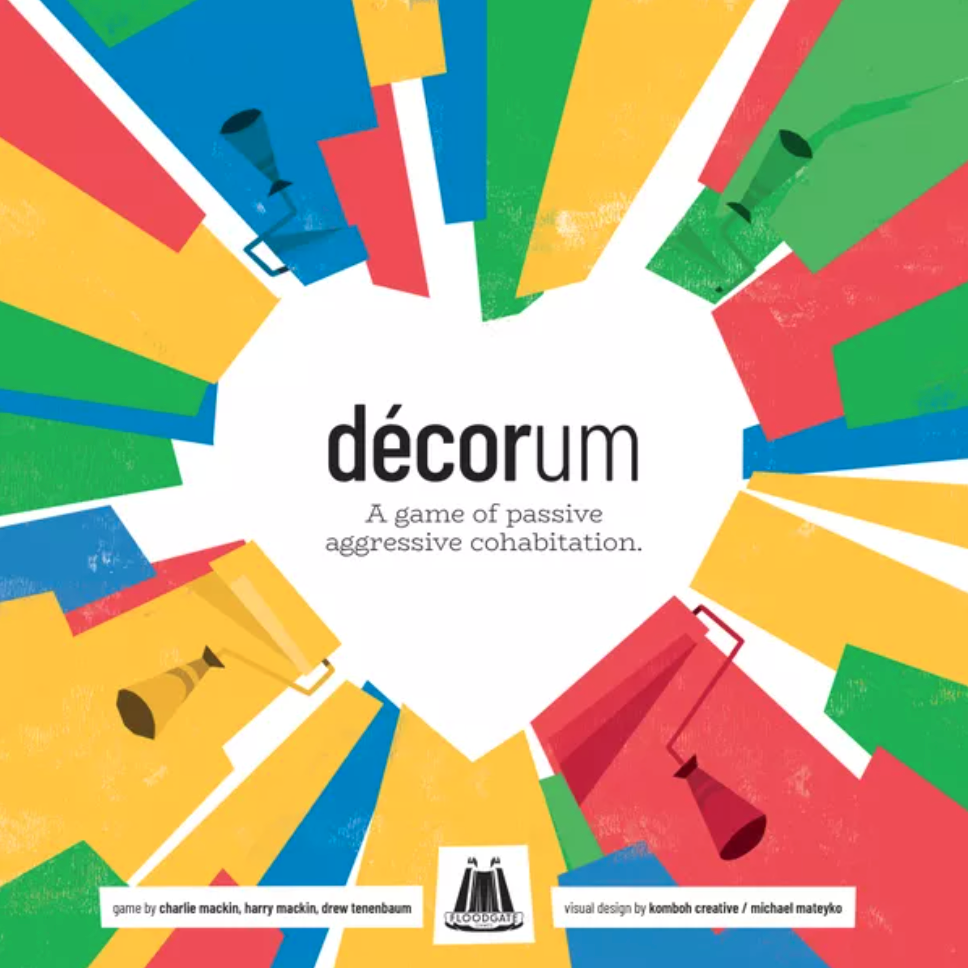


As the box states, Décorum is a game of ‘passive aggressive co-habitation’. A nod to the nature of relationships, this collection of puzzles would be easily solved if players – or, in the storyworld of the game, the people they represent, only spoke to each other. But life isn’t always like that…
The game is very simple. In a series of scenarios (or separate plays) the board, representing a house, is set up in bespoke fashion and the players are the newly-arrived residents. But each of us have our own ideas about how the house should be decorated, and how we go about achieving these goals is the game: each room can be painted a differentr colour, and be adorned with three different objects (lamp, wall-hanging, curio) in one of four different colours (red, yellow, blue, green) and styles (modern, antique, unusual, retro)
For example, I might want the downstairs all painted green and simply can’t countenance antiques in the kitchen. You might want at least one room in red and desire an antique curio, but not particularly care which room it’s in. The players aesthetic needs are carefully engineered so there is always a way to satisfy everyone, and it’s just about how many turns you take to find the solution.
After the first scenario – relatively straightforward – it gets very tricky very quickly, as your ideas of bedroom decor are quickly harpooned by someone who seems to be in conflict with you. Fortunately, two things in Décorum help players navigate the path to harmonious living. One is that after each players turns, the other players can (in fact, must) respond positively, neutrally, or negatively. In the story of the game it’s like a conversation over the progress of this particular renovation. But in terms of cracking the challenge, it also gives critical information: a positive response means whatever you just did fits with that player’s objective. Negative means it actively doesn’t. And neutral is exactly that: if I don’t want antiques downstairs and you put one in the bedroom, I’m fine with that. Whatever.
The other helping hand is at certain junctures of the game, a heart-to-heart is allowed: overwhelmed with the passive-aggressive placement of ornaments and painting of bathrooms, we break down in tears (in the game) and share one of the objectives on our cards (which helps us collaborate on solving the puzzle). If we can meet everyone’s cosmetic yearnings in x number of rounds, we win. If not, the relationships are doomed!
Sam says
Ultimately, it’s a logic puzzle where the design has deliberately obfuscated where the solutions exactly lie. The miniature stroke of genius here is the setting, where rather than detectives puzzling over a crime or cryptologists deciphering strange alien artefacts, the makers of Décorum have their tongues firmly in cheek, recognising that very human thing of not being able to admit our true desires, even when doing so would make everything so much easier for everyone. It’s tricky as well, and gets trickier! Those heart to hearts will be necessary in order to clear the rainclouds and bring in light: a good lesson for the game, and for life itself.
-

Take That!
Intentionally, none at all. Inadvertently, plenty. It's like a microcosm of why talking is so important in relationships: almost an educational missive as much as a game.
-

Fidget Factor!
Low. Turns are quick, and when everyone is confused you're at least confused together, and actively involved in trying to work it out.
-

Brain Burn!
The logicians and puzzle-solvers will have a ball. Those of us who find logic puzzles a grind may need a fire hydrant.
-

Again Again!
There are multiple scenarios for two, three and four players. Once they're done they're done, although by the time you've completed scenario 15 it's unlikely you'll remember scenarios 1-10...


