
Distant Suns
Designed by: Gary Kim, Yeon-Min Jung
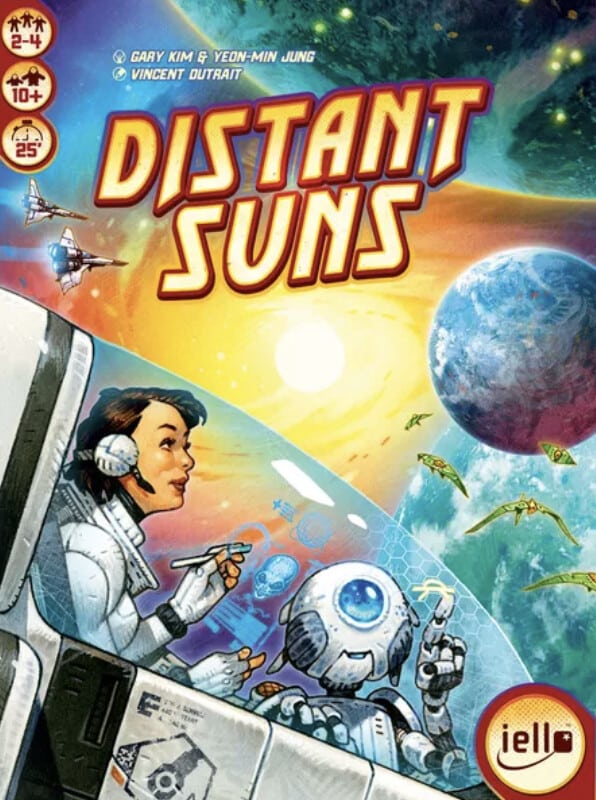
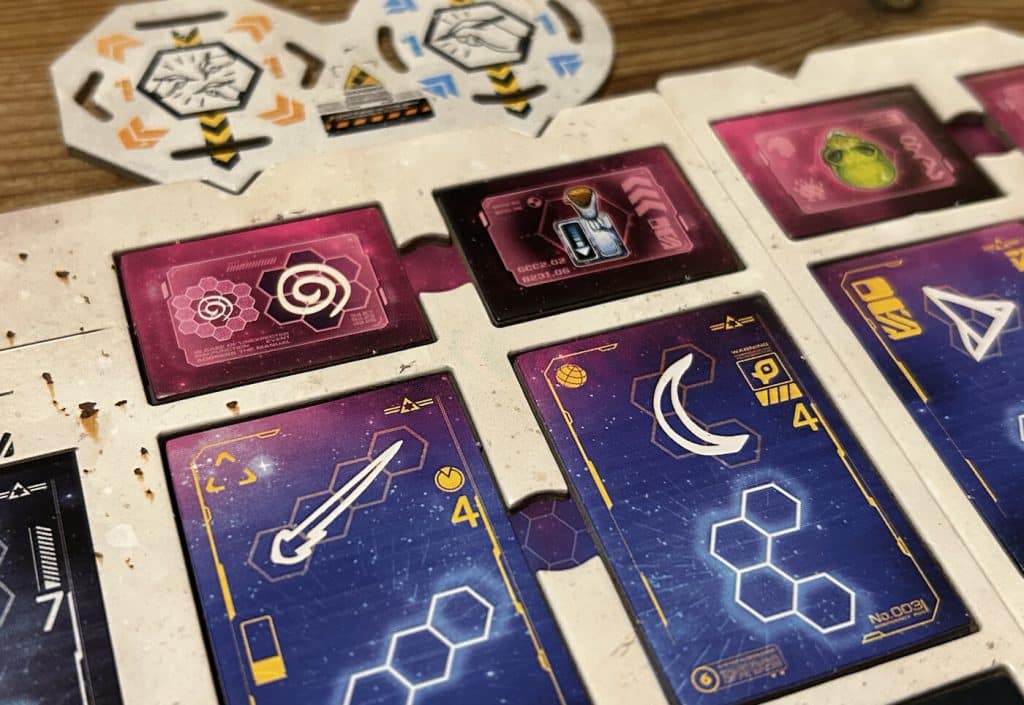
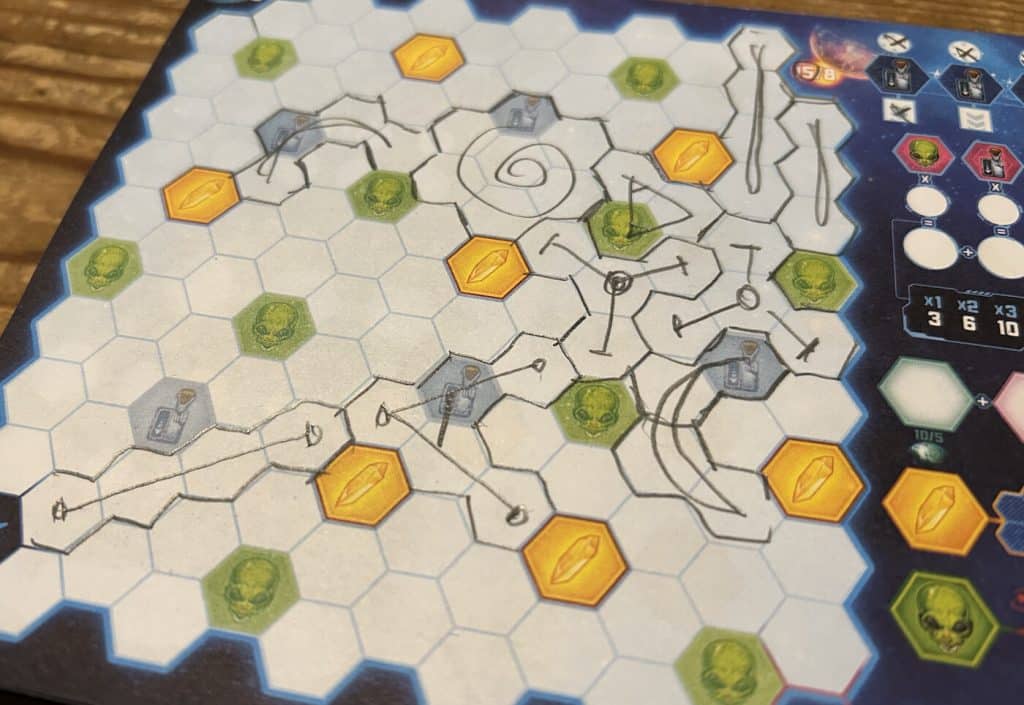
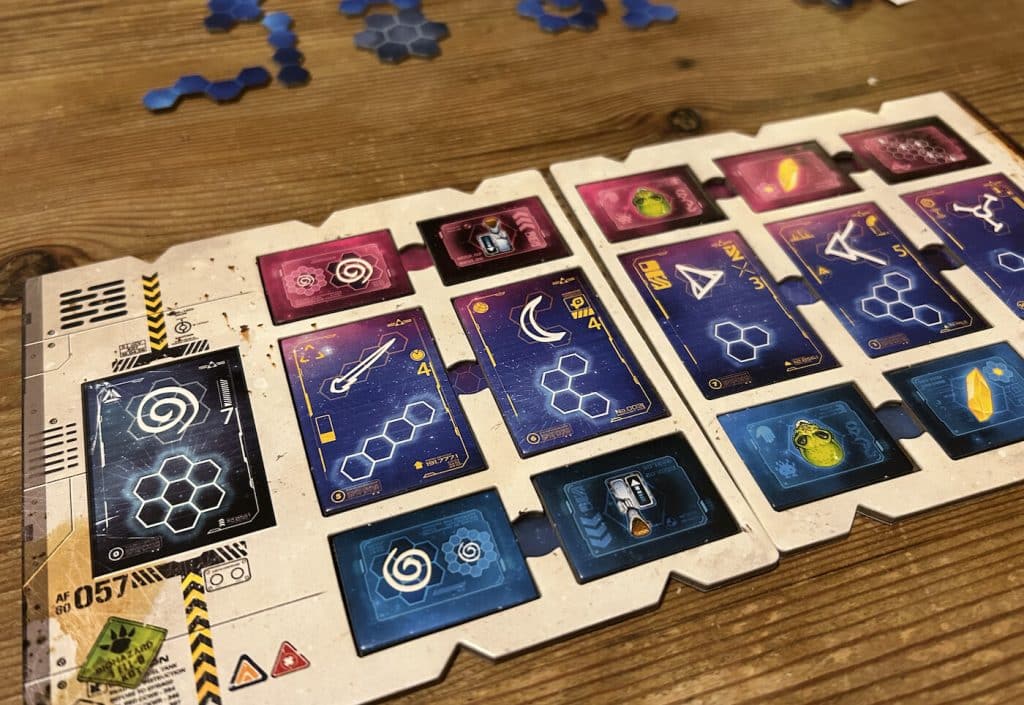
Distant Suns is a puzzle game of sorts: each turn, all players will add a new shape to their own bespoke sheet of paper and the idea is we are exploring the galaxy. But really, this is an abstract game of managing this puzzle the best, as each shape has its own way of scoring at the end of the game.
The game comes with a big pad of these ‘Cosmos’ sheets, and each player is given their own sheet – a map of the cosmos – plus a pencil, before the game starts. Placed centrally on the table is the Mission Control board, from where players will choose what shapes they draw on their sheet: on your turn, you choose what shape you get to draw and what shape all other players will draw (-it won’t be the same shape) by placing. Module tile next to Mission Control (see pics) to define what these shapes will be.
Everyone can draw at the same time, filling the shape on their board. Note that you must start in the bottom left of your sheet, every shape drawn must connect to at least one previously-drawn shape, and you cannot draw over the yellow ‘Treasure’ spaces on the map. Apart from that you’re free to connect things however you like: covering alien spaces is good because uncovered aliens mean minus points at the end of the game. Treasure spaces that get surrounded are good because they give you plus points. Covering an Upgrade space gives you an upgrade do use on a future turn, which is a way to draw a shape with one less hexagon on it – your choice – giving you more flexibility on where it goes. And connecting to the Outer Worlds in the other three corners of the map also give your bonus points – more if you’re the first player to reach them.
However Distant Suns also asks you to think strategically: it’s not just a matter of filling the map in on the fly, because at the end of the game – after three rounds – certain criteria score extra points and they are all about what shape you used where. For example, if yo’ve covered up the aliens with a particular shape then this is worth extra points, and it’s the same for covering the Upgrade spaces, being adjacent to the Treasure spaces and the Black Hole (a shape your draw yourself) and the Cluster tile: a randomly assigned shape that you score having them connected together on your map.
All of these end-game goals, in fact, are randomly assigned at the start of each game. You’ll also score your surrounded Treasure spaces now, and Outer World bonuses, and lose points for uncovered Aliens. The player with the most points is the winner.
Sam says
This is a very competently put-together little game, satisfying a certain itch. I like the squeeze between rewards now and points later and how the designers have managed to pack in a little player interaction (via the selection of shapes) into a game genre that usually, with exceptions, lacks it entirely. It also plays reasonably fast. Production could have been more thoughtful: it gets quite hard to read what’s what on your sheet in the late game, and you really need to go to town with that pencil to make things clear. But my bigger issue with Distant Suns is that it feels like it hasn’t really landed anywhere: there’s no drama to speak of, there are no laughs, and it doesn’t – for me, your mileage may vary – really make up for those shortcomings with the kind of easy moreishness that something like Trails of Tucana does. It’s certainly a clever design though, with an intriguing avenue to try and manage other players as well as yourself.
-

Take That!
Present without being overwhelming. The active player forces everyone else to draw a shape, and they may not want it. Black Holes in particular take up a lot of - ahem - space
-

Fidget Factor!
Fairly minimal, although if players struggle with the spatial aspect it could begin to climb
-

Brain Burn!
It's a neat little puzzle: the rules are straightforward so the sauce is balancing the short and long-term rewards
-

Again Again!
Set-up is variable, and there are different approaches you can take: on the fly, hare-and-tortoise, or even trying to sabotage others, albeit opportunities are limited


