
Dominant Species: Marine
Designed by: Chad Jensen
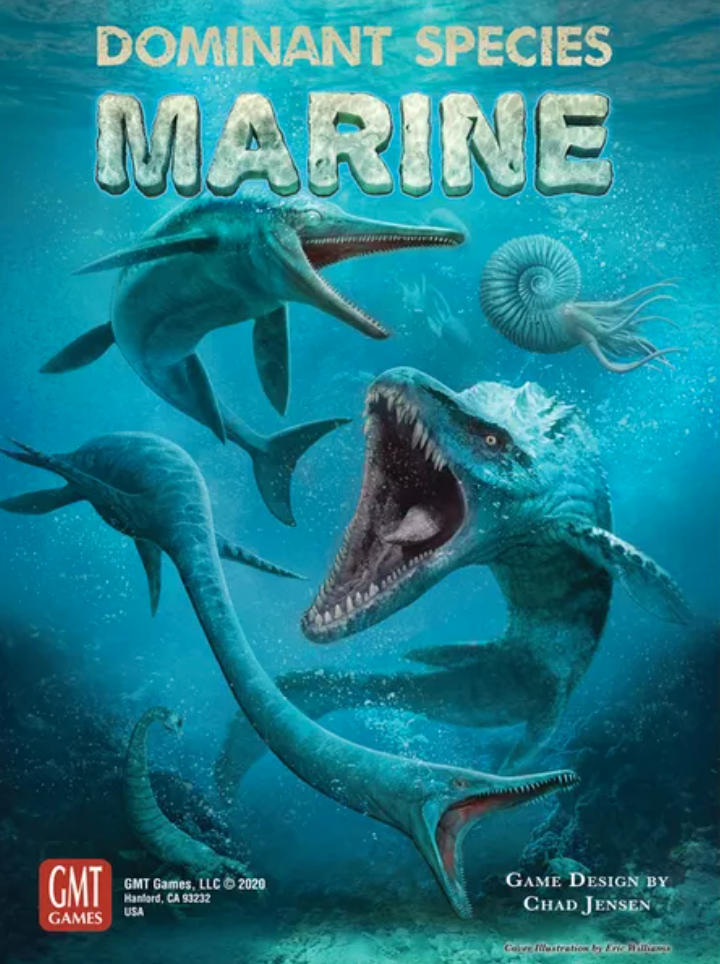
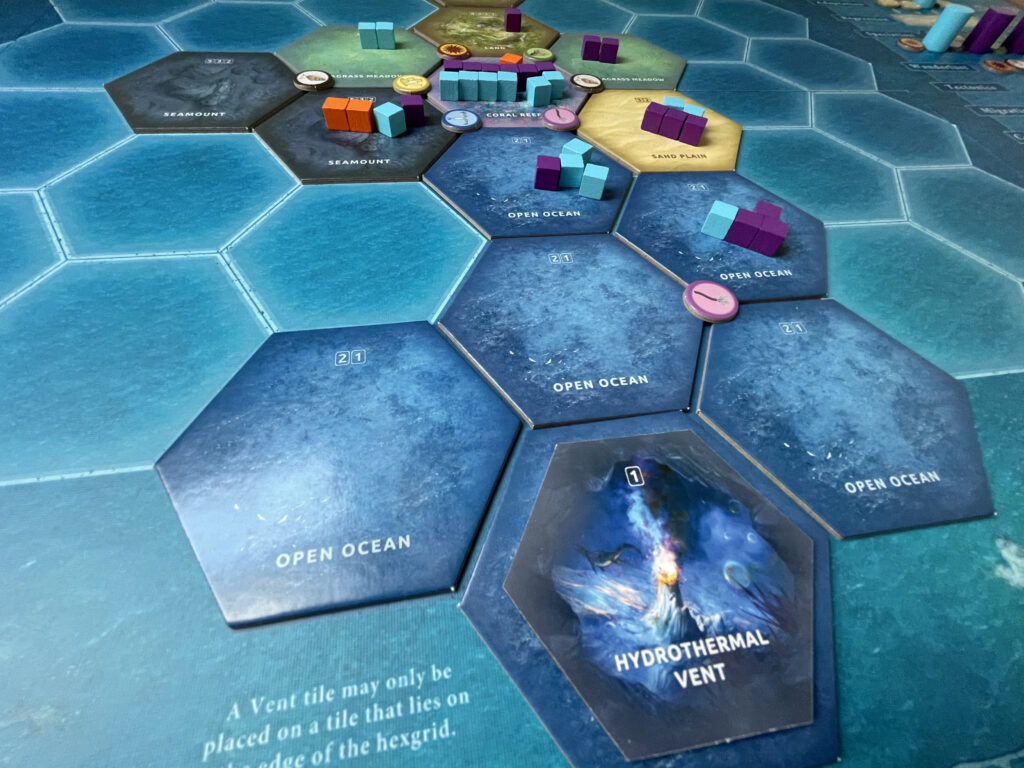
Life. It’s a beautiful thing, a precious thing. But it can also be a nasty thing, and in Dominant Species: Marine that nastiness is celebrated, as players each play competing animals (up to four: crustaceans, fish, reptiles and cephalopods) fighting for dominance in the early years of complex life on Earth. We all know who won in real life: humans – we’ve got the pixels, micro-plastics and wars to prove it. But here the fight will end at the arrival of the asteroid…
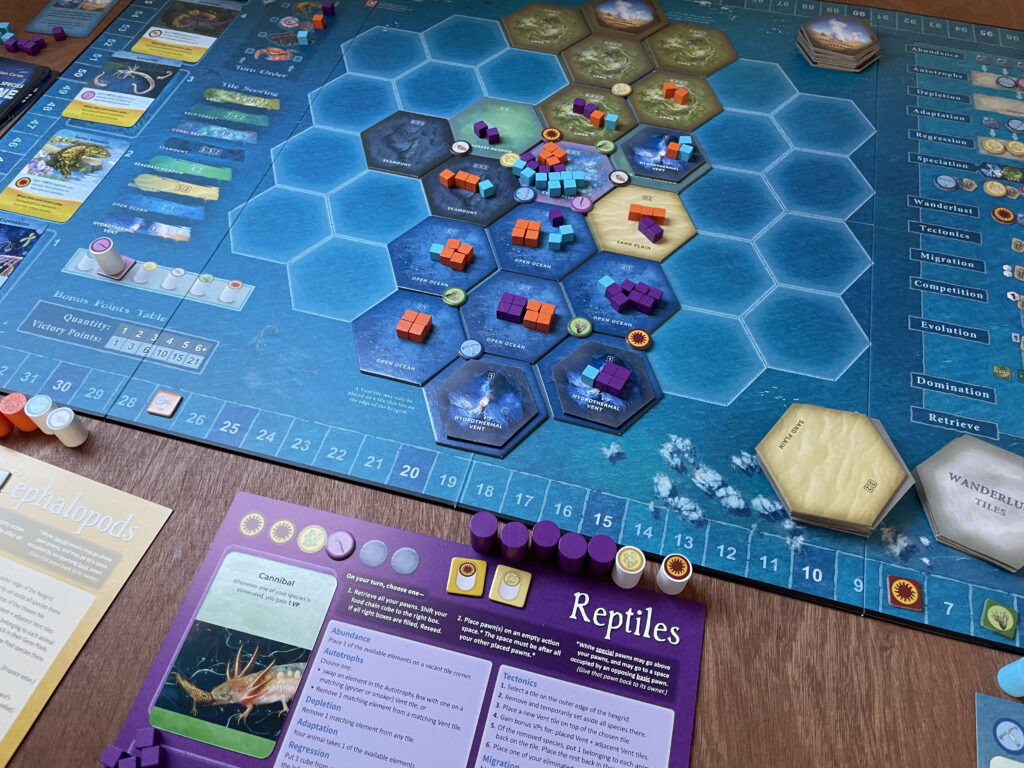
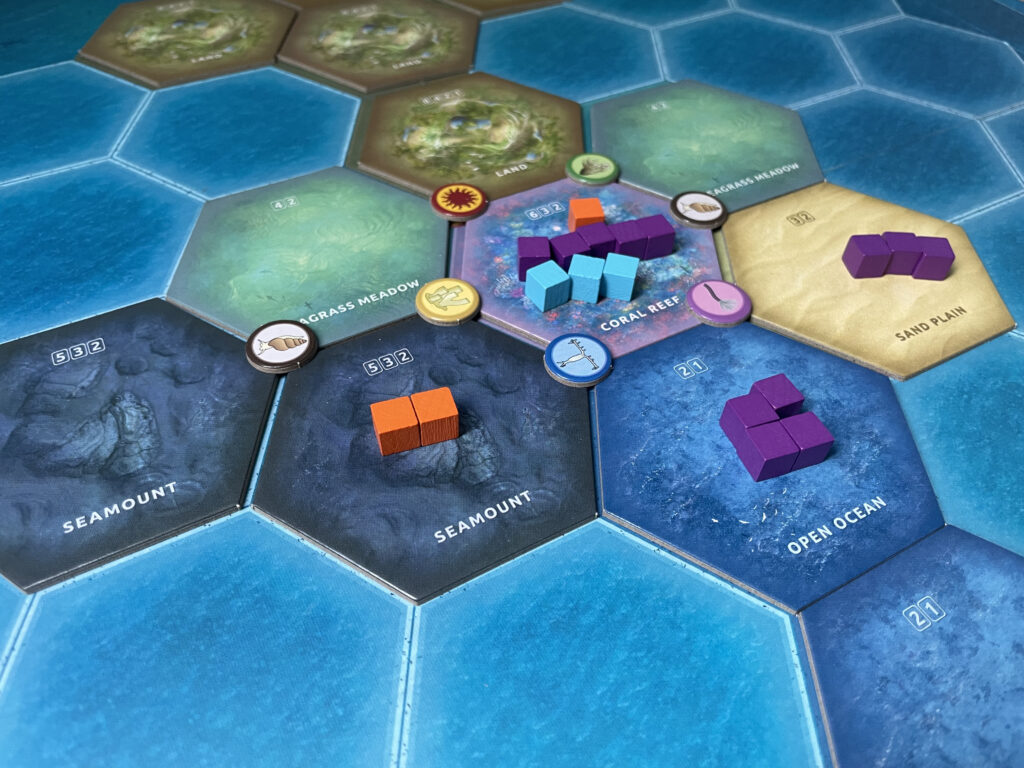
The big board starts with some hexagonal tiles on it representing the different landscapes of the youthful planet: sea, coral, seagrass, etc. Even land. Players begin with three of their cubes (each cube represents a species in their animal family, although which one exactly doesn’t matter) on the central coral tile. At the corners of the hex are the six different types of food (shown in token form) the coral has in plentiful supply for all of us living there. You’ll see each token neighbours up to three tiles, and each of those tiles is considered to have that food type in it.
Why six different types of food? Because each animal – the players – needs different types of food to survive; hence at the start of the game the coral is a safe space for everyone. What food you can eat is shown on your player board (which also explains what each of the actions do) and the more food you can survive on, the more flex you have on the board, migrating, dominating, and surviving.
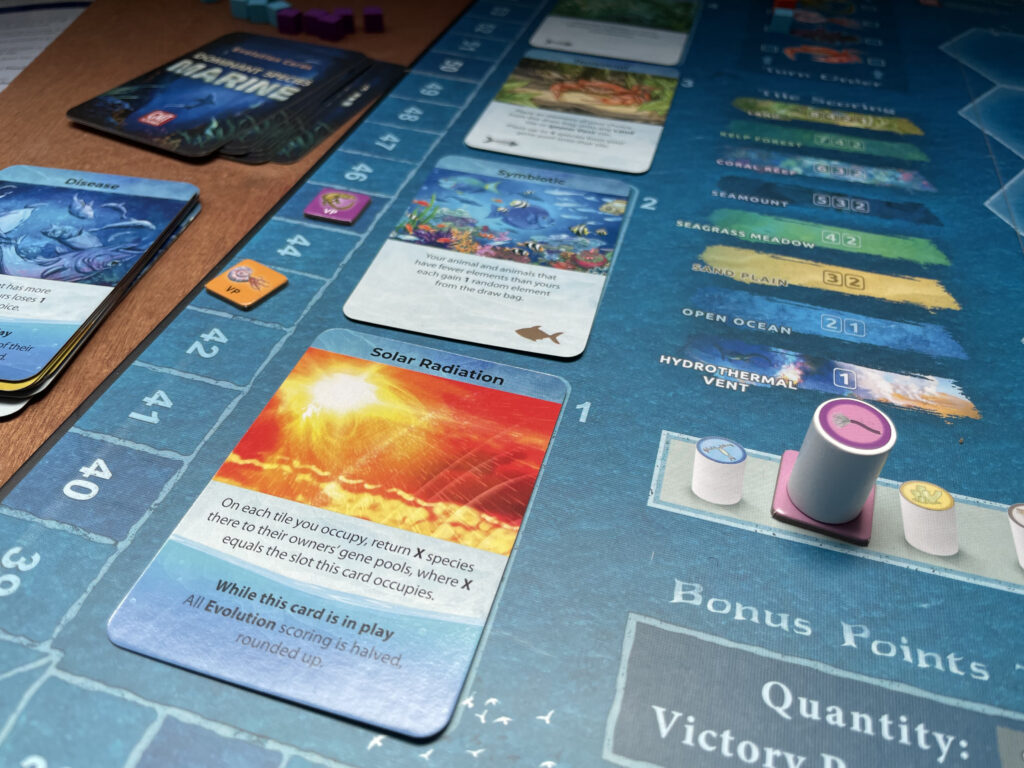
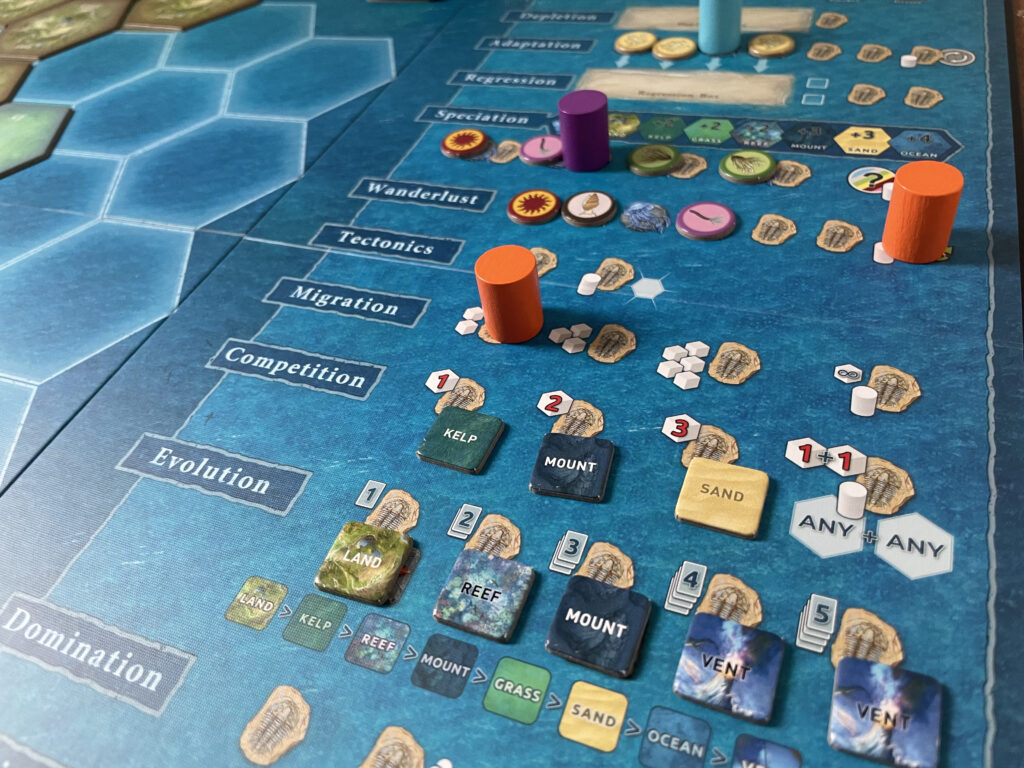
The actions are what drives the game. Everyone has a set of pawns that, on your turn, you play to an empty action space on the board. What do the actions do? We won’t list them exhaustively here, but essentially they either advance the cause of your own animal (for instance, more species on the board or adapting to survive on new types of food) interfere with others (kicking their species off certain tiles) or ideally, both. One of the actions is a critical one, and it’s called Evolution. Evolution is critical for two reasons: one is that it’s one of the key ways to score points in the game: choose a certain tile, and score points for the species present on it (hopefully just yours!). But then you also get to take – and play – an Evolution card from the face-up display. These can be – occasionally – harmless but are – more often – pretty nasty for those on the receiving end: they can wipe out species, force migrations, score points for a particular thing of your own choosing and so on. The Evolution cards also act as the game’s timer, because near the bottom of the deck is the Asteroid card: when it gets played (and it’s a brutal one!) it triggers the game’s finale.
Without going into further detail on the actions, it is worth mentioning a couple more important aspects to Marine. One is that players must play their pawns according a simple rule: you must always go right of/down from any previously-played pawns in your colour. This might seem a somewhat arbitrary ruling at first glance, but mechanically it does two things: put a lot of narrative tension into placement, and also prevent the game from stagnating due to a huge amount of options, because each pawn you place is narrowing down subsequent possibilities until you retrieve them all: that’s when you run out of pawns (or places to go) and pull them all back to you. It costs you a turn to do so, so limiting the amount of retrieves you do in each game can be key – which is not helped by some of the juicier actions being placed right at the bottom of the board. When everyone has retrieved the board reseeds: new opportunities are revealed in the actions, and one or two new dangers as well (you can potentially lose the adaptation you made to eating snails!)
Finally, one of those aforementioned juicier actions is the ability to gain a special pawn. These are white and have two benefits: you can ignore the usual placement rule of right/down, and you can even bump opponent pawns out of an action spot to take it yourself!
When the asteroid is played there’s a final bit of scoring – every tile on the planet! – before players compare scores to see who, exactly, is the dominant species.
Sam says
Not only is it complex, it’s also pretty long, very feisty and possible to feel pummelled into submission way before the end. But I really enjoy it as an event game, and I think it’s a considerable improvement on original Dominant Species for a couple of reasons: one is that whereas the older game had a rhythm of phases, Marine dumps that in favour of keeping everyone’s turns rolling around a bit quicker, and has a simpler, more dynamic scoring system that tends toward one tile at a time, rather than many. It looks great, it’s really thematic, and if the first play is – like so many of these big games – exploratory and overwhelming in some ways, repeat visits speed it up exponentially (*your mileage may vary depending on who’s playing, of course). There’s an option for a shorter game, which I recommend for your first couple of plays, but even then this isn’t a breezy undertaking. More tactical than strategic, more combative than a punch-up in a fish-bowl, whilst Marine might scare some off with it’s twelve actions and their decidedly non-Waddington names (speciation; autotrophs) there’s still a great, nasty experience here.
-

Take That!
High. This is not some contented goldfish blowing bubbles at each other, but a Darwinian fight for dominance
-

Fidget Factor!
High on that first play or two, when you'll need to keep checking what each action does (although they're all clearly explained on the player boards, to be fair) but dropping to moderately staccato, or maybe even low with 2 or 3 players
-

Brain Burn!
As mentioned above, Marine doesn't really lend itself to long-term strategic thinking so much as reacting to the opportunities on the board - and the available cards - and taking best advantage of them. Being aware of when someone else has a powerful move (and preventing it!) doesn't hurt either
-

Again Again!
Each player has a special power for each game - these vary - and both the tiles and evolution cards appear randomly thanks to a shuffle. Each play will probably feel brutal, but there is a lot of variety in the smaller beats of the story.


