
Dominion
Designed by: Donald X. Vaccarino
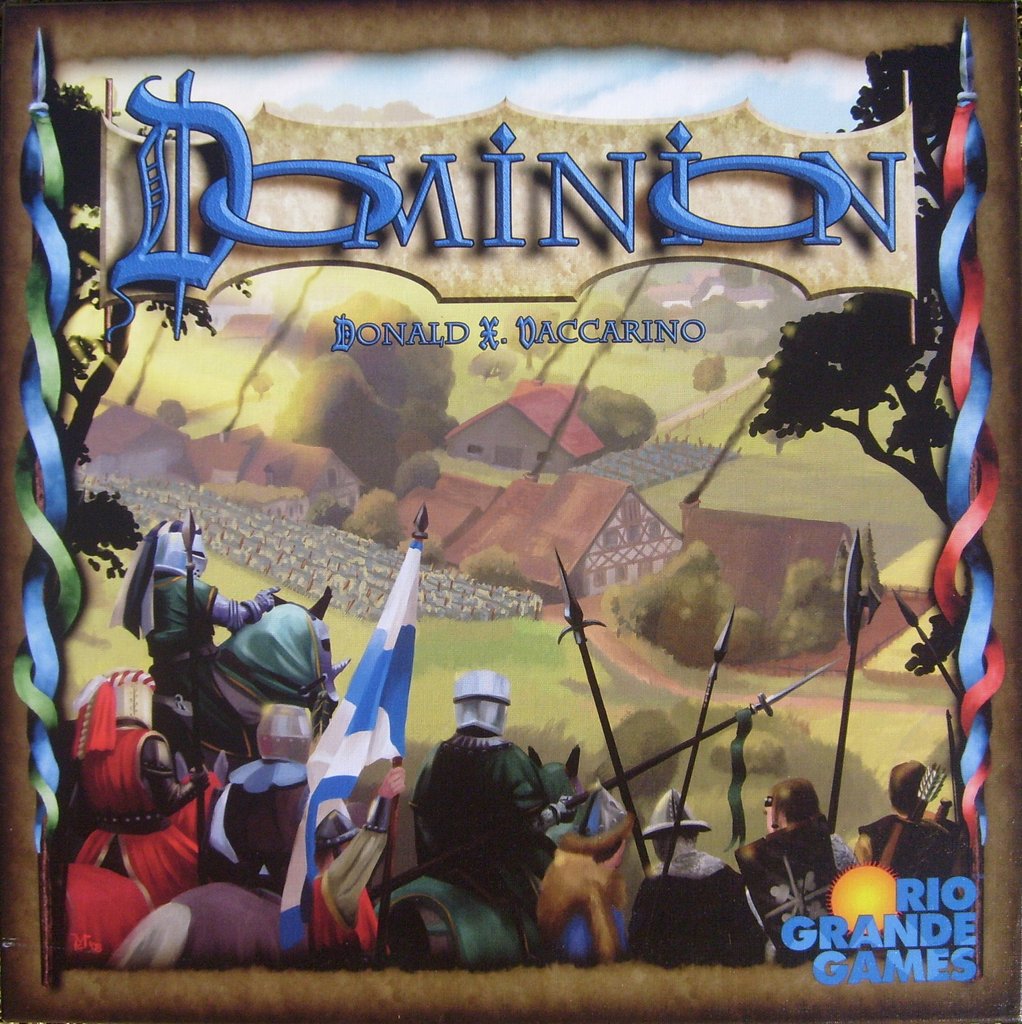
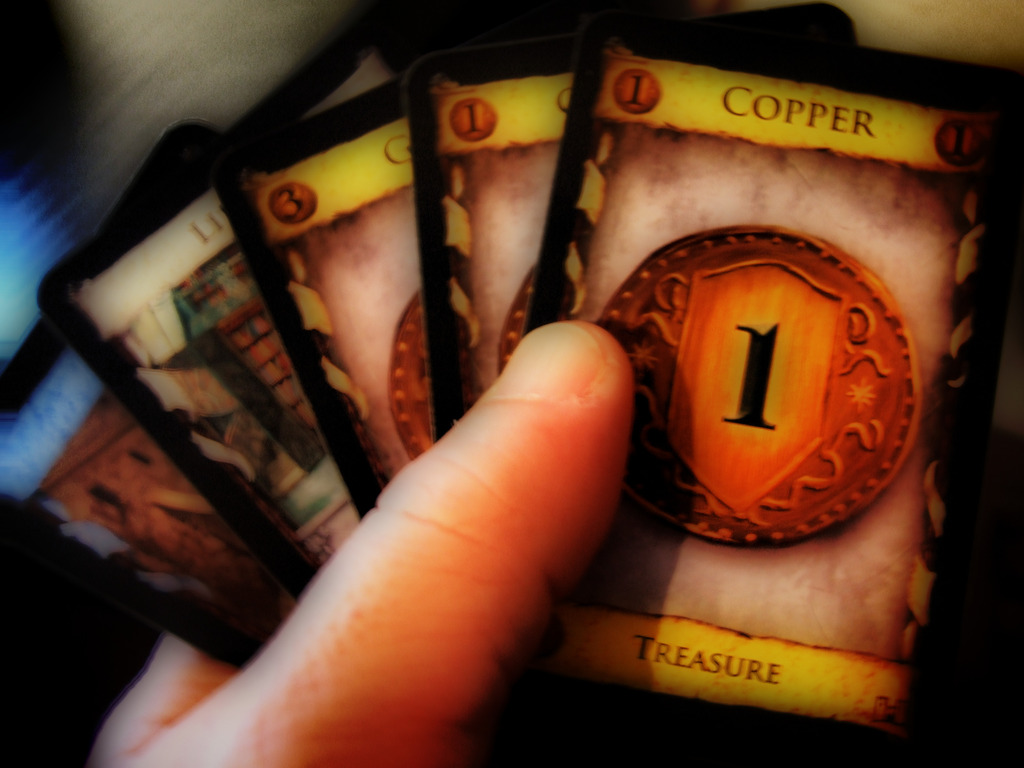
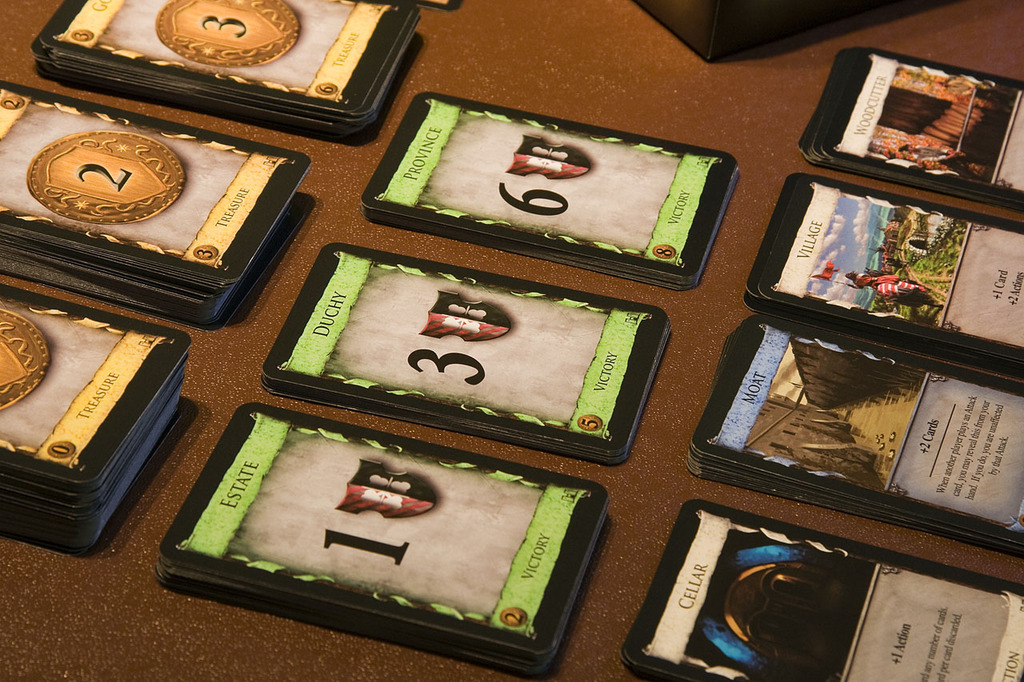
In Dominion you represent a monarch competing to expand their empire over the region, whilst the your opponents are trying to do the same thing.
Each player starts with an identical set of cards, and on your turn you deal yourself five cards from your deck and follow a simple set of phases:
1. Action a card
2. Buy a card (if you want to and can afford it)
3. Discard all of your hand
4. Deal yourself 5 new cards ready for your next turn.
The actioned cards do various things, from generating more cards for yourself, or more actions, to attacking other players and discarding from your hand. You buy a card from a display that is available to all players (see Again Again below) and then phases 3 and 4 are mere preparation for your next turn. When your draw deck is depleted, you simply shuffle your discards and make them your draw deck again.
So essentially each player starts with a small deck, and over the course of the game, builds a bigger one from the central display. They need to pick up money cards in order to buy stuff, but they need to pick up Action cards as well in order to further their ends. And what are their ends? That’s the twist with Dominion. The game is won by scoring the most victory points, and these are also represented by cards that must be purchased (they have values of 1, 3 and 6). At the games’ end you want most points, so you need to be buying these… but during the game they do nothing except clog up your hand and get in the way!
Dominion is a game that is easy to learn and teach, with wide variety built into it.
Sam says
I respect Dominion, and can faithfully pass on that many people love it – it’s a popular title, and something of a game design milestone. My personal feeling on it is that after an initial few plays, I began to find it slightly procedural. There are certainly interesting decisions to be made about which cards to add to your deck and how they interact, and I like the tangible luck-pushing of when exactly to start getting those otherwise-useless points cards that clog up your deck. And there are round-by-round tactics and long-haul strategies, and as a family game it’s great for the brevity of the rules and the variation – especially if you include the many, many expansions for Dominion that allow you to add new cards and some of these bring in new, more interactive elements as well. Overall though I feel the ‘deck-building’ mechanic Dominion created that has since been adapted to more intriguing effect elsewhere – the madcap treasure-stealing of Clank, for instance, or the word-building game Paperback. But I would happily play this again.
-

Take That!
There are some cards that target other players, but it's possible to play with just a few of these, or none at all, or as many as possible if all players like a dogfight!
-

Fidget Factor!
Low to none. Dominion plays fast.
-

Brain Burn!
Low. Some games give you choices to ponder; Dominion functions by quite often restricting them.
-

Again Again!
Dominion comes with no less than 500 cards - there is a massive array of cards available to you and you only select ten kinds for the central display in each game. So the simple draw-play-discard game does offer huge variety.


