
Empire’s End
Designed by: John D. Clair
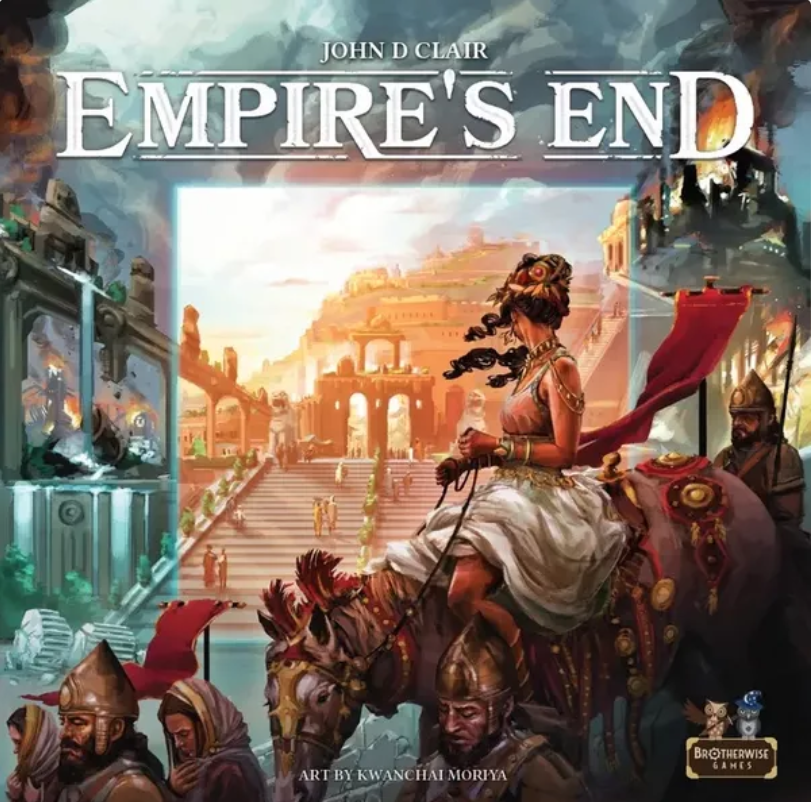
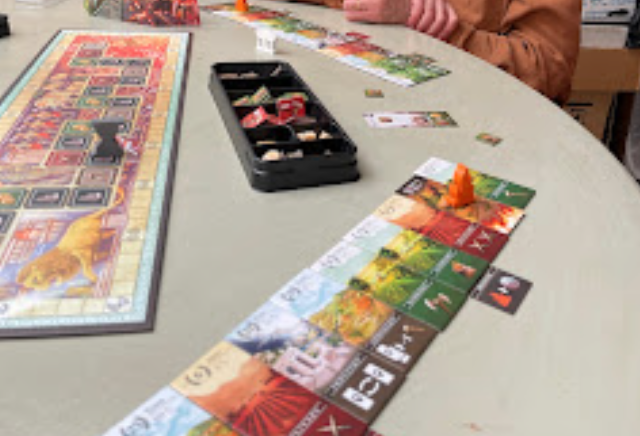
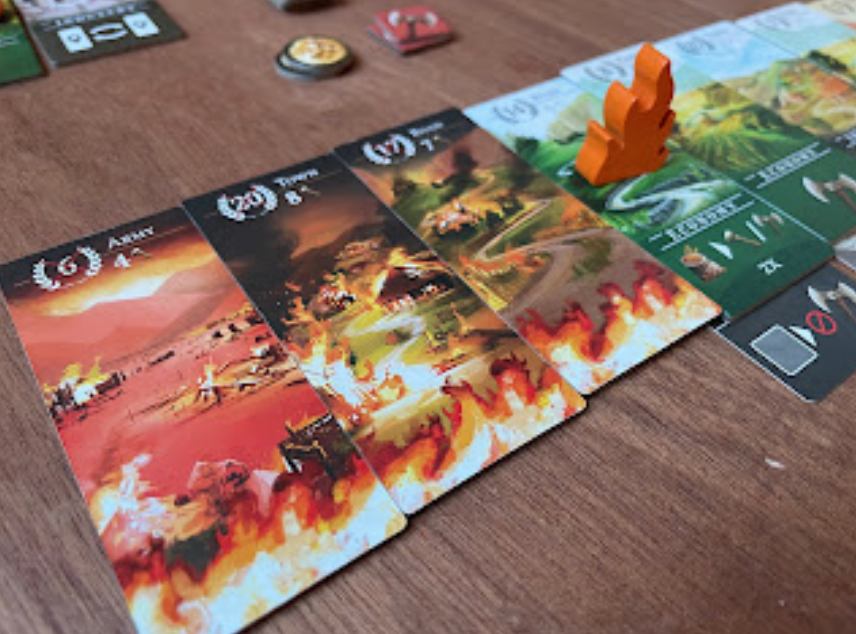
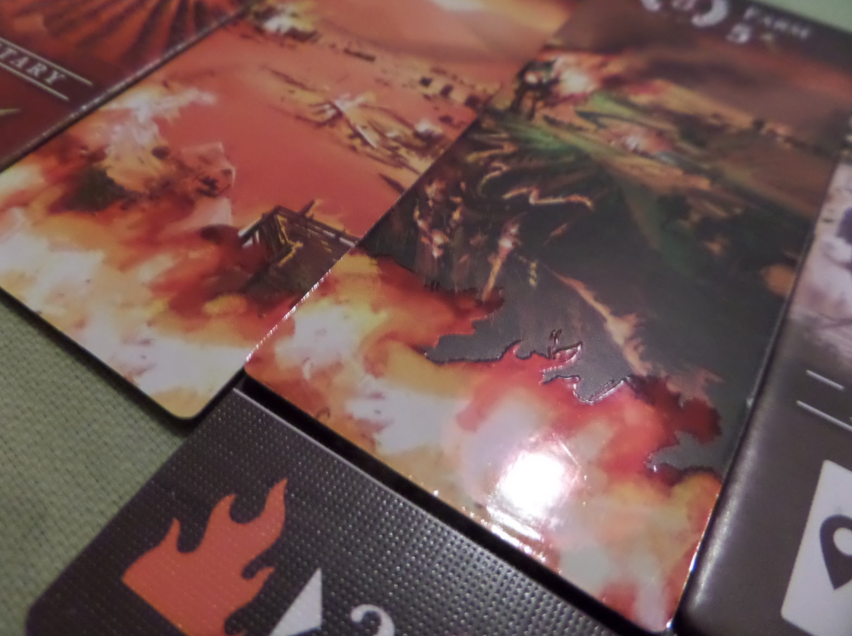
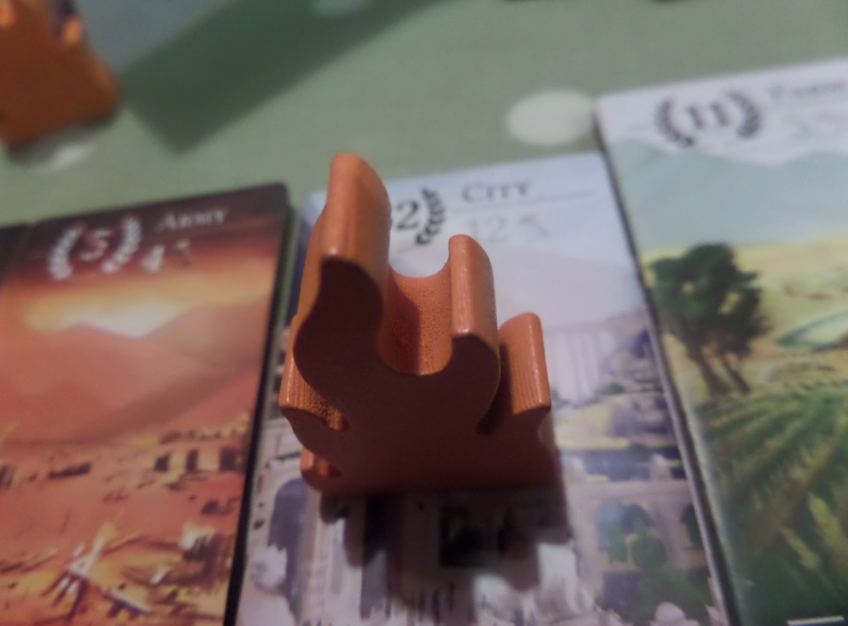
In Empire’s End, players empires are disintegrating: you begin with your domain intact, but during the game Disasters will befall you, causing Farms, Roads and Cities to crumble and fall. Fire, Flood, Earthquakes and Barbarians all appear to inflict damage – and the empire that survives the best will be the winner.
Each player’s empire is represented by cards that are laid out in a row before you. The board tracks the rounds of the game, which come in four different categories: Industry, Economy, Military, and the game’s dark, grisly heart: Disasters. Let’s start with them.
In a Disaster Round, a Disaster card is flipped face up, showing which location (or locations!) are under threat. Now there’s a bidding round where everyone is bidding not to take the disaster: the card itself will say what can be bid to avoid this fate, placing axes, hammers, wheat or coin (wild) tokens beside the card until someone decides to pick it up. Picking it up is bad, because that part of your empire is hit by catastrophe: the location in question is flipped face-down and will not score you any points at the end of the game. But! Picking up is also good – at the right time – because you also claim all the axes, hammers, wheat or coins that everyone else bid to avoid it: they are resource-poorer, whereas you are resource-richer: good for avoiding future disasters!
Each Disaster card also has an Innovation at the bottom of it: a way to improve your empire. You get to slide the card under one of your healthy locations and use that innovation in the future.
Industry rounds allow you – potentially – to swap the position of two locations in your empire, and – if you have enough hammers to pay for it – rebuild disaster-stricken locations, flipping them face-up and ‘healthy’ again. Economy rounds allow all your green locations and innovations to activate: mostly, this is about gathering more resources. And military rounds see you add up the sword symbols on any healthy locations/innovations tofight for points. Everyone folows this process – and everyone can also choose to add more axes from their supply (everyone reveals how many at the same time), sacrificing them to gain more points and perhaps be the most powerful military in the round, which gets bonus points.
When every round is finished, players score all their healthy locations plus any innovations attached to healthy locations that have end-game scoring criteria.
Sam says
Empire’s End is a more complex, semi-thematic version of the simple card game No Thanks, where players pay money to not take cards. Designer John D Clair has taken that mechanism and built more of a story around it – although as each player’s civilisation is essentially a tableau of cards where everything from cities to roads can be moved, how immersive the game is as a civilisation-building experience is debatable. I found the first couple of plays interesting, but my interest waned after that: I’m not sure the extra stuff merits the extra time needed to both learn and play it, and the moving around of things feels fiddly and abstracted. It feels like an experiment to me; a worthwhile effort in design exploration, but not a game that I’m yearning to play again.
-

Take That!
Not much at all from the other players, but the game itself is constantly forcing you into contextual cul-de-sacs, where you’re choosing between the frying pan and the fire.
-

Fidget Factor!
Considering the epoch-spanning theme of civilisations rising and falling – mostly falling – Empire’s End can play reasonably quickly, at least with the disaster rounds. Some of the shenanigans around moving cards about in your tableau can be a bit ponderous, however.
-

Brain Burn!
There’s a mixed bag here, from how many resources you’re willing to pay to not take the hit on something, to the he risk/reward of hoping to actually pick the darn thing up! Keeping an eye on what other players are doing can be helpful as well.
-

Again Again!
A decent amount of variation in how things can pan out on the micro level, with player inputs having considerable ramifications. But outside of that each play did feel to us, slightly procedural.


