
Etherstone
Designed by: Simone Luciani, Virginio Gigli
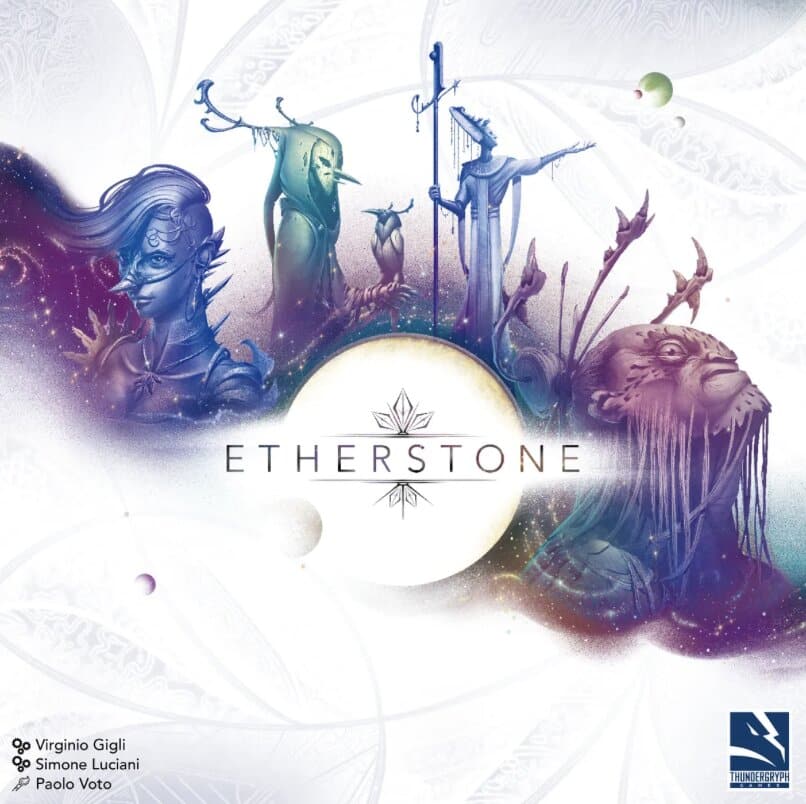
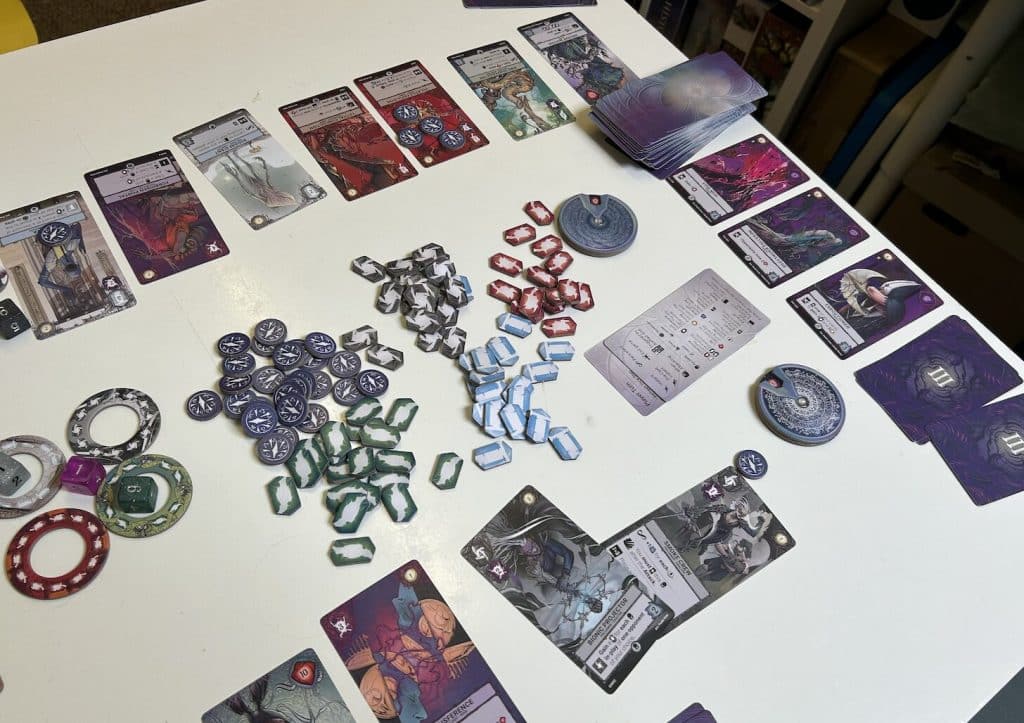
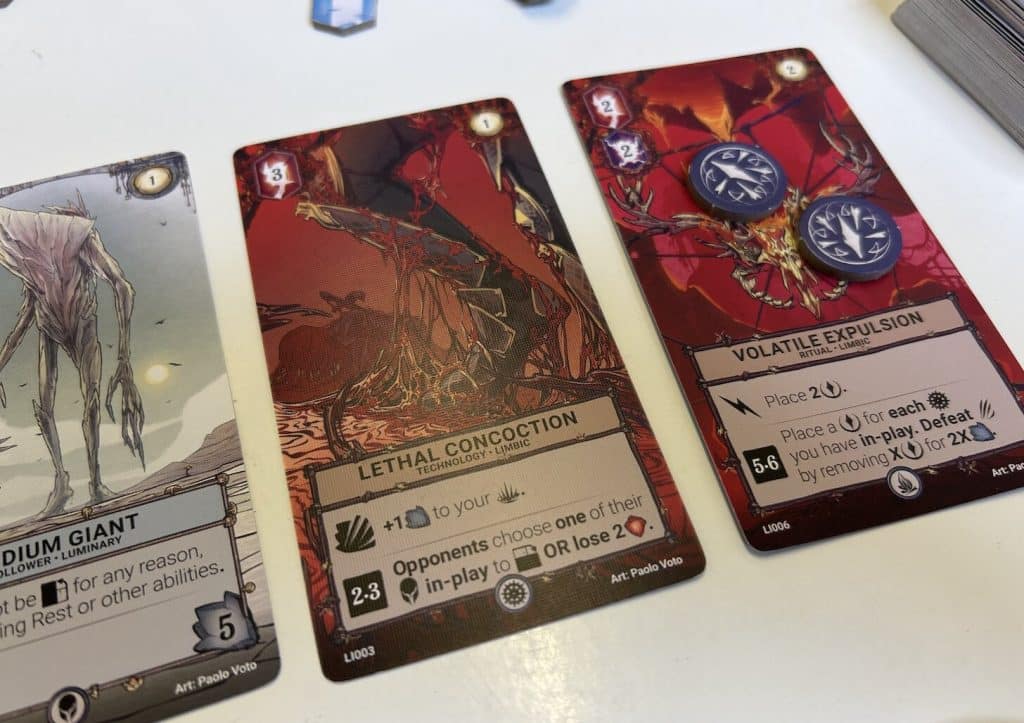
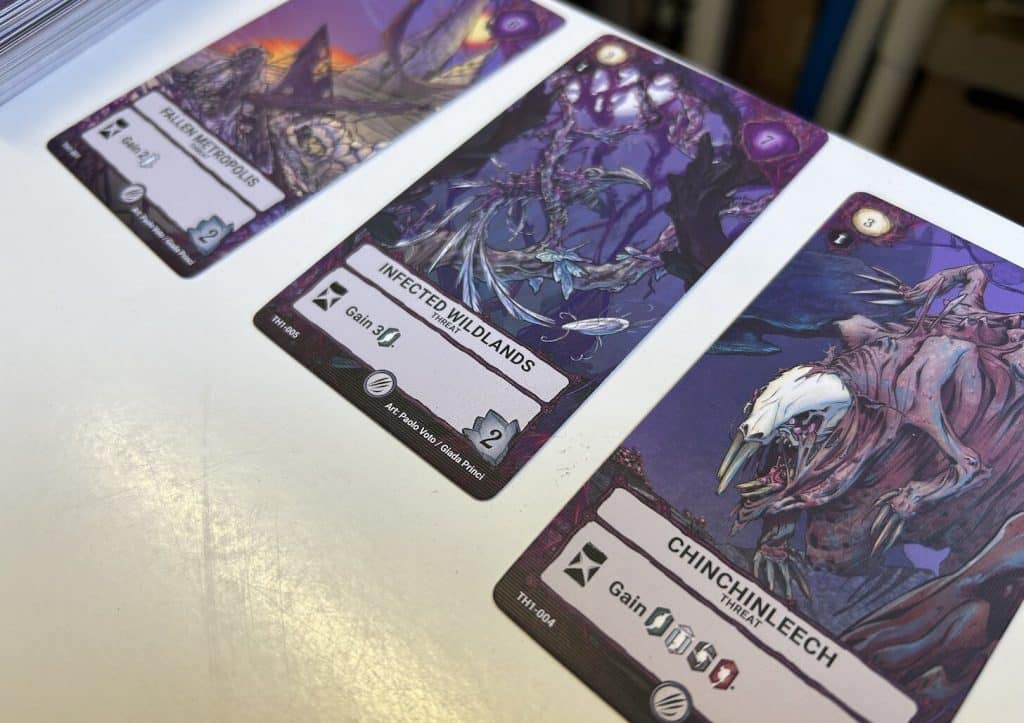
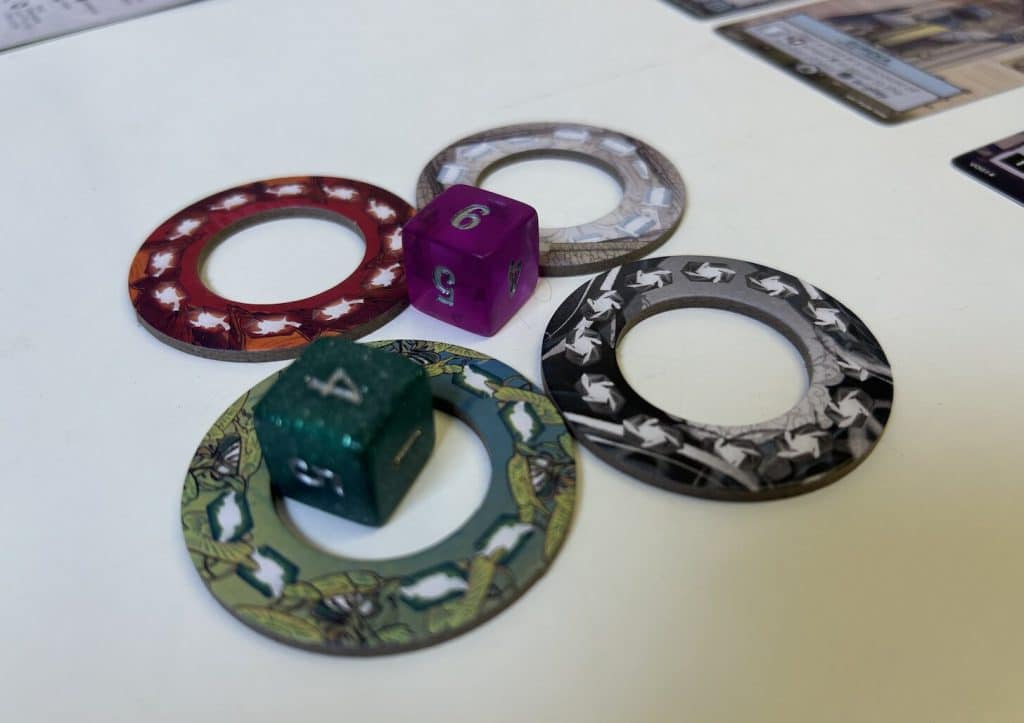
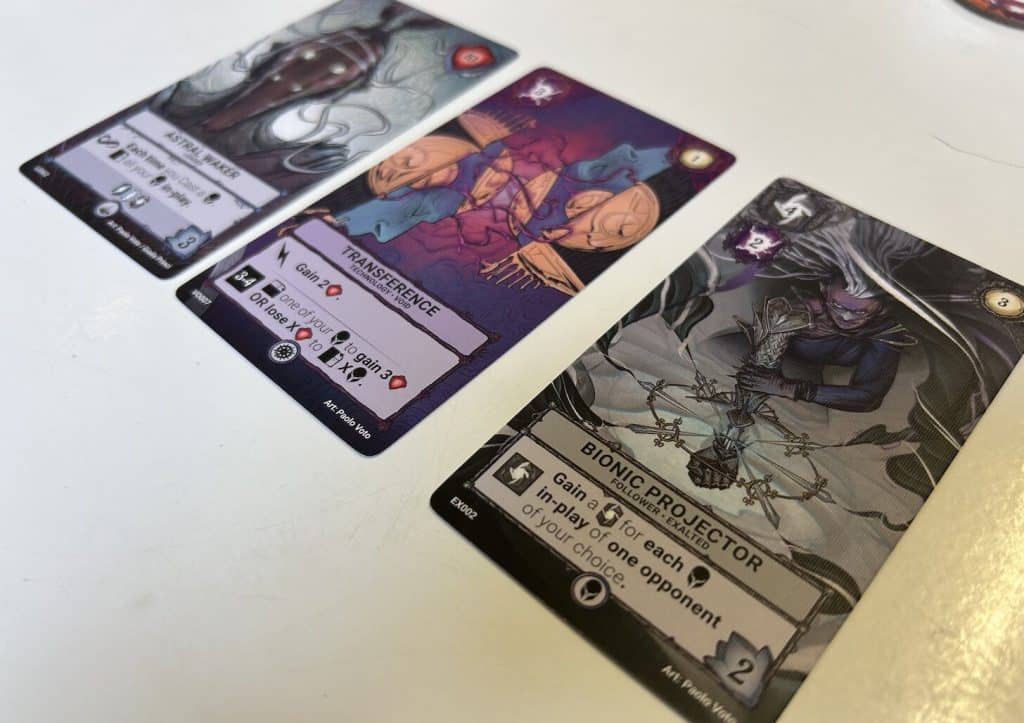
Etherstone is a 2-4 player game of summoning creatures, casting spells, and combat. Although players can damage each other, the primary focus is defeating the Threats in the ether… and for that, you need the precious etherstones.
Each player begins with a Life dial, a Leader card (chosen from two) and a hand of seven Entity cards: you can draft these, or try the rulebook’s suggested introductory hands. The cards are divided into suits, and – once played – get activated in different ways, triggering an array of abilities. As mentioned above, you really want to focus on defeating those horrible threats – but it’s not the only avenue to victory.
Etherstone continues through a series of clockwise turns. On your turn, you take one action from the following list: take a Die, Cast a card, Attack, Rest, or Void Pact. Taking a die is simple: there are five dice in total, and when the game begins they are all available from a central display. Taking a die of a specific colour gets you two etherstones of the matching colour, and these are good because an Entity card requires payment – in etherstones – in order to cast it, which is essentially playing it from your hand to the table. You’re creating a miniature army of entities in front of you, and many of them will automatically activate when you take a die of a particular colour/number/both. At the start you only have your Leader on the table, but later in the game one die may trigger several entities, showering you with rewards.
The Attack action is about taking on those threats. There are always three on show, with a defence strength and an attack strength. To attack you commit entities to the battle, as long as their combined attack strength is equal to, or higher than, the defence strength of the threat. You keep the Threat card, getting some immediate benefit now, and points at the end of the game for having defeated it. If your Leader was part of the battle, it takes damage (tracked on your Life dial) in return. If you didn’t use your leader, you can ignore the Threat’s damage potential.
A new Threat card is drawn, and all your committed entities in the attack (apart from your leader) are now considered exhausted: the cards get turned sideways to show that, for the moment, they are unusable in combat (-although their special abilities will still activate if appropriate). Resting is the action that straightens them up again, ready for attacking. And finally Void Pact is the action you ideally want to avoid – it means your health has hit zero, and you must take this action. The void pact – a token – resurrects you back to your leader’s initial starting health, but at a cost of minus 7 points at the end of the game.
If you want to take a die and all the dice have been claimed, you gather them all together and re-roll them before making your choice. The purple die doesn’t match any etherstone: you can choose its colour, but it does cost you one Life to take it. You can gather and re-roll dice while some are still available – but doing so costs you Life for each die still in the pool. For example, the purple and red dice are still available, but you really want green. You gather all the dice, no matter where they are, and re-roll them before taking the green die – but you lose two Life: one for each die you could have taken.
That’s pretty much it. There are some secondary things around the basics: some cards get counters on them which function in different ways, but in each case the card itself explains them. The game continues until the Threat deck is emptied, you’ve played all your hand cards or the stash of points tokens has been exhausted. At that point, there’s some end-game scoring for your played cards, defeated Threats, remaining Life, and a couple of other criteria: most points wins!
Sam says
As I’ve said elsewhere on the site, I’m not a huge fan of games where the parameters of what happens keeps changing depending on the cards in play: you’re constantly referencing text and icons and it feels – to me – like the rulebook experience has somewhat bled into the game itself. Etherstone’s invented world (backstory: we’re on the forgotten planet of Nobura, there’s an empathetic cosmic being sacrificing itself to give the planet purpose and so on) is also not something I get excited by. But playing sensibly keeps the text to a minimum, the icons manageable and sidesteps the attritional feel of some card games by introducing the third party of Threats. The three different end-game triggers add tension: there are strategic decisions over whether to push for a faster finish by playing your cards as soon as you can, or go aggressive on threats and try to rack up points that way. I can overlook my personal preferences here, because when I play Etherstone I do get absorbed, and enjoy it. I’d suggest it’s best for two though; playtime creeps up exponentially as you add more players.
-

Take That!
Present without being overwhelming. Players can occasionally damage each other, and the taking of dice is another way to passive-aggressively impact one someone, if you know they want a particular die and want to make them pay (or wait) for it
-

Fidget Factor!
Low with two, climbing moderately as you add more players
-

Brain Burn!
A light poach rather than fried or scrambled. You're looking for synergies: cards that fire off each other and create mid band late-game surges.
-

Again Again!
The deck of Entity cards is pretty huge: 75 of them, each distinct.


