
Farm Hand
Designed by: Craig E. Somerton
Farm Hand is a trick-taking game with a twist. Actually, several twists.
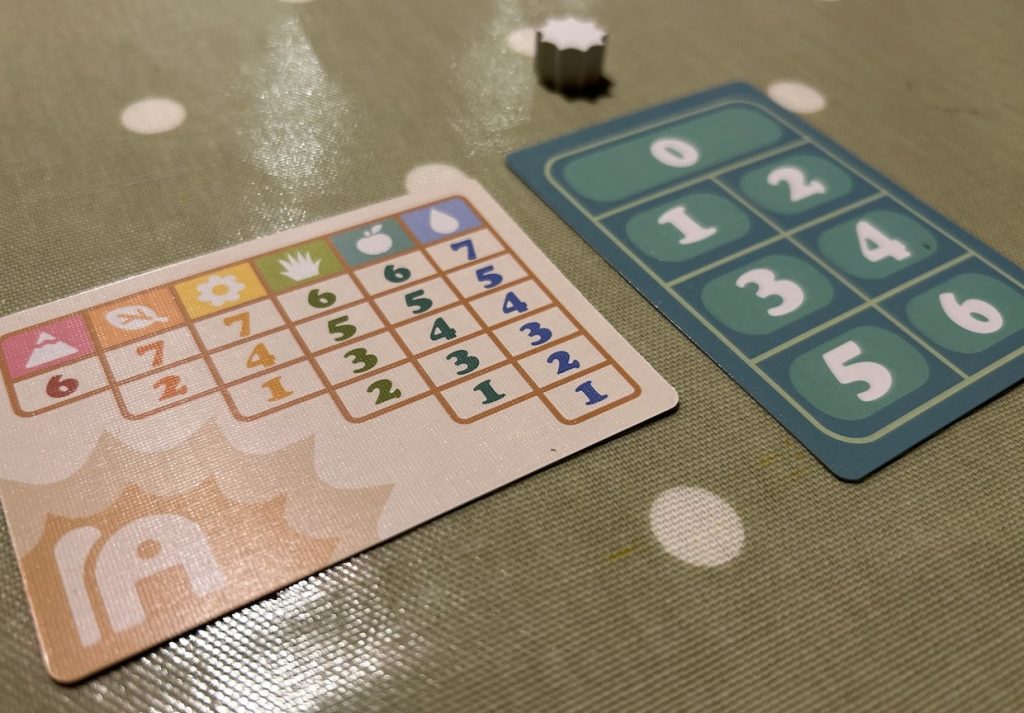
Puns aside, it’s a pretty simple undertaking in terms of rules: everyone is dealt a hand of cards, and before each round all players simultaneously (using a verbal countdown and then your fingers) announce how many tricks you think you’ll win. Hit your target and you score the point value of the current round: there are six rounds, so round one would be a paltry 1 point, whereas the final round there are 6 points to claim if you win it. If you miss your target, however, you score the difference between your target and the amount of tricks you actually won in negative points. Which is a bit of a mouthful but very straightforward on playing: if I bid for four tricks and only win two, I’m getting -2 points. You can go below zero in this game!
There are some quirks to proceedings though. One is that in the first round you’re dealt a single card, then in round two 2 cards, in round three 3 cards and so on up to round 6 where you have a comparative abundance of options in six cards.
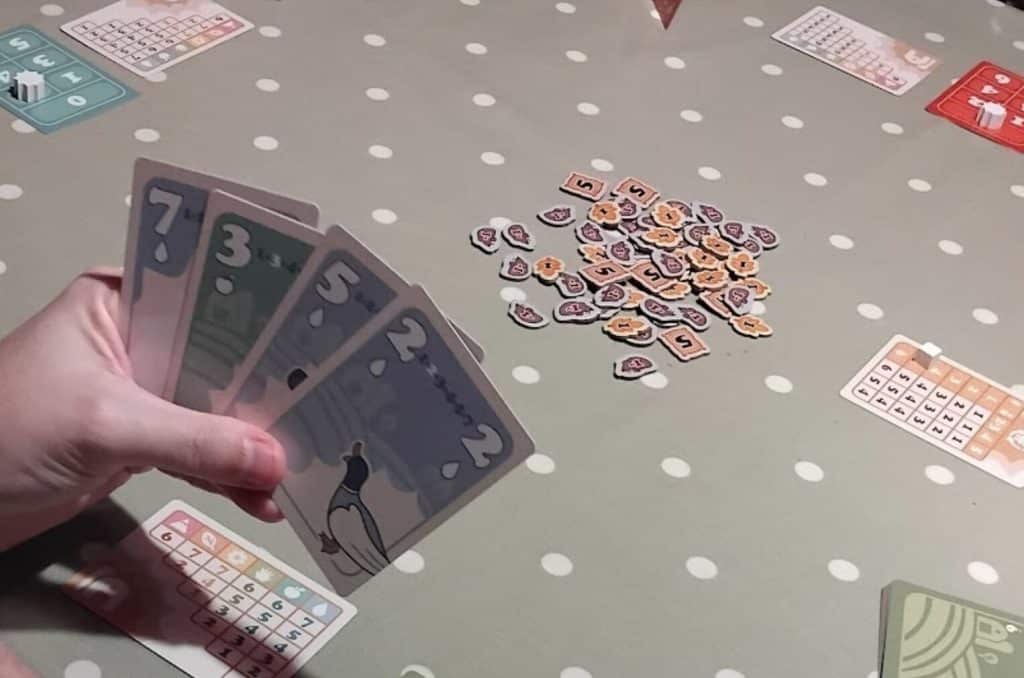
Secondly, any matching numbers played to the same trick cancel each other out, whether they are on-suit or not. Thus two or more matching-numbered cards will negate each other, and someone who played the lowest value card may end up winning the trick. Unlike many trick-takers, the winning card does not have to match the led suit: it’s just the highest-value card left after any like-numbered cards have been eliminated. What’s more, the backs of the cards reveal to the other players both what suit they are, and what numbers they might be. The final quirk is that each suit has a different number of cards in it – the blue suit has six cards, but the orange only two and the red just a single card!
So Farm Hand is like contract whist mixed with some limited information and the hand-grenade possibility of matching numbers exploding each other out of contention, deliberately or not: sometimes it’s inadvertent, but it may well be sabotage.
After all tricks are resolved and scored, a new round begins. After round six, the player with the most points is the winner.
Sam says
I don’t think Farm Hand is going to change the mind or tastes of anyone who finds trick-taking games mechanical, dull, themeless or <insert other negative here>. The name feels picked out of hat and playing it does not prompt visions of bucolic rolling hills. Maybe squelching in mud though, as for card-game enthusiasts and trick-taking fans especially, there is a lot to enjoy here. Like many modern trick-takers – there are a number coming out of Japan – it’s quite opaque on first sight and getting your head around what is happening is – hopefully – part of the fun. Especially as the later rounds enter their last trick or two, the surprises Farm Hand can throw up are – to us, at least – funny, and the fact you can guess (or even predict) what cards opponents are left with gives the game a comically despotic air. A hit with us.
-

Take That!
Can vary from a little to a lot, as players force each other to take tricks they didn't want or find themselves self-sabotaging.
-

Fidget Factor!
Low, especially in those early rounds. And the entire game can be over in 15 minutes anyway.
-

Brain Burn!
If you can work out the best way to play your cards AND glean enough information from others that things make sense to you, you're a better farm hand than I
-

Again Again!
For lovers of trick-taking games, yes. It's bonkers and brief, clever and mildly chaotic. But it's not a lottery: there are decisions to be made here.


