
Findorff
Designed by: Friedemann Friese
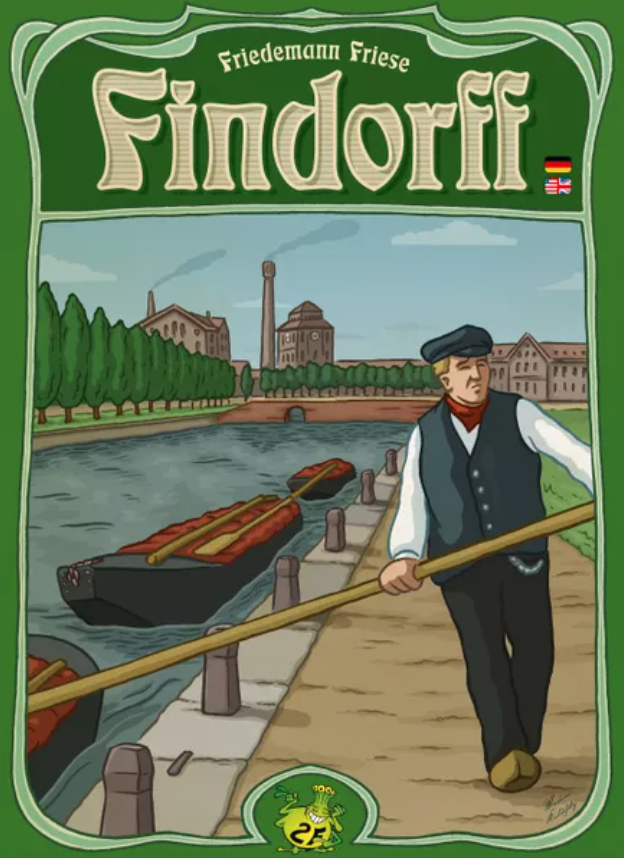
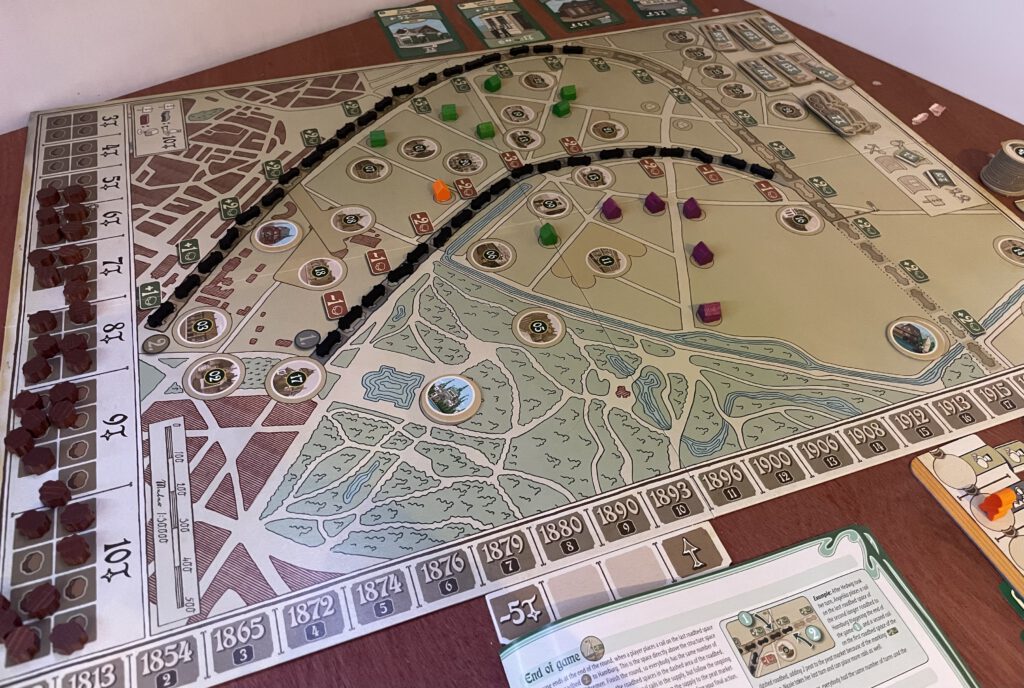
In the game of Findorff, players build and populate the Findorff district of Bremen (home town of the designer) over a century or so of game time. The quirkiness of the theme carries over into into the game play, as players produce bricks to make buildings, and rails to build track – the railroads also serving as a kind of timer, as their completion marks the end of the game.
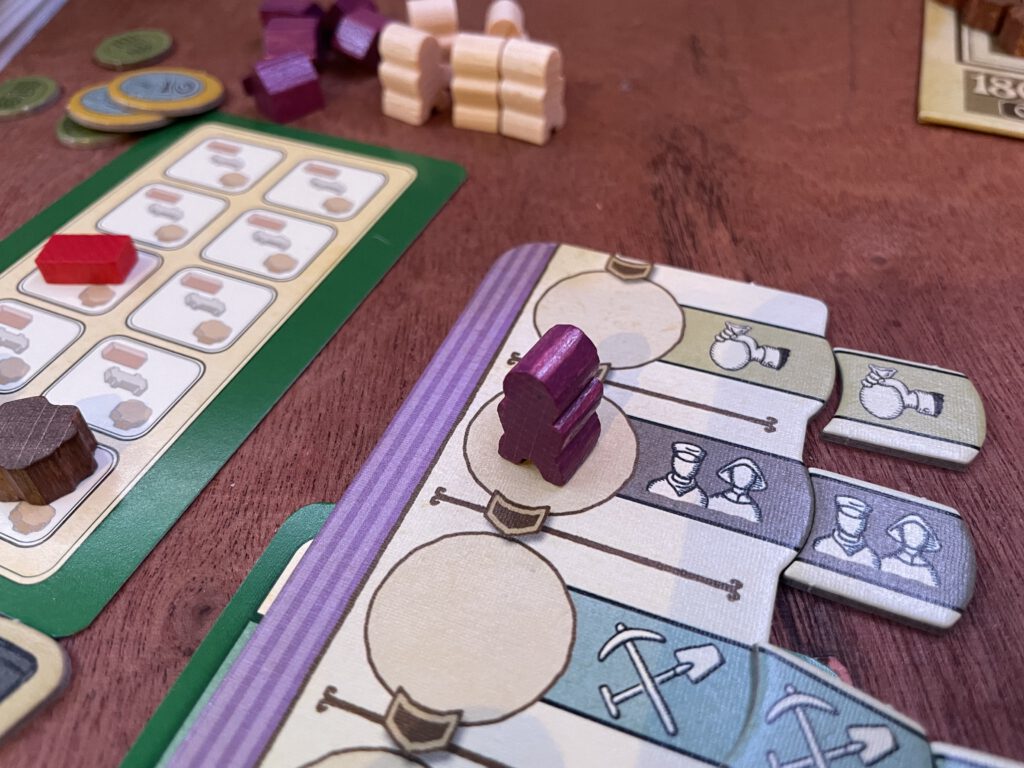
Everyone begins with some cash, and foreman next to their company board, and some peat in their warehouse. Although that’s quite the opening salvo of terminology, the game is pretty simple once you’re up and running, and surprisingly fast-moving. On your turn, you simply move your foreman 0-3 spaces down the company board, taking the action you halt on. There are four actions: you can make purchases, gain workers, produce stock (peat, bricks, rails) or sell produced goods from your warehouse – and the actions have a kind of flow to them: by purchasing you can increase the number of times you take any action, increase the number of workers you gain, pay for production tiles that your workers will occupy to produce the peat/bricks/rails and so on. The purchase action is also where you can build buildings into Findorff: on the board!
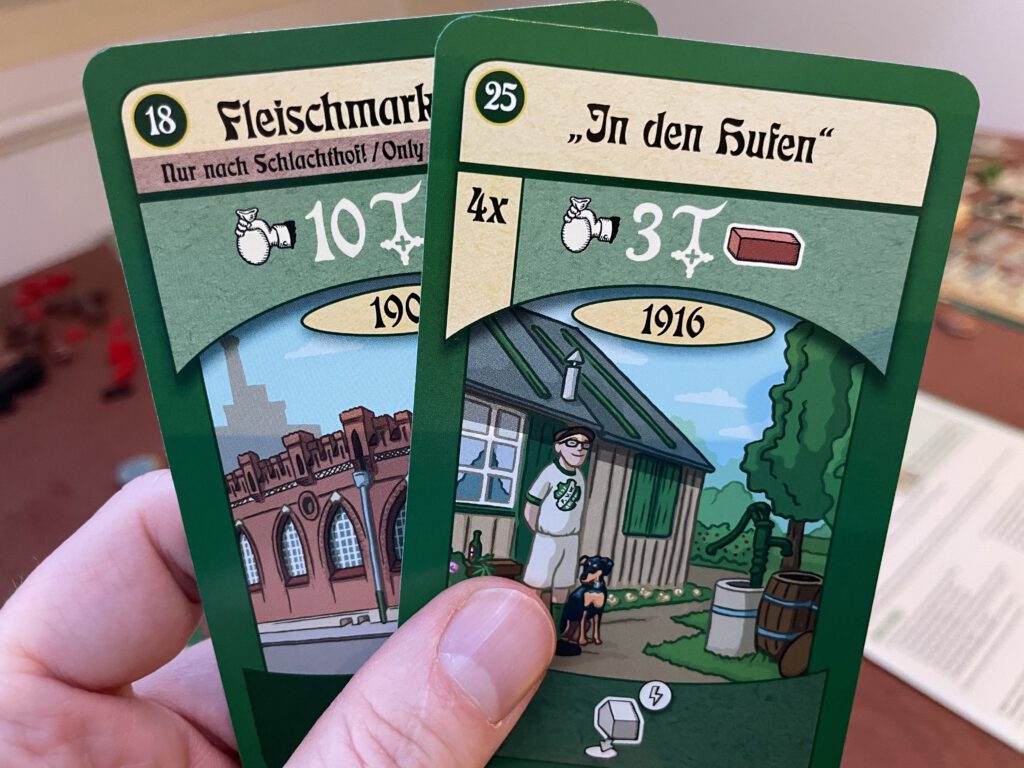
The buildings come in the form of cards: you each have a hand of cards and there’s also an open market you can choose to build from. Pay any costs (money, bricks, rails) and play the card to the table – all buildings give a benefit of some kind; some are instantaneous, some boost specific actions, and many give you a cash income when you perform the bureaucracy action.
Bureaucracy isn’t so much a choice as an enforced action. Your foreman can only move down the company board, before looping back around to the top. Whenever you do this loop, you perform the bureaucracy action, which follows five easy-to-follow steps we won’t bother listing here. Suffice to say they are largely productive, but you do lose a worker from your workforce to signify the passing of time…
So there’s a cyclical nature to the game of foremen working their way down the company board, improving actions, taking actions, producing goods and spending them to generate the buildings that make up Findorff itself (you can also add your own houses to the town, generating more income). The ticking clock of the game is represented by the railroads – when the second railroad is complete, the current round is completed and then scores are totalled – for cash, for bricks, rails and peat in your warehouse (the value of peat can vary wildly, as it has a fluctuating market throughout the game) but mainly the buildings you’ve built, which each score 50 points.
Sam says
I’ve enjoyed playing Findorff, as I tend to do with designer Friedemann Friese’s games. It’s kind of bonkers – the board does very little other than keep track of things – but it’s also kind of moreish, in how each turn gives you this micro-reward – and later, larger rewards – and the management of those little moments keeps driving you forwards. Navigating that space between each tactical decision and the overall pacing of the game – it speeds up rapidly, and you can be caught out by the railroad finishing!- is key, and if it’s light on interaction, the speed of play makes for a breezy experience, with a time-running-out finale. One of those games that goes from grunts of confusion to grunts of understanding and, finally, exclamations of satisfaction. There’s no real marks against it, except to say that series of micro-moment satisfactions perhaps don’t lead to a whole much greater than the sum of its parts: the game is fine whilst I play it, but it doesn’t demand to be played again the way some games do.
-

Take That!
Very little. Players can manipulate the stock market or build a building you might have been working towards, but that's about it
-

Fidget Factor!
Moderate at first, but when everyone understands the game's rhythms, it speeds up dramatically. Many turns take just a few seconds.
-

Brain Burn!
Not too much, but not too light either. Each turn is an attempt to push your productivity forward, and turn your work into cash and points.
-

Again Again!
For all it's beige appearance and niche theme, Findorff rewards repeat plays simply because each player decision has small but significant ramifications - for themselves, and occasionally others.


