
Forestry
Designed by: Michal Peichl
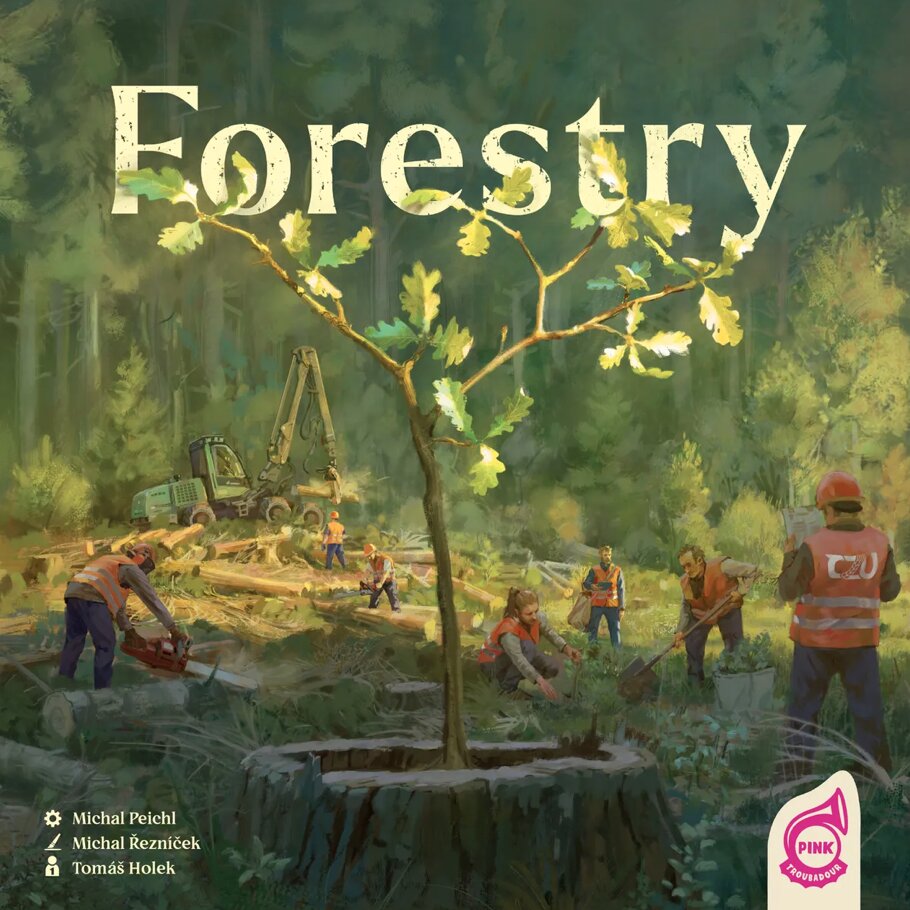
In Forestry, players are managing a large forest, in charge of deforestation, reforestation, and pretty much everything in-between. It’s a game of a lot of moving parts, but a simple nub at its core: your primary goal is to fulfil contracts. And you do it via action points.
The main board shows the forest itself, broken into three distinct areas (light green/dark green/brown) and within those areas, hexes in which trees grow, represented by tokens. As well as tree tokens, the board also starts with some smaller Forester tokens, representing the smaller aspects of management. Each player also has their own board that keeps track of your progress: how many action points you have to spend, how many tree tokens you can keep under your control and a place for both Forestry tokens and Seedlings, which you’ll be spending to replant the trees you’ve cut down.
Each round of the game, players take actions, so let’s look at what they are. Specific to the map are the Harvester actions: you can move your harvester piece around the board, Harvest or Reforest wood at its location, Tend to the forest (mechanically, this just means picking up the Forester token there), or construct Buildings or Water Structures, both of which give a little reward now and a potentially big one later in final scoring.
Around the hedge of the board are the three Sawmills, and you can move your Sawmill Manager between them, take an available action at one of the sawmills – gaining resources to build with, or processing wood in order to fulfil a contract – Upgrade a sawmill (flipping it from its basic side to its advanced side) or gain a new contract, which you will most definitely want to do at some point.
Forester tokens and Seedling tokens you’ve spent on reforest actions get placed on your player board, giving you an immediate benefit of some kind (cash, points, or stars) and – potentially – more at the end of the game. But we just mentioned stars, so let’s turn our attention to those.
In the middle of your player board is your circular star track, around which your star token moves whenever you gain stars. Whenever it reaches or passes the ’12 o’clock’ spot, a reward is triggered, gaining you points, money, resources or a movement up the Development track. The development track is fairly short – there are only six spaces on it – but moving up it can be absolutely critical, as it’s a way to boost your default ‘3 actions per turn’ up to 4, 5, or even 6. In a game of ten rounds, it can make an enormous difference.
Lastly – sort of, this is a very broad overview! – are the Task cards, which you might get in the game from the development track, fulfilling contracts or from some other bonus. Each can be discarded now for an immediate benefit (-often these do requite cash as well) or kept back for end-game scoring, where the bottom half of each Task card will score points just for you relating to your performance on the board. They might score for Forester tokens or seedlings, or buildings built beside specific trees. And likewise the Water Structures will score in different ways, depending on where players built them. After scoring across a few different categories, the player with there most points is the winner.
Sam says
I wouldn’t rush to play Forestry with four, especially if anyone is given to excessive pondering. I think it suits 2 or 3 best – but that said, even then everyone needs to be okay with the pace being a staccato one – sometimes rapid, sometimes stalled: if you’ve just harvested the cedar I wanted, I need to rejig my plans and look at other strategic ways forward. The game does give you a lot of angles of pursuit – we’ve not described every detail here, but almost everything you do has a benefit of some kind – however, those multiple angles do mean there are considerations to be made at every turn, and for me personally it does mean the game moves at a slowish rate and is a workout for the brain. I’d recommend starting with the ‘Tutorial’ game – it’s a little simpler – and definitely play yourself before introducing to others (a good habit anyway; it makes teaching a game far easier and takes a fraction of the time).
-

Take That!
Whilst harvesters can pass each other in the forest, they cannot share a space when stopping, so the geography is more constricted with 3 or 4 players. The ebb and flow of available trees to harvest also impacts on other players, as do - to a lesser degree - the presence of others at Sawmills.
-

Fidget Factor!
There's only ten rounds so it can be fairly quick with two - probably about 30 minutes per player. With more the playtime does ramp up quite a bit - not only are there more turns, there are more ramifications and hence more pondering to be done
-

Brain Burn!
It's a game of a lot of moving parts. The strategy is there in the endgame scoring of buildings and task cards. The tactics are there in how the other players are hampering you - or just doing it better!
-

Again Again!
Whilst Forestry is not exactly an accessible game to casual players, it can't be accused of becoming rote. There's a lot of variables even in the basic set-up, and the rulebook offers an Advanced variant for those who'd be happy having a little more to think about.


