
Indigo
Designed by: Reiner Knizia
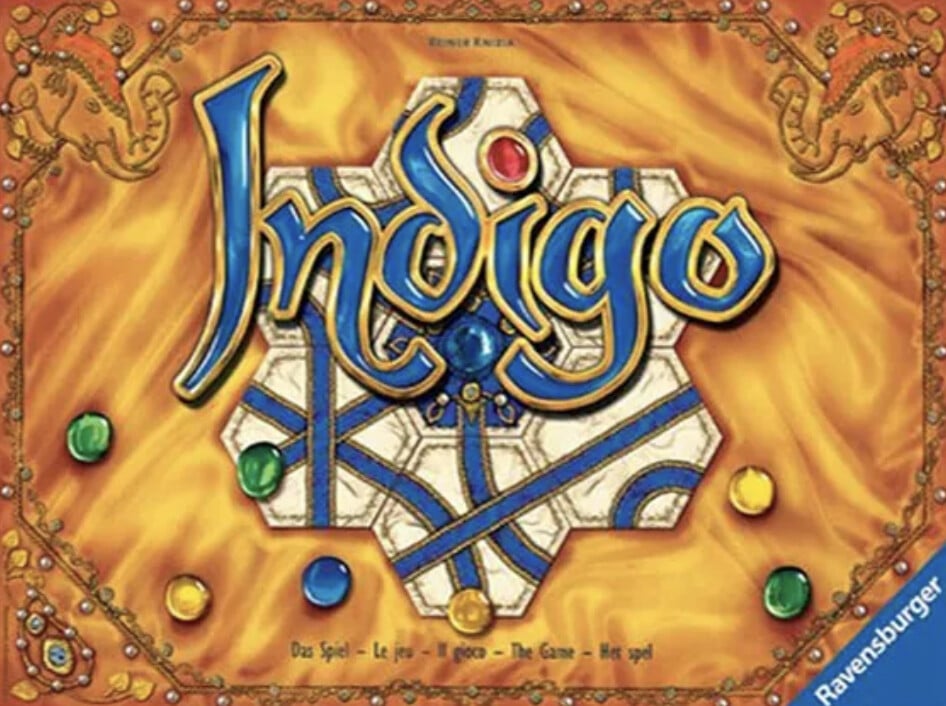
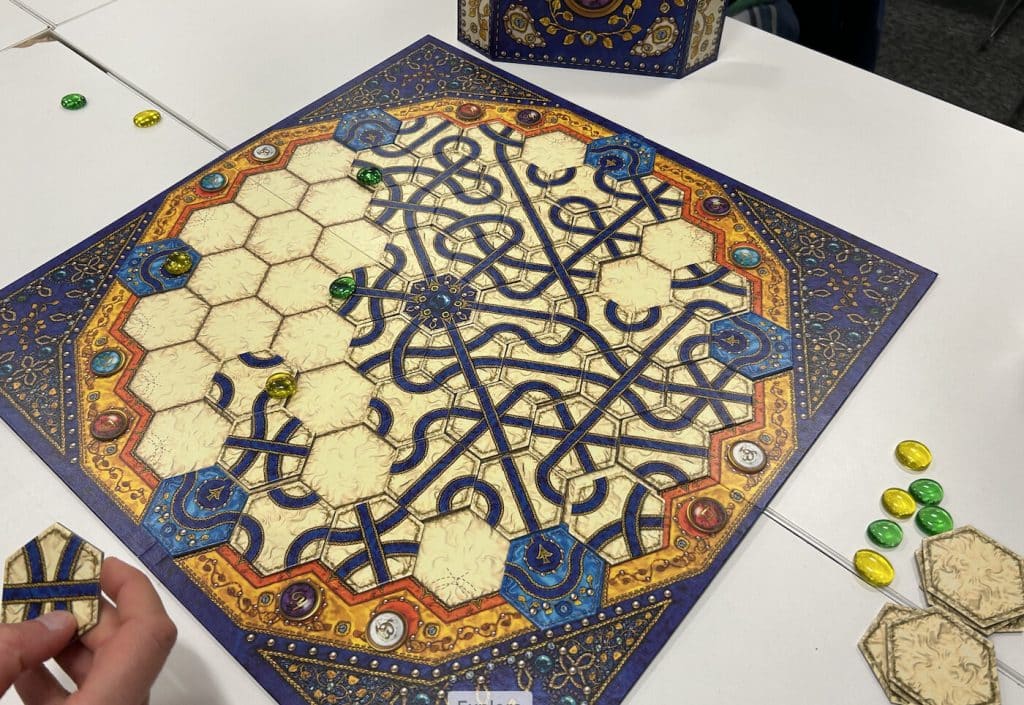
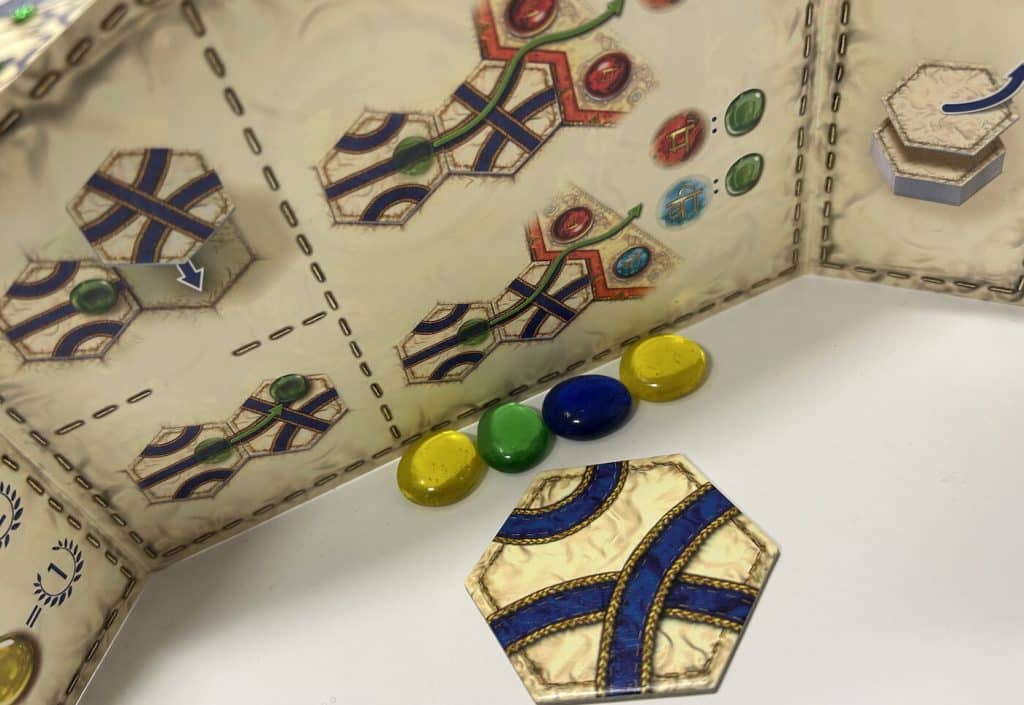
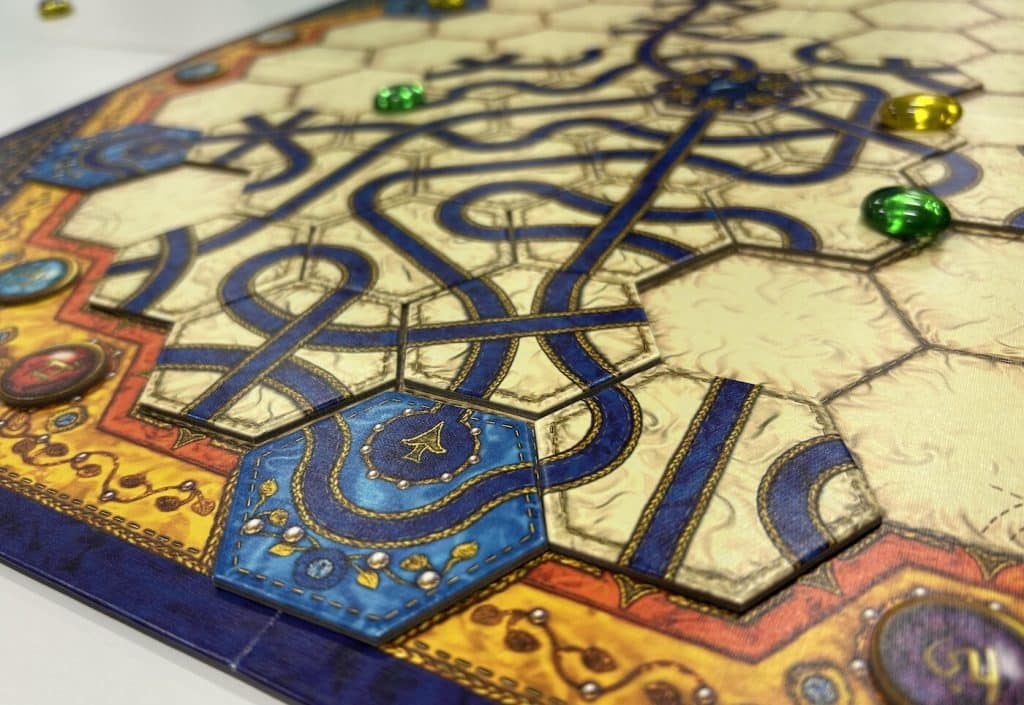
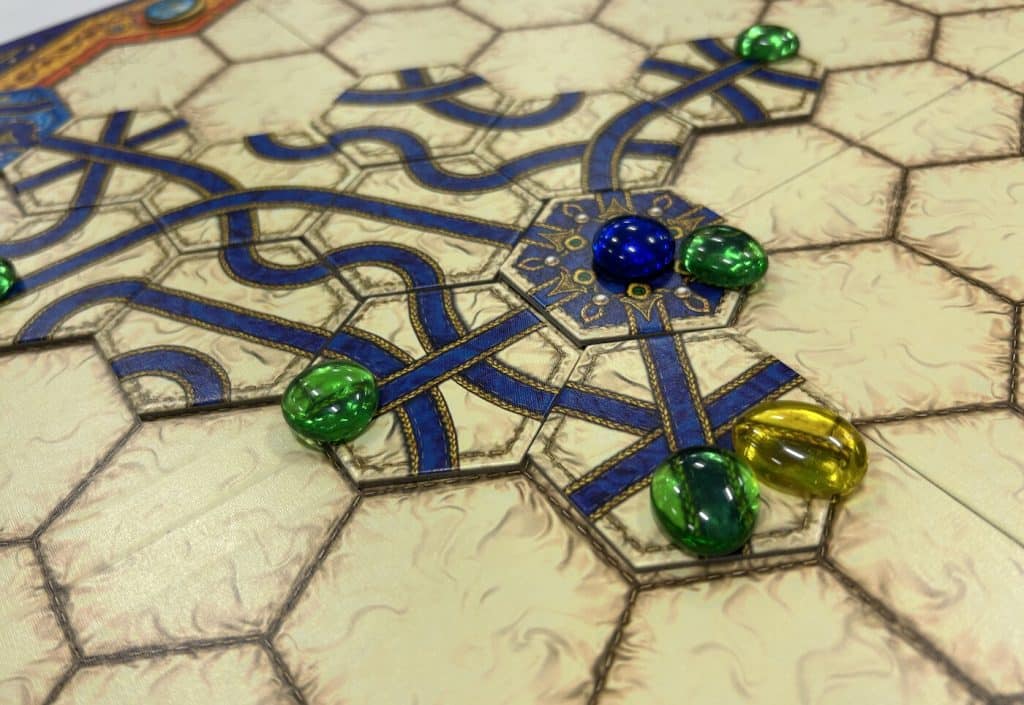
Indigo – also published as Butterfly Garden – is a largely abstract game of building paths to ferry gems along. The catch is all about where the paths end: different edges of the board will suit different players.
The board is laid centrally with a number of high-value gems (blue/green) in the middle, and a few low-value (yellow) around the outside. Paths are made with tiles: each turn you’ll have a single tile to lay, but you can place it anywhere you like on the board – as long as it’s not on top of another tile. If the path connects to a gem, then that gem will move along it… but as you can see from the pictures, most tiles can be played in different orientations, to push the gems in various directions. If a path ever connects to the edge of the board, the gem on it will be ‘delivered’ and this is where Indigo’s significant twist comes into play: each of the playing area’s six edges belong to two different players (*this is different in a 2 player game) and when a gem is delivered both of those players get to keep a gem of that type: one from the board, and the other matching gem from the supply.
What this means in practice is that players have certain shared incentives: if I’m the red player and your blue, we’ll share one side of the playing area and might collaborate on pushing a gem that way. But maybe you’re sharing an adjacent edge with the purple player, so when they push the gem that way you don’t mind at all, whereas I’d be less happy about it. As play continues, the tiles will create more and more interesting options, and a tile might connect to other tiles and send a gem across to the other side of the board!
The first five paths starting from the middle of the board will move the green gems – and the last will move the big-scoring blue gem. As you also have six yellow gems around the outside (whose paths begin pointing inwards onto the play area) there can be up to 12 gems in play at any one moment! After the last gem has reached the edge of the play area, points are tallied and the player with the most points is the winner.
As far as we’re aware, the Butterfly Garden edition changes the theme, but not the rules.
Sam says
Indigo takes the path-building premise of Tsuro (-play a tile; move a thing) and adds the shared-incentives of players’ temporary alliances, spoken or otherwise. I’d say this makes it a more nuanced game, but it’s also a little more stop-start in its pacing thanks to the numerous possibilities. I like Tsuro for its simplicity and speed: you focus on your own path. With Indigo you’re restricted to a single tile but have a portfolio of places to put it, delightfully muddied by the fact that you inevitably want to move three or four different gems at the same time. From a designer who almost without fail prioritises player interaction, it doesn’t disappoint on that front. The decisions are interesting. But the game as a whole, counter-intuitively, feels slightly bland to me, lacking Tsuro’s last-one-standing drama and each moment of impact on the board compromised by the fact that a subsequent tile will probably undo whatever you just achieved. I’d happily play it again, but it’s not a game I would actively seek out.
-

Take That!
You can have your plans go awry, for sure, as players tile-placements constantly change the make-up of the board.
-

Fidget Factor!
Low to moderate. As well as the dilemma over which gem to focus on in each turn, there's also a spatial puzzle at play.
-

Brain Burn!
The rules are simple and players even younger than 8 can enjoy Indigo. The best decisions can be elusive for reasons given above: all tiles (barring the all-straight-paths tile) give you options, and there are numerous places they can go on the board.
-

Again Again!
It's pretty accessible and usually only takes around 20 minutes or so.


