
Irish Gauge
Designed by: Amabel Holland
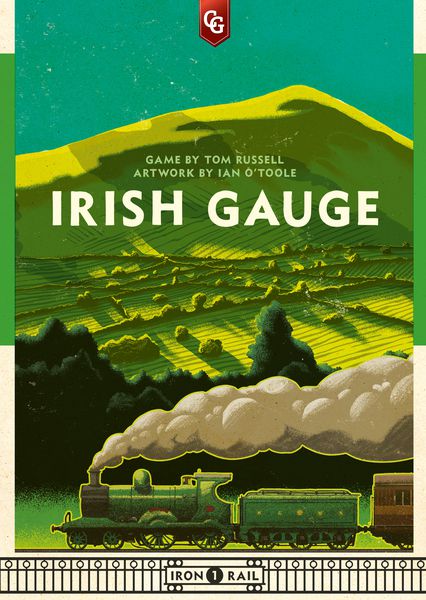


Irish Gauge is a railway game of simple rules but weighty decisions.
Players are industrialists overseeing the construction of several railway lines across Ireland in the 19th century. the board shows Ireland itself, broken into hexes and with some hexes representing cities (these each have a cube in of pink, black or white – more on these shortly), towns, or difficult-to-build-in areas. There are black railway companies (yellow, blue, red, orange, purple) in which players can take shares – in fact, at the start of the game one share from each company is auctioned off. You begin with only £20 to your name, so spend wisely!
But spend you must, because only by investing can you be competitive. On your turn, you take one of four possible actions. You can auction off a share. There’s no guarantee you’ll win it – and depending on circumstance you may not even want to! – but only if you own shares in a company can you do the next action, which is lay track. Track-laying is represented by adding trains of that company’s colour onto the map. You get three ‘build points’ to spend, and where you build on the map has a cost: empty hex, 1 build point. Occupied hex, 1.5 build points. Difficult terrain: 2 build points. And so on.
The point of all this auctioning and track-laying is, of course, to make money. And a third optional action is to call for dividends. Here you dive your hand into a bag and pull out three of the pink white and black city cubes mentioned earlier. Now every company that has track connected to those cities with a matching coloured cube in score points: 4 points for the cities and 2 points for any connected town. Your fourth and final action is to try and make these dividends more rewarding by turning a town into a city by adding a cube – when taking this action, you can look in the bag and choose the colour.
What manifests from these four actions is a highly interactive game where every player is invested – emotionally, if not otherwise – in every turn, and alliances are formed (often unhappily!) when players hold shares in the same companies. As soon as the last cube is drawn from the bag, the final dividends are taken and the game is over. The richest player wins!
Sam says
Like the same designer’s Northern Pacific, this is a train game with simple rules and hard choices. To newcomers it may feel a little inscrutable – and involve checking and rechecking the status of each company and which cities they’re connected to, which doesn’t feel that playful compared to the blunt and brutal immediacy of the older game. But that’s a minor gripe in the big picture – and perhaps unfair on Irish Gauge to judge it by direct comparison: this is a slightly denser and chewier affair, but with much to recommend it for lovers of uneasy alliances and murky motives. Delightfully presented as all.
-

Take That!
Plenty. PLENTY! There's no stealing and not a blaster in sight. But from that plain-looking board arises all manner of dastardly politicking.
-

Fidget Factor!
Low to moderate. The actions are simple, but the decisions are less so because everything has ramifications.
-

Brain Burn!
See above. The worst situation to be in is cash-poor when an auction starts. But Irish Gauge thrives on worse-situations.
-

Again Again!
Well, you have to like the flavour here. For all the bucolic theme and pretty appearance, Irish Gauge is actually a fairly feisty affair. It's probably at it's best after 2 or 3 plays when everyone is familiar with the nuances of play.


