
Kelp: Shark vs Octopus
Designed by: Carl Robinson
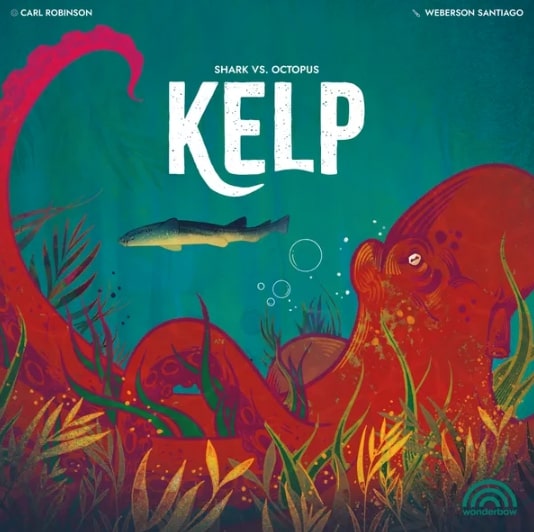
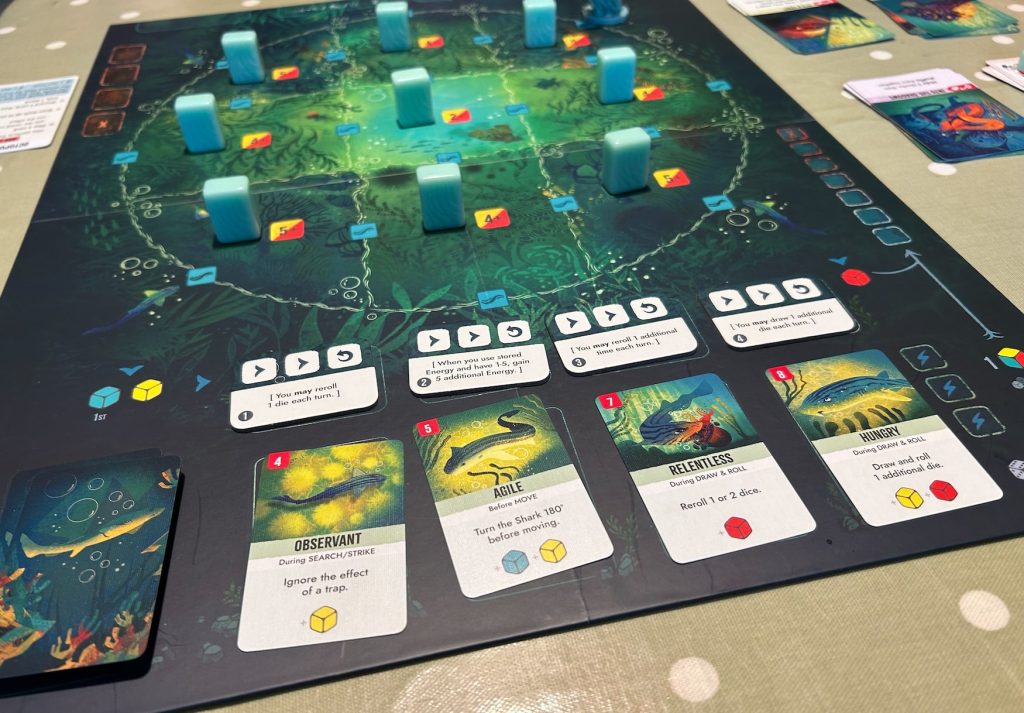
Kelp is a two-player challenge of high asymmetry. For one, playing the shark is about finding and attacking the octopus. For the other, you must either eat four different kinds of food, or simply hold out until the shark is exhausted.
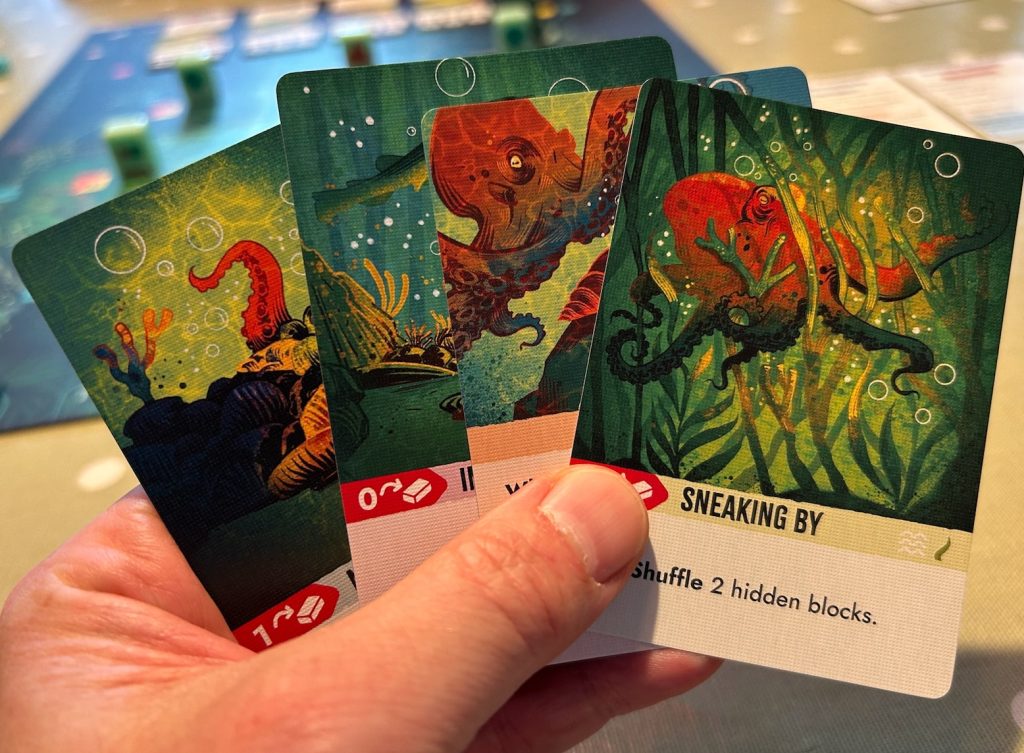
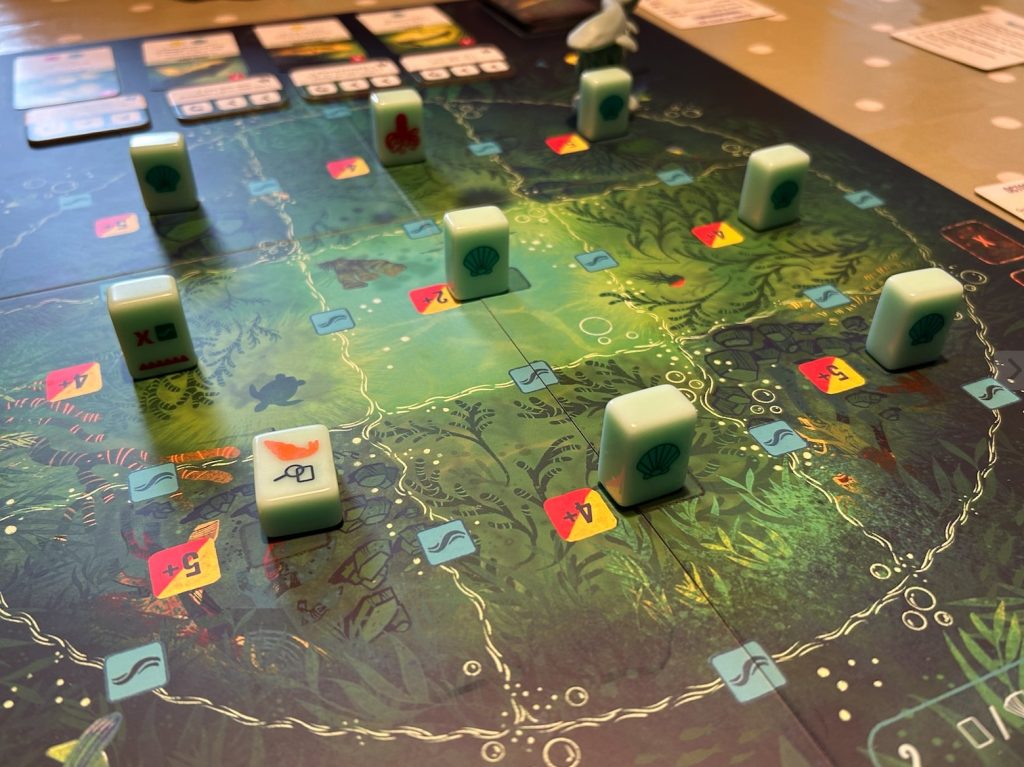
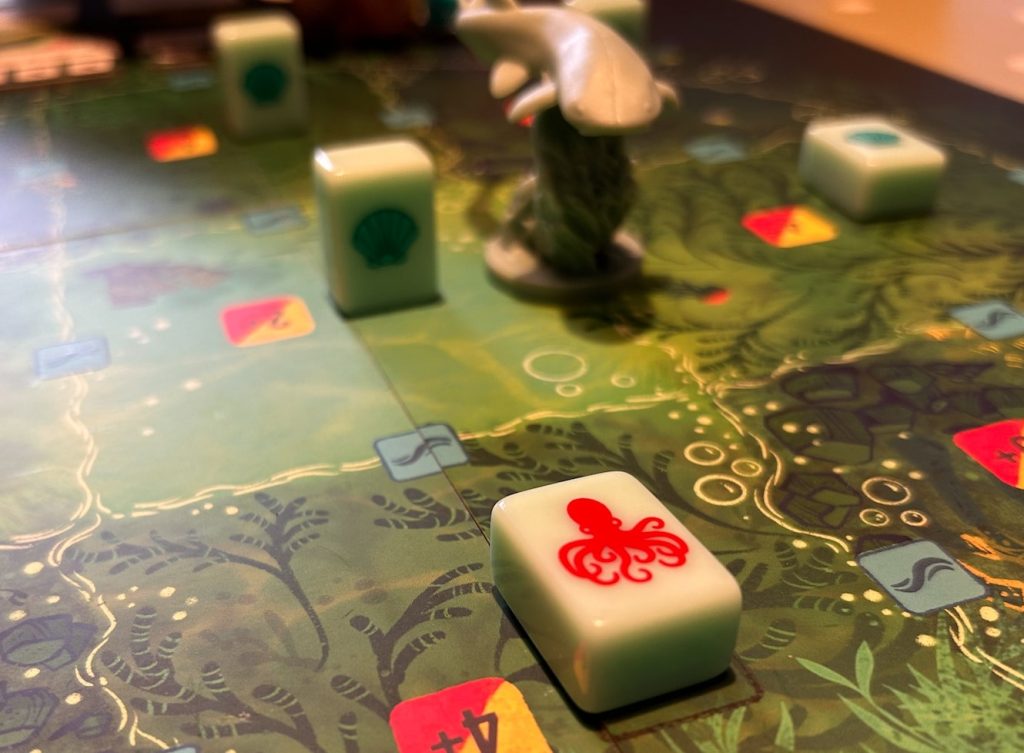
The board represents a small section of ocean where the octopus hides. At the start of the game nine tiles are laid out, visible to the octopus player but hidden from the shark. One of them is the octopus, one is a trap for the shark, and the other seven are simply shells: places the shark can look but will find nothing. For the octopus, turns consist of two actions. You begin with a hand of cards and playing a card is an action: whilst some cards are free to play, others have a cost and the cost is revealing tiles on the board: laying them flat so the shark player can now see them, and get a better idea of where the octopus might be hiding. The cards themselves are relatively easy to understand: there are four different types and they generally involve the moving, swapping places, shuffling or hiding of tiles. There are only four ‘eating’ cards and each of these come with a tile – if you add an eat card to your hand, the tile gets added to the board and you can subsequently play the eating card to claim the food: the downside being that your octopus tile needs to be adjacent to it on the board, and the act of eating reveals exactly where you are. But if you eat all four tiles, you win the game… You can also spend an action to draw up to your hand limit, and finally you can discard any card from your hand to hide an exposed tile.
For the shark player, things are very different. As well as not being able to see any upright tiles, the structure of your turn starts with pulling two dice from a bag and rolling them. There’s a little more procedure to a shark turn than we’ll go into here, but in short your dice come in three colours: blue are current dice, that can be placed on the board to allow you – as the shark – to get around that much faster. Yellow are search dice that may let you expose the tile you’re next to, lying it flat. And red are strike dice: not only do they expose a tile, but if the tile is the octopus you can now attack it as well: this causes a confrontation, which we’ll come to shortly.
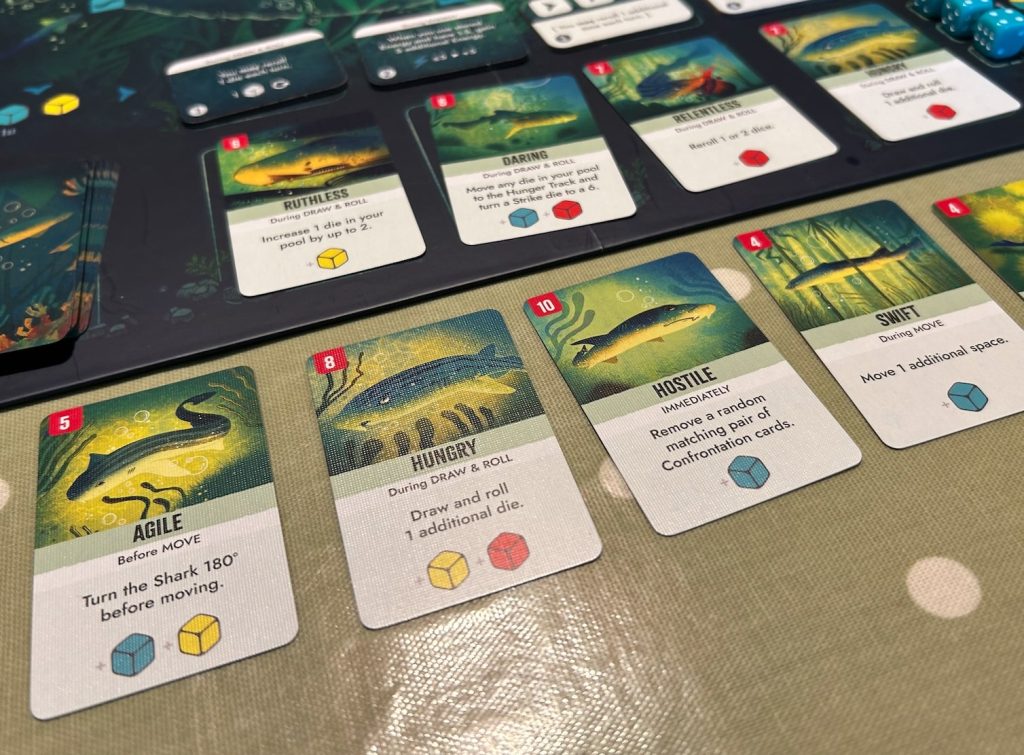
So the dice are immediately about moving, searching and occasionally striking. But once they are used, they go onto your growth track, which consists of four tiles each with room for three dice. As soon as a tile is full you flip it over (return the dice to your bag) and gain a permanent power. The shark can also simply store dice as ‘energy’, which can be spent on cards of their own. Unlike the octopus cards, most of these are single use, but buying them adds more dice to your bag: the only way to improve your strike efficiency, as you only begin the game with a single red die.
When the shark provokes a confrontation, a miniature game-within-a-game occurs. Both players have three confrontation cards: representing the three strategies an octopus might use to escape the shark: flinch, fight or flight. The octopus secretly selects one, and the shark secretly selects their counter-strategy. Then the cards are revealed: if the two players match, the shark wins the game. If they don’t, the octopus survives to fight on, but critically they lose the played confrontation card, meaning next time the chances of survival will drop to 50/50… and if they survive that, they won’t survive a third confrontation!
The octopus’ other route to victory (instead of eating the four foods) involves less exposure but could take longer: when the shark strikes a block that turns out to be anything other than the octopus – a shell or a trap (traps give the octopus help when revealed by the shark) – then the strike die goes on the Hunger Track. If the hunger track is ever filled up, the shark loses. Otherwise, keep hunting!
Sam says
It looks lovely on the table and is intriguing in how different it plays for each side; almost like two different games crashing into each other and seeing what waves they create. We’ve not covered every rule here, needless to say, but you hopefully get the thrust of what each side is trying to do. It’s worth mentioning that the shark must move each turn, and so the octopus can try and anticipate where. The shark can use memory to a great degree: if a tile is exposed, you still know what it is when it’s hidden again…. at least until it’s shuffled with another. The octopus can use a bit of bluff here too: inviting the shark to think they’re in one part of the sea when they’re actually elsewhere. But as the game continues, it seems like victory favours the shark with its growing powers and cards, so it seems like the octopus really wants to get eating. Which in turn means giving away its’ position…
-

Take That!
Very little for the shark. A fair bit for the octopus, but that's the food chain for you.
-

Fidget Factor!
Low. You need to be focused on what your opponent is doing.
-

Brain Burn!
Whilst each side is very different from each other, neither is tremendously tough to understand in itself
-

Again Again!
Each side has small random factors and you can play both animals. The hidden information means it's never totally predictable.


