Lancaster

Designed by: N/A

In Lancaster you play the nobles of Henry V, all vying for his attention and hoping to be the most highly-regarded by the end of the game.
You begin with two knights of level 1 and 2, a small castle that you can improve during the game, and a screen to hide how many gold and squires you have. The main board shows a map of England with a number of courts you can send your knights to: each of the courts only accepts knights of a certain level, but it’s possible to sneak a lower-level knight through the door by having squires accompany him – the catch being that whilst you get your knights back at the end of the round, your squires are gone for good. Why go to the courts, though?
Well, at the end of each round a knight in a court gets a reward: it might be gold, squires, votes (more on those in a moment), an upgrade on one of your knights (level 1 to level 2, etc), an upgrade on your castle (bringing a bonus every round) or a new level 1 knight to add to your hopefully-growing workforce. Or you can choose a nobleman to come and eat at your castle – good for point-scoring – or you can get both rewards by spending 3 gold. But before we get to any of that, you need to know that knights can push each other out of the courts, merely by being stronger – you can use squires for this purpose as well, though squires never go anywhere without a knight, So your lowly level 1 knight may find himself pushed around a few times before he finds a home.
The other thing you can do on the board is send your knight to battle the French – this brings an instant reward from the king, who loves it when people go rushing off with a sword, and also points for taking part in/winning battles. Losing battles is not so good…
What gives Lancaster intrigue though is the laws. At the end of each round players vote on three new laws, a majority or tie meaning that law comes into effect – bumping an old law (the King only likes three laws at any time) and potentially rewarding everyone, or more likely, only one or two. Getting a law passed is a way of pushing your points up – and that’s why the extra votes you can pick up on the board come in handy.
After the laws the courts and battles are resolved and you get rewards from your hopefully- expanding castle. And after five rounds the game concludes: you score points for the values of knights, castles, and potentially crucial: the noblemen eating at your table. During the game they earn you votes, but at the end they can provide a big swing on points!

Sam says

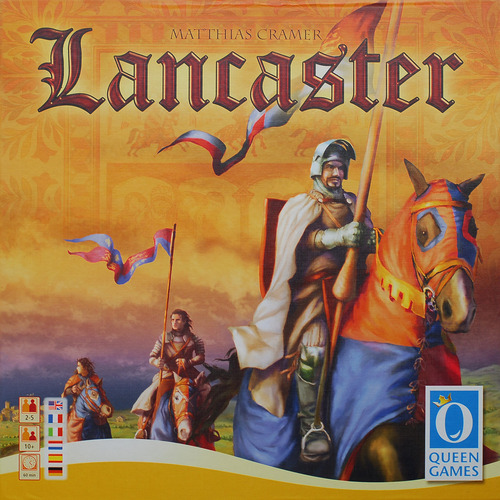
The box art makes it look so dry and old-fashioned, but Lancaster’s genius is in stitching in the laws into an otherwise fairly straightforward worker-placement game: put a guy somewhere to get something back. But and it’s not just the laws, but the fact that Knights can bump each other out of the best positions, the fact you can’t be sure how many squires someone had and whether it’s worth you risking yours if someone else is going to kick your Knight back home… I really enjoy the tension in that, along with the fact that the game really zips along once you know it – for me Lancaster is a keeper.

  • Take that! icon

    Take That!

    There's a reasonable amount of Take That, that increases as the game continues and is more prevalent with five players, say, than two or three. Knights can push each other out of castles, swoop in to grab the glory at the tail-end of battles, and - most intriguingly - collaborate to jettison a law that could help someone score a bunch of points.

  • Take that! icon

    Fidget Factor!

    Once that first play is out of the way, pretty low. Early rounds will zip by, and it's only in rounds 4 and 5 when the board is getting crowded that there may be pauses for thought.

  • Take that! icon

    Brain Burn!

    It's not hard on the brain; there's decisions to be made, but many of them are reactive. But the goal of making all the games elements work in tandem for you does demand a wee bit of thought.

  • Take that! icon

    Again Again!

    Laws and battles come out randomly, apart from that the game's variation comes in the different strategies it offers: concentrate on expanding your knights? Your castle? Focus on the noblemen, which in turn give you greater power in voting in (or out) laws?