
Letterpress
Designed by: Robin David
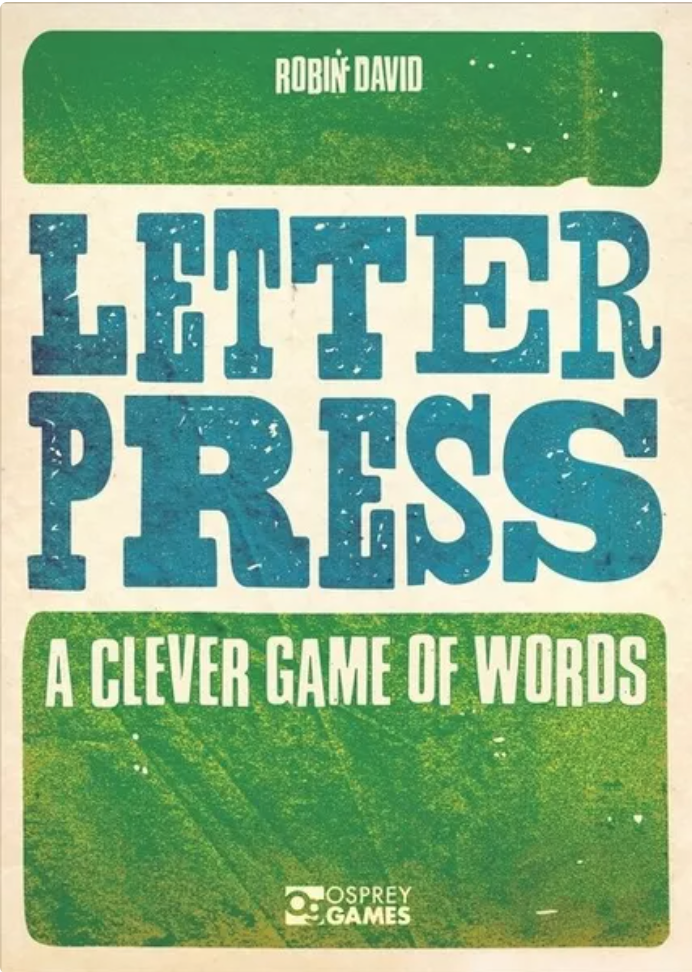

Letterpress is a word game played over five rounds, where players collect letters over the first four rounds for the final showdown in the fifth.
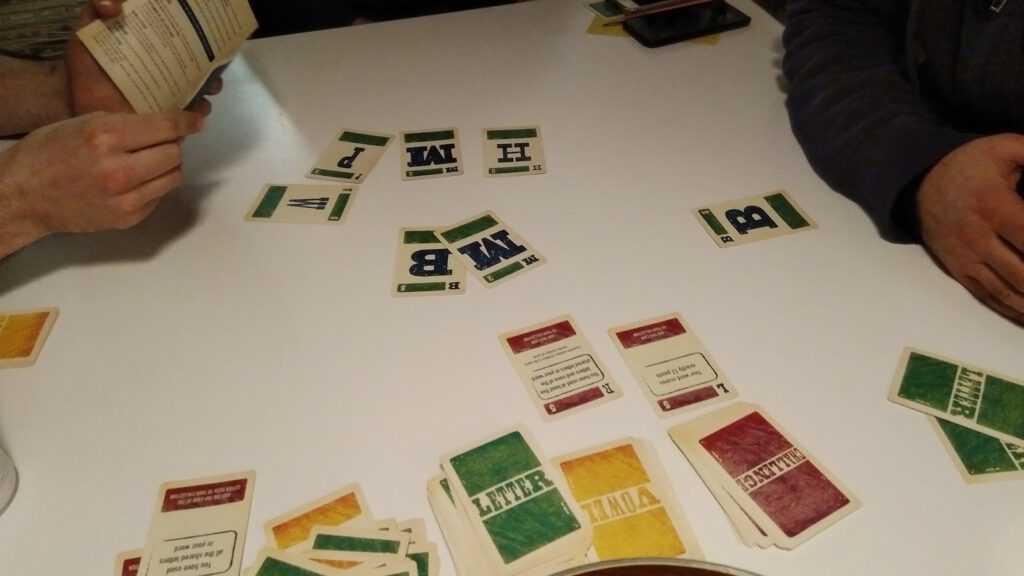
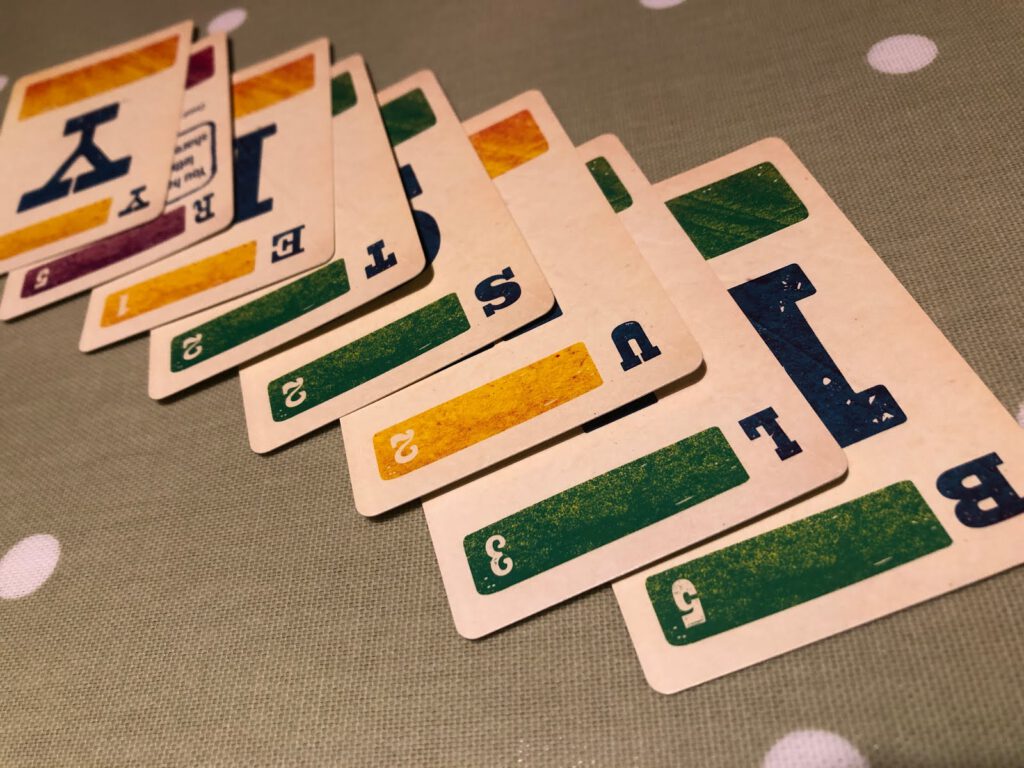
The above sentence really does most of the explaining! In each round one yellow Vowel card is laid face-up along two green Letter cards (the Letter card deck contains vowels as well). Players are dealt a hand of five letter cards and then draft them: keeping one from the five and passing the remaining four to your left, then keeping one from the four and passing the remaining three and so on until the final card is passed, at which point play begins. In each round you attempt to make the highest-scoring word you can using the letters in your hand and the three shared letters on the table – note that each letter has a point value, so the longest word is not necessarily the highest-scoring.
Letterpress also allows you to duplicate a letter in your word, as long as it goes next to itself: for instance the cards LETER could become LETTER instead. The ‘ghost’ letter doesn’t score any points, but it does allow you some more flexibility as to what words you create.
Once everyone is finished making their word, all are revealed and the highest-scoring player takes two (their choice) of all the played letter cards in the round and puts them aside for the fifth round: this is called their collection. All the other players take one letter each. Then new shared cards and new hands are dealt for the next round, and this continues until round five, when the shared cards are laid on the table… but instead of being dealt a new hand, players now use their collection to compete with. Winning the previous four rounds puts you in an excellent position, but it’s not a cast iron guarantee of winning the game, and surprises at this point are part of the joy of Letterpress.
We’ve left out one important thing though. In rounds one to four, there are also three purple Challenge cards available for players to claim: they might be for a word that scores a specific point value, a word that uses a certain amount of letters, using all of the shared letters, and so forth. If you claim one of the challenge cards they add letters to your deck, and they’re a shrewd way of building your collection without necessarily winning the round in question. These are refreshed at the start of each round (except the fifth). The winner of the final round wins the game!
Sam says
Probably at its best as a two-player game, with more Letterpress can become staccato-paced – it only needs one person to ponder at length for the game to stall slightly. But – assuming you like word games, because if you don’t this is a hard pass – this is one of the best, comprising very simple rules with a miniature hand-grenade of a finish, where someone who lost every preceding round can still pull off a dramatic win. I like it a lot, and have played numerous times over the years (a previous editi0n, Movable Type, dates from 2016). A rich vocabulary does no harm, but because you’ll have at most 8 letters to work with – and sometimes precious few vowels – it’s a word game that doesn’t throw up a barrier to younger players as well. Something of a gem, with a canny solo mode included in the box as well.
-

Take That!
You're engaged in competition, but interaction is very indirect: it's all about point-scoring and the most frustrated you could feel is being outscored. Which with the greatest respect you might better off playing something else if that annoys you!
-

Fidget Factor!
Low if and when players are computing at the same speed. But you should probably expect and be sanguine about the odd lull as someone searches for that elusive word...
-

Brain Burn!
The rules couldn't be much simpler, but the task at hand can feel crunchy: there are inevitably times when you know there's a word there somewhere, and you're scratching around for it in your head...
-

Again Again!
Letterpress is pretty much the same experience each time, but with variety and nuance under that umbrella: vowel cards, letter cards and challenge cards all come out randomly, and obviously there are tens of thousands of words to be found with them!


