
Life in Reterra
Designed by: Eric M. Lang, Ken Gruhl
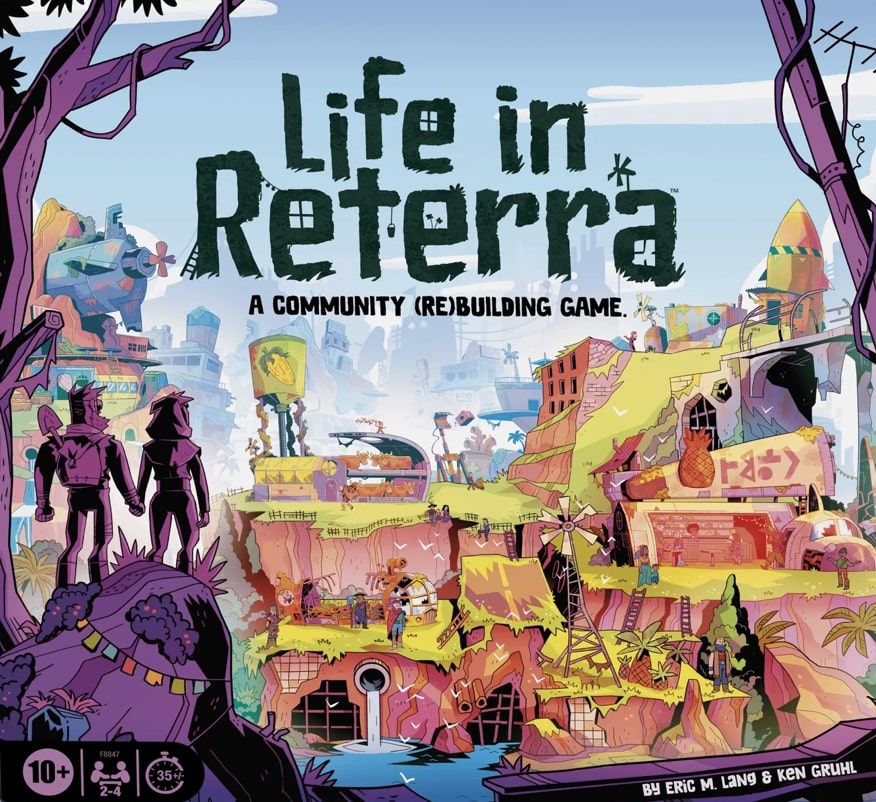
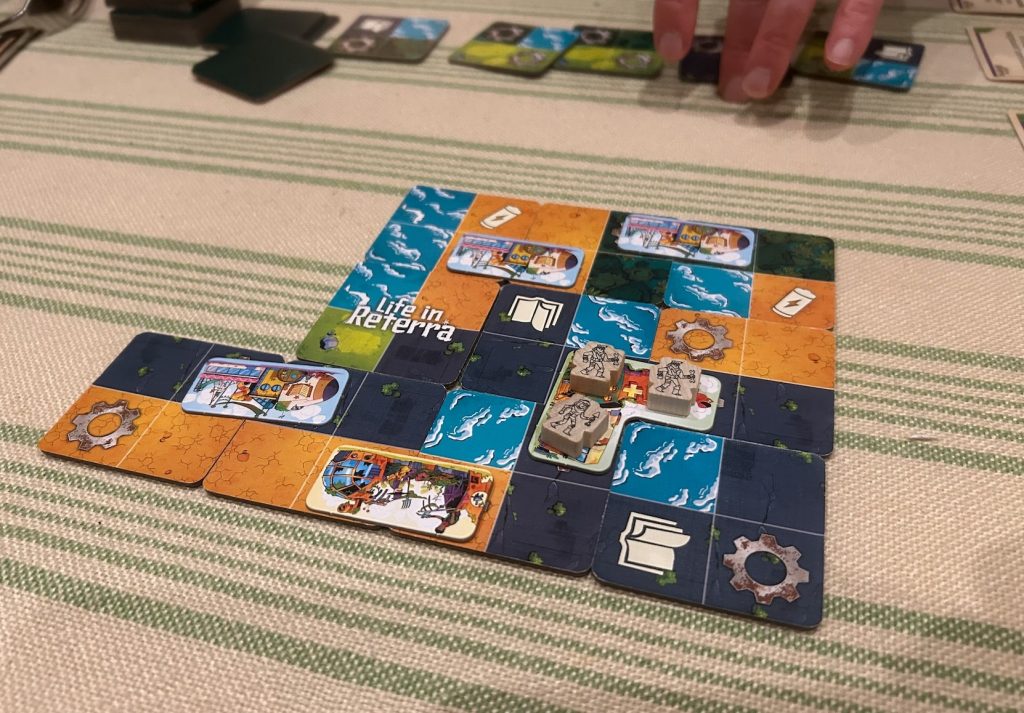


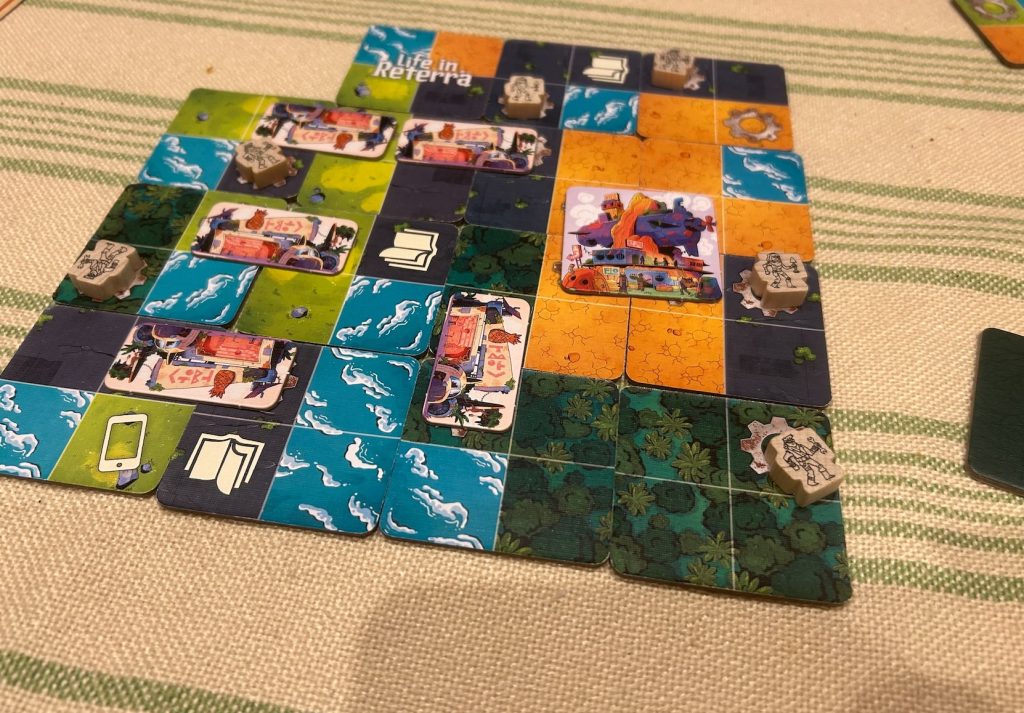
Life in Reterra is a tile-laying game where players take turns taking domino-styled landscape tiles to build their own, hopefully thriving, community. However, the buildings players can place are limited in number, meaning as well as a construction project, Life in Reterra is also a series of races.
You begin with one tile face-up as the start of your community, and three available in your own personal supply. Several more tiles are placed face-up on the table, from which players will, in turn, select one tile and add it to their own version of Reterra (alternatively, you can choose from your own supply of three tiles). Over the course of the game, each player will get 16 turns, building a 4×4 grid of tiles in front of them – and as you do so, many of the tiles will have Gears on them, which you can use in different ways.
You can always place an Inhabitant on a gear when you place it – nice and easy, with each inhabitant worth a point at the end of the game. But if you collect two or more gears in a matching terrain type, that allows you to build a Building on them, which have varying gear costs from 2 up to 4 (and 4 gears can be tricky to align!). Each game of Reterra will have different buildings – there are many – and we won’t list them exhaustively here. But be assured they are all about scoring points: for example, the Observatory is worth extra points if placed at the edge of your community, and the Infirmary allows you to add extra inhabitants if you have the space for them.
Cheap buildings tend to be more numerous, and more expensive buildings will have only one or two of them: the 5 gear buildings are particularly juicy.
At the end of the game, you score points for having large sets of the same terrains, energy source tiles (these pop up from time to time, but will only score if surrounded), relics (again, an occasional tile feature), inhabitants and buildings. The one feature you don’t want is junk, which players may inflict on each other during the course of the game. Most points wins!
Sam says
I like the presentation and the fact that Life in Reterra offers variety in the buildings, with thousands of combos lending slightly different flavours to each play. I like the simplicity and accessibility. It ticks a lot of boxes, but manages to do so without being hugely exciting or massively memorable. It’s all fine, but I don’t get the sense of invested designer love or intense player excitement that come with some other games. The similar but simpler Kingdom Builder, with its canny turn-order system of risk and reward, feels more accessible, engaging and interactive to me, although I would add that if you like Kingdom Builder and are interested in something not a million miles from it with a bit more puzzle to chew on, this could well be the one to satisfy you.
-

Take That!
Some buildings have elements of interactivity, but it’s not really the predominant feature of the game.
-

Fidget Factor!
Reterra is light enough that once familiar, you can rattle along at a decent pace.
-

Brain Burn!
A ticklish-enough turn by turn engagement is abetted by some strategy
-

Again Again!
So many different buildings does give Life in Reterra variable options on each play.


