
Luxor
Designed by: Rüdiger Dorn


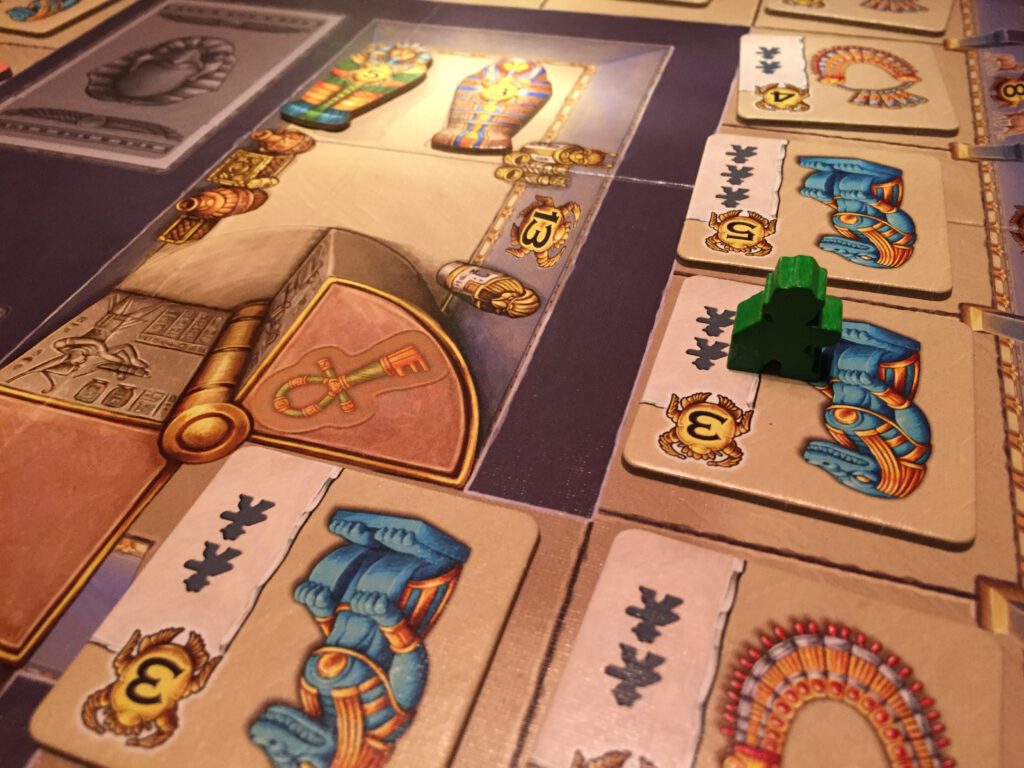
In Luxor players are adventurers, ransacking an Egyptian pyramid in order to come out with the most loot. It’s part excavation, part race, and all exploitation!
The board represents the inside of the pyramid with a spiralling path to the tomb at its centre. At the start of the game various tiles are laid along the path, which the players will be trying to collect along the way: there are three types of treasure tiles (points per tile, plus points for each set) as well as a few other special tiles. Also along the route are extra adventurers you can trigger – when one of your conscious adventurers passes these dormant ones, they ping back to life – returning to the pyramid entrance where they’re at your disposal. Which is important, because movement is key in Luxor – a few tiles can be collected by a single adventurer, but many require you to have two or even three present before you can claim the tile. And how you move is what makes Luxor interesting.
Each player has five movement cards. Importantly you’re not allowed to interfere with their position in your hand – you can only ever play a card from either side, and replenish with a new card into the middle. The movements vary from 1 to 5 spaces (some also give a die roll for movement!) so how you plan ahead and combine your currently-available cards with the upcoming ones is really key to success.
As some tiles are collected, new ones will take their place that allow the next adventurers to arrive to collect something juicy despite the treasure already being nabbed – scarab beetles score points, scrolls function as ‘jokers’ for your sets of treasure, and tunnels can allow lagging adventurers to catch up with the rest of the expedition party. Also on the path are places to pick up a key (you need one to enter the central tomb!) or special movement cards, which give you much more flexibility than the lottery of drawing from the movement deck.
The game ends when a second adventurer reaches the tomb – the current round is played out and then scores are tallied: beetles, keys (a solitary point each), treasures, and where your adventurers finished the game – by and large, further along the path is better – all contribute to your score.
Sam says
Luxor could have been a real plodder if all you did was trudge along a path picking stuff up. But the movement rules make it much more fun – a great, reasonably light family game that plays quickly, and a card system that allows interesting decisions without overwhelming you with choices.
-

Take That!
Very little - although as you get bonus points for reaching the tomb, there is a race element here. Someone will no doubt grab a treasure tile you were planning to pick up too, but it shouldn't feel too combative.
-

Fidget Factor!
Luxor moves along reasonably quickly.
-

Brain Burn!
You only ever have two card options, though in the latter stages of the game, you'll have more adventurers to potentially spend them on.
-

Again Again!
The tiles are laid out randomly, and you can't predict the cards either. As well as the light rules, Luxor does offer some strategy - race ahead, or take your time? Grab whatever you can, or try and plot a route that gives you sets of treasure (one of each kind) giving you a substantial bonus at the end of the game?


