
Maglev Metro
Designed by: Ted Alspach

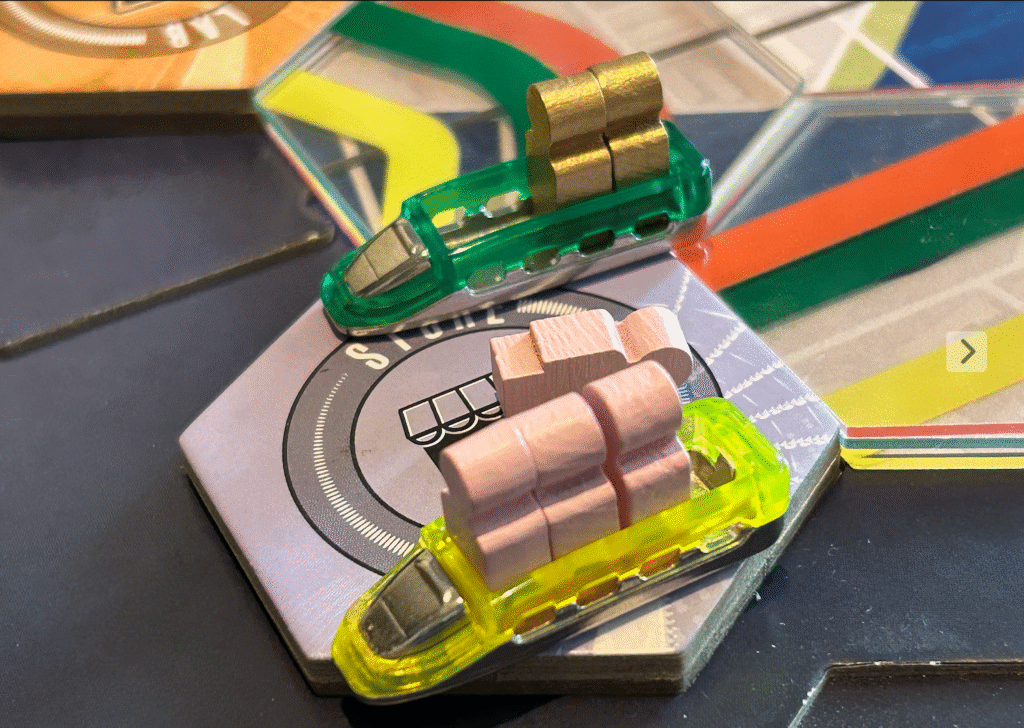


Maglev (magnetic levitation) is a gravity-defying train system used in various cities around the world. In Maglev Metro, players are building this high-speed track in either Berlin or Manhattan (flip the board for your choice). There are some small differences depending on which side you choose, but we’ll describe the Manhattan side here.
The board is basically a simplified map of Manhattan broken into hexes, with various station locations dotted around. Players begin with their own train in the Hub – a three-hex central location – and their own player board.
In essence, your goal is to pick up passengers of various colours (copper, silver and gold start on the board; other colours will be added later) and deliver them to the station of a matching colour. Whenever you deliver passengers, they get added to your player board and can be used to make your actions more powerful. You get two actions each turn so let’s look at what they are.
Build track is a matter of placing tiles on the board that show the development of your own route. You can also use a build action to remove them as well. There are restrictions here: the default is that you build a single line, so – apart from the hub, which provides an exception – you cannot branch off anywhere, but only continue extending the same route. Happily, players don’t block each other at all: the transparent tiles allow players to share spaces and build alongside or across each other. Move allows you to shunt your train along your line, in order to pick up or drop-off passengers. You can also refill a station with more passengers, drawn from a bag. You can reverse the direction of your train, which will otherwise always go the same way until it reaches the end of the line. But to do all of this, the players need to build stations in the first place…
Building a station has a couple of requirements. You need to have track already built leading to the location, and the ability to do so as defined by your board. At the start of the game any player* can build the copper, silver and gold stations and begin delivering passengers to them. As play continues, players will also be able to build the four other station types, unlocking the ability to both do so and carry the matching passenger types on their trains.
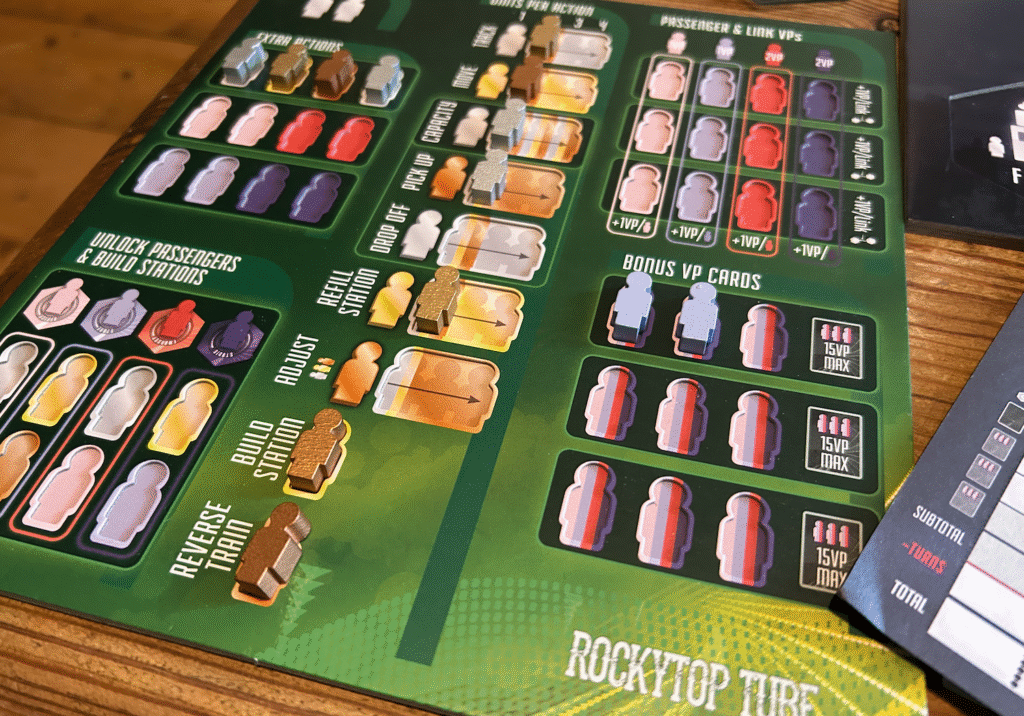
You can also spend an action to adjust where your passengers are on your board, choosing to devalue one action in favour of another. And remember, with all of these actions (except reverse and build) you begin with a basic power (eg build one section of track, move between two stations) but will be increasing their strength by adding your delivered passengers to your board. At the end of the game, you’ll score a point for every link you have built between stations, points for passengers you’ve collected and points for your highest-scoring bonus card: you’ll have 3 or 4 bonus cards and they offer different incentives from game to game: collecting passengers of a certain type, linking specific station types directly; having certain passengers on your board and so on.
Finally there are a heap of other spots on your board that don’t increase your action power, and at first the array of possibilities can look dazzling. But they’re reasonably simple: the left-hand side of your board is about (potentially) giving yourself extra actions each turn and developing the capacity to build stations (and deliver the matching passengers). The right-hand side of your board is all about scoring points at the end of the game. Passengers here will increase the value of your links and/or the value of your collected passengers, and allow you to score more than one of your bonus cards. The player with the most points is the winner!
*if you have followed the rulebook’s suggested set-up of where to place your starting passengers!
The Berlin side of the board dispenses with the hub and offers a more strategic challenge.
Sam says
Like so many railway games, there’s a slight gap between what feels thematic – building track, moving trains, delivering passengers – and the abstraction that a game demands in order to function. Maglev Metro sometimes feels a bit quirky in the latter regard, and a first play can require a bit of patience as you navigate the various spaces on your player board and come to understand what they all mean. But things pick up speed as you do, and on a second play you may find things are racing along as decisions form out of the fog. I’m a sympathetic audience to train games, and I really enjoy this one.
-

Take That!
There's no direct interaction in Maglev Metro, but players can certainly sneak ahead of each other to nab passengers at opportune moments.
-

Fidget Factor!
First play fidgets? A lot of turns are super-fast. Sometimes someone may need to compute their options.
-

Brain Burn!
The Manhattan side of the board is largely tactical, although the bonus cards you get also give some strategic direction. The Berlin side is a bit thinker.
-

Again Again!
Although there isn't a huge amount of inbuilt randomness, player decisions keep things interesting. There are also more boards to be found from publisher Bezier games (although they're not cheap).


