
My Island
Designed by: Reiner Knizia
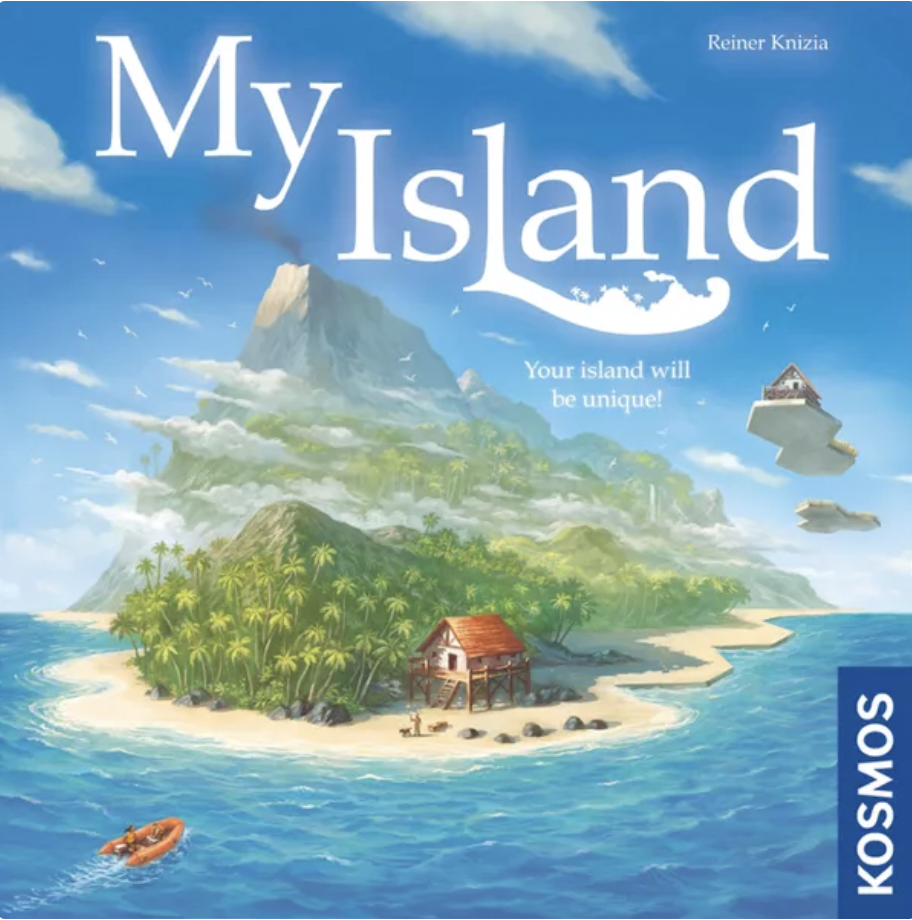


After the geometric puzzling of My City and its Roll & Write sibling, designer Reiner Knizia ramps up the challenges with My Island. Where once were Tetris-like tiles forming your city, now there are hexagons asking new questions of you.
Like its predecessors, My Island comes as a campaign: a series of relatively brief games that come in chapters of three, with eight chapters forming the entire game. The first game is simple: you arrive on an island (your personal board) and start populating it with your personal tiles; which tile being decided for everyone by the flip of a card. Everyone must place the same tile, but players will be making their own decisions as to where on their own boards – the only restrictions at this point is that you cannot cover up the rainforest, and – throughout the entire campaign, in fact – each tile must be placed next to a previously-placed tile so that the landscapes (houses/paths/fields/walls) match. For this initial play, you score points for houses on the beach and lose points for any beach left uncovered (you can optionally not place a tile, but this also costs you a point). Simple!
But like its predecessors, each subsequent game introduces new ways to score. None of them are complicated, but the net effect of all the different avenues to points levels up the complexity of the puzzle, if not the rules. We won’t go into them all here as to do so would amount to spoilers – each chapter is contained in an envelope, and let’s just say the island is not quite as harmless as it first appears. From the humble beginnings, My Island slowly adorns itself with new components in stickers, cubes, new cards, new tiles and so on, until the innocent days of game one have incrementally found themselves replaced by a considerably brow-furrowing puzzle!
Winning an individual game gets you two progress points, which you track by literally marking them on your board. There are other ways to occasionally earn these points, and occasional consolation prizes for the losers. After the final episode has been played – it’s hopefully clear by now that all 24 episodes would be played by the same players – the player with the most progress points gets the overall win.
Sam says
Honestly, for me My City was more fun for being lighter and breezier. But I enjoyed My Island a lot on its own terms, which are slightly more taxing on the brain cells. Gladly, that tax isn’t the rules though, but the gathering plethora of ways-to-score pulling your attention this way and that and making you agonise over decisions! The way the game steers you in is so gentle and easy as to feel almost deceptive by the time you hit the bonanza of opportunities in chapter 4. But it’s also genius in that the core of place-a-tile next to a matching landscape never changes. The decisions themselves, however: that’s a different matter.
-

Take That!
There's no direct interaction with the other players.
-

Fidget Factor!
Everyone's turns are simultaneous, so the occasional lulls are - in the latter games - when someone is trying to work out the best place for a particular tile. In our two-player games we've generally played around the same speed, but certainly there've been moments when a bit of patience is a nice addition...
-

Brain Burn!
...because the brain-burning nub of My Island is how, as the chapters ramp up, the various ways to score (and/or lose) points overlap, tempt you in different directions, and require you to gamble, or not: a certain tile coming out before another one would be a huge help. But do you want to risk it?
-

Again Again!
The universal side of the board (which never changes) is still fun, but doesn't have the ongoing narrative element of the campaign. So each box contains '4' plays of the campaign that could do once for a party of three or four, or twice for 2 players.


