
New York 1901
Designed by: Chénier La Salle
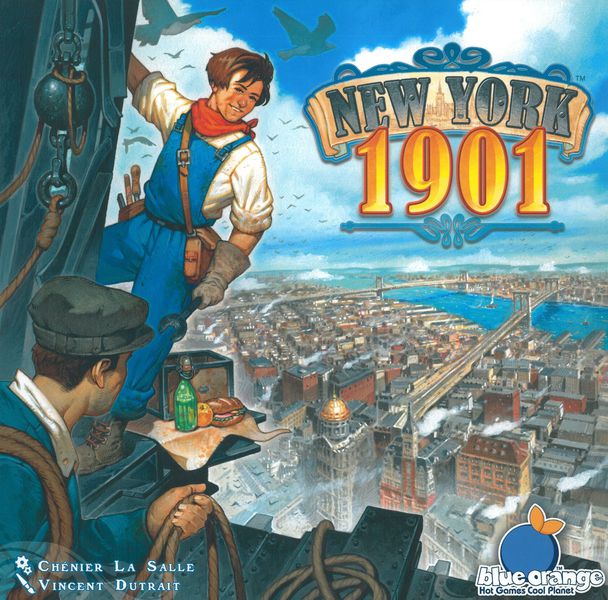
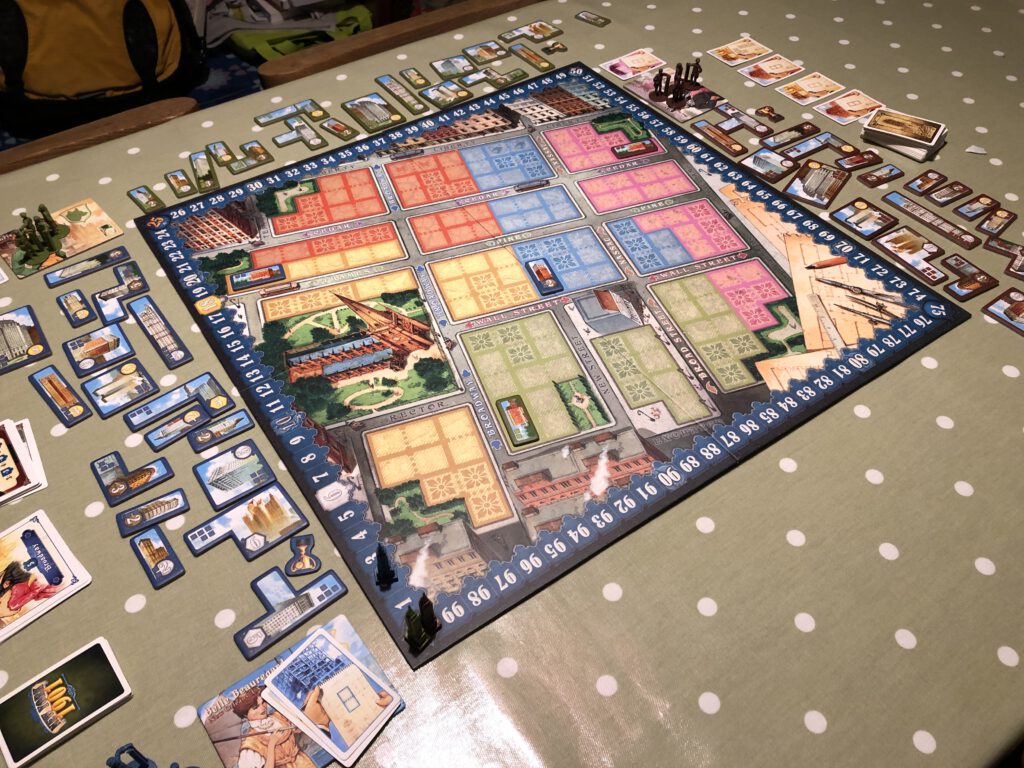
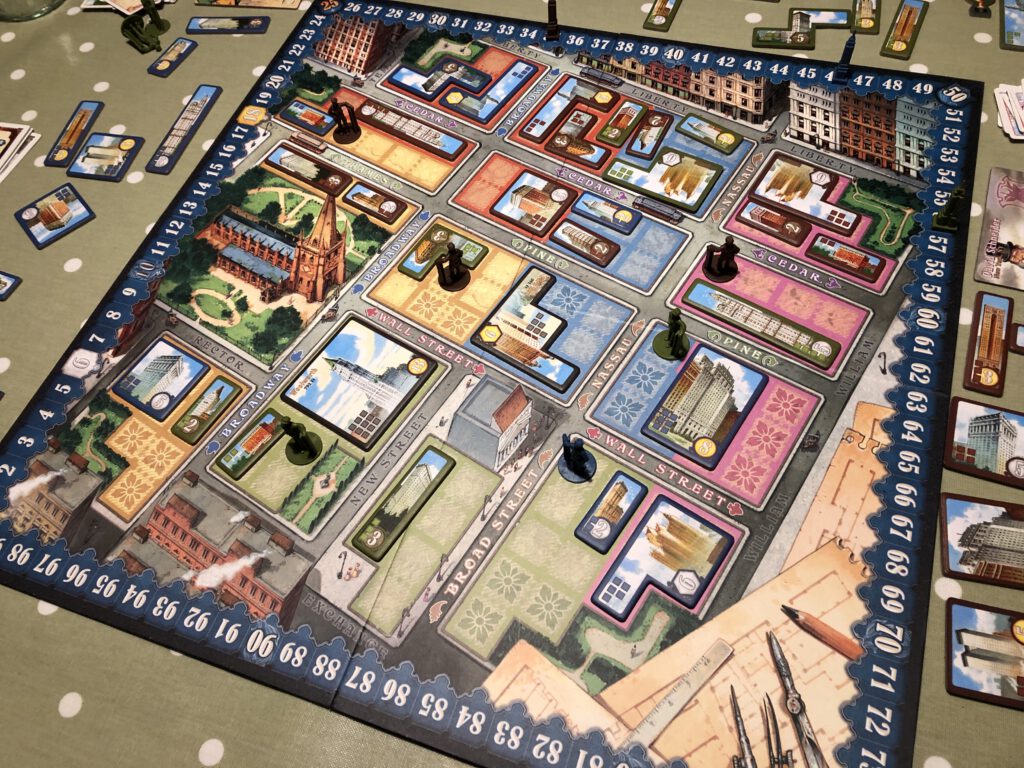
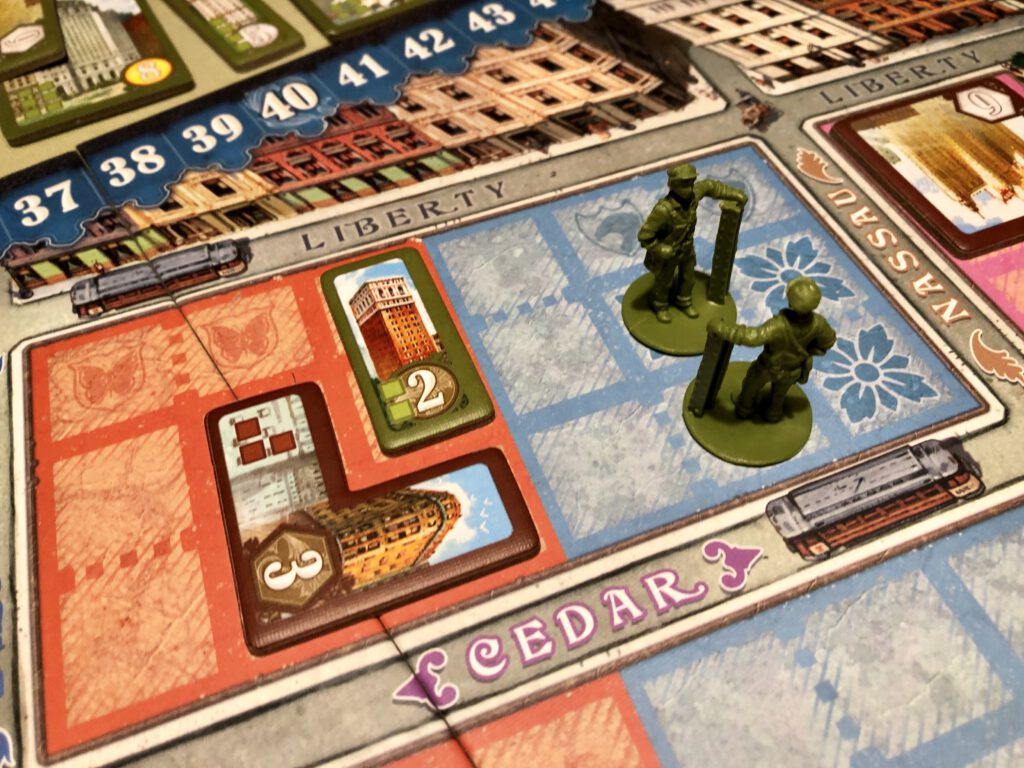
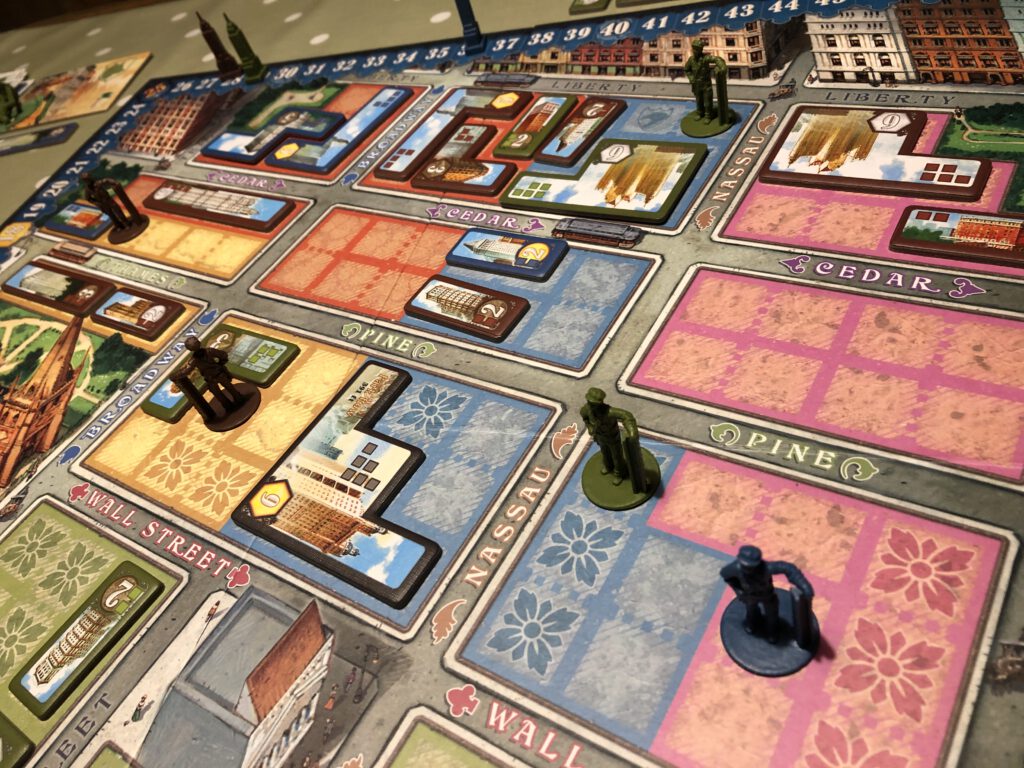
It’s New York, and it’s 1901. Why that specific year? Because you, the players, are seeing in the new century in the only way westerners found acceptable at the time – by building skyscrapers!
The board shows New York itself – or part of it – with the blocks on the map vacant and ready to be built upon. Everyone takes possession of four workers and their tetris-like skyscraper tiles, and places their starting skyscraper on the board. Four lot cards are flipped face-up and the game begins.
How New York 1901 plays is actually rather simple – on your turn, you acquire land by taking one of the face-up lot cards and place a worker in the matching colour – there are several on the board; some tiles are patterned and need a matching pattern on the lot card. Then you may (if you want to) build; removing a worker or workers from the board in order to place one of your tiles into the lots they had claimed. Crucially, you cannot overlap with any other lots, whether unclaimed or occupied by an opponent. Whenever you build, you score points! And as you move up the score track, initially only building the basic (copper) tiles, you’ll trigger the ability to score better tiles (silver) and best tiles (gold). So there is a decision to be made between some points now or more points later, as the more workers you have grouped together, the bigger and better skyscrapers you can build.
You should also factor in the legendary skyscraper tiles – there are four of them, and each player can only build one per game by taking the demolish action. This allows you to remove previously-built skyscrapers in order to plonk a legendary (big points!) skyscraper in their place. Again, there’s a catch: you can only remove ‘inferior’ buildings, so legendary skyscrapers may only be built on silver and/or copper buildings, not gold. And you can only take the demolish action if you can subsequently build on the same turn, so you need a worker elsewhere on the board.
If you ever start a turn with no workers available, you simply skip the acquire step and go straight to build.
Finally there are some wrinkles that give the game extra dynamics: everyone has some bonus action cards they can either cash in or keep for a point each at the end of the game, certain streets on the map are worth bonus points if you’ve built the most skyscrapers there, and each game will have just one of several bonus challenge cards that also – potentially – score points for the player who has met the criteria most successfully – once everything is tallied, the player with most points is the winner – and the tallest legendary skyscraper will break ties.
Sam says
A rules-light game suitable for families – kids can play and grasp the strategies easily enough, and the decisions are weighty enough to keep adults engaged. You need to be ok with the spicy element here – like Ticket to Ride, spoiling tactics are readily available and the game is probably at its best when they are embraced! But if you’re okay with that then it’s a neat game – relatively abstract; more puzzle than story – but one with simple enough rules to entice more or less anyone in, and enough variation to merit repeat plays.
-

Take That!
Although there's no direct interference, New York 1901 is a race of kinds where space is premium - and it may be in your best interest to block a space and prevent someone from building big there...
-

Fidget Factor!
Low. There's very little luck in the game outside of the lot cards, and there's only ever four at most to choose from. That said...
-

Brain Burn!
...the dilemma is a juggling act of furthering your own plans or interfering with your opponents'. Factor in the street scoring and the bonus challenges and although the rules are light, decisions are meaningful.
-

Again Again!
The order of lot cards, the street cards and the bonus challenge cards all change from game to game - as can your strategies. It's more a multiplayer abstract game than a strong narrative, but it's light and doesn't outstay its welcome.


