
Odin
Designed by: Gary Kim,Hope S. Hwang,Yohan Goh

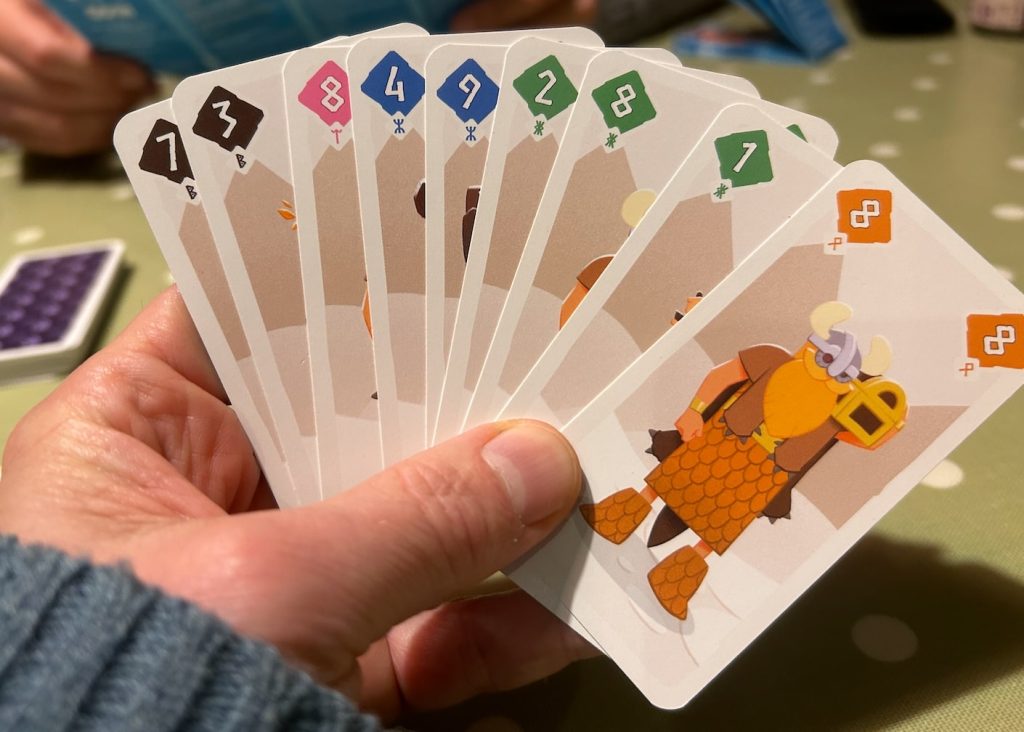
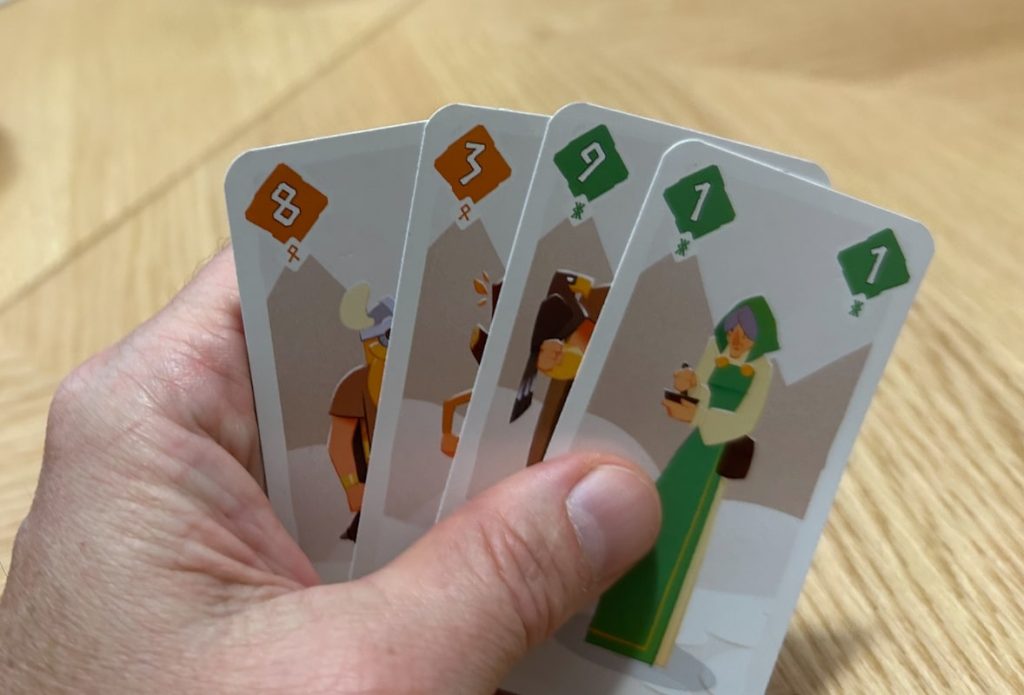
Odin is a very simple card game, officially playing up to six players, but probably best with 3 or 4. In each round, you’re dealt a hand of cards and trying to be the first player to shed your entire hand. The starting player must play a single card, but after that players may either play a higher single card, or two cards of a matching suit or number: for example you start with a 9, a reply with a 33. Following players can always add one extra card if they choose, but the number the cards make must always be higher (to continue our example, someone follows the 33 with 53 (a 5 and a 3 of a matching colour) then the next player jumps to three cards, playing as always matching colours or numbers. Optionally you may pass – and if you cannot go, you must pass. If everyone passes back to the active player, the cards are moved to one side and a new turn begins.
The catch is that whenever you beat the previous number, you must add one of the beaten cards to your hand. This can be a pain – but it can also be a helpful route to building big numbers. As soon as one player plays their last card, everyone else scores a negative point for each remaining card in their hand, and a new round begins. When anybody hits a certain number of points – how many depends on the number of players – the game ends, and the player with fewest points is the winner!
Sam says
Odin is the poster-child for simplicity. While the rules are very accessible, there’s enough going on here to keep you interested in decisions: both yours and others. If you’re leading a new turn and you only have matching colours or numbers, then you’re allowed to break the single-card-leads rule and play them all. This leads to some surprise endings as people lay out something in the thousands, or even tens of thousands! I’ve enjoyed this with 2, 3 and 4 players. With 5 it starts to get a little stretched, but if folks are playing speedily enough it’s still good fun.
-

Take That!
The only painful moment is when you’re poised to go out and then someone else does.
-

Fidget Factor!
It’s not as fast-moving as Uno, but it’s hardly ponderous
-

Brain Burn!
There are decisions to be made about what your future hand consists of, or whether to risk passing. But nothing onerous.
-

Again Again!
Whilst Odin is very simple, the decisions are big enough and interesting enough to keep you engaged for multiple plays over time.


