
Perfect Mismatch
Designed by: Alexander Peshkov
Perfect Mismatch is a party game of giving and decoding clues across a series of wildly abstract spectrums. If that sounds crazy – well, it is. You can play the game in one big group co-operatively, or competitively as individuals. We’ll describe the co-op game here.
Players take turns being the Leader, and it’s the leaders job to clue one of six words randomly chosen from a Task card. Let’s say you’re the Leader, and you end up with the word Swamp. Everyone can see the task card and the five words, but nobody knows which one you’re clueing.
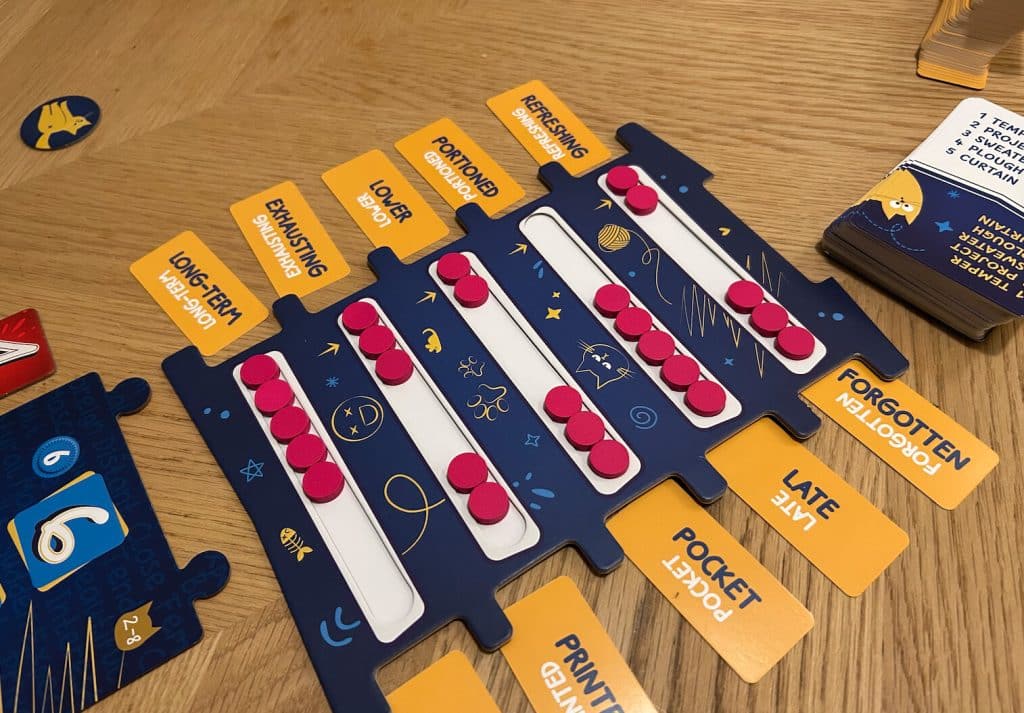
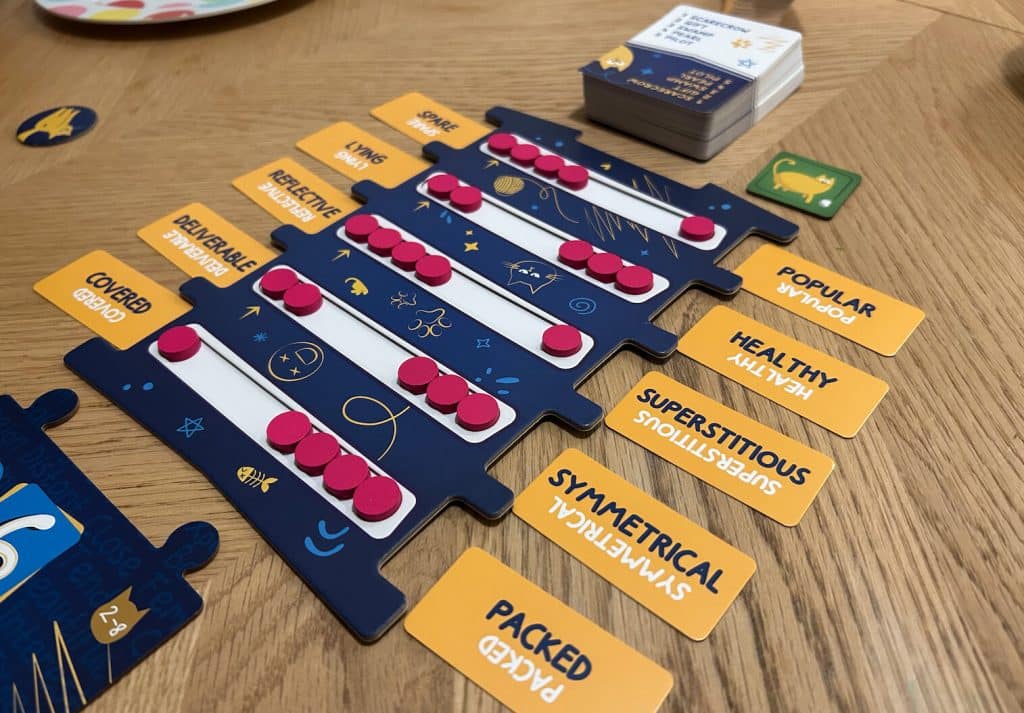
On the board are five slots with Attribute cards – adjectives – at either end, with six beads between each one. Your challenge is now to decide where the beads go in each slot, dividing them up between the attributes in a way that you hope will lead your fellow players to your chosen word. In our swamp example, if the two attributes are rigid and wet, it makes sense to push all the beads over to the ‘wet’ side of the slot. Swamps tend to be wet, and aren’t known for their rigidity. But often the attributes are much more abstract. Maybe the slot words are dishonest and frantic – where does a swamp fall on that spectrum? Perhaps you feel that a swamp is more dishonest than frantic, because it’s deeper than it appears. Or maybe frantic suggests itself more because that’s how you’d feel if you fell in one. Either way, you might want to split the beads up here, pushing some towards one attribute and some towards the other.
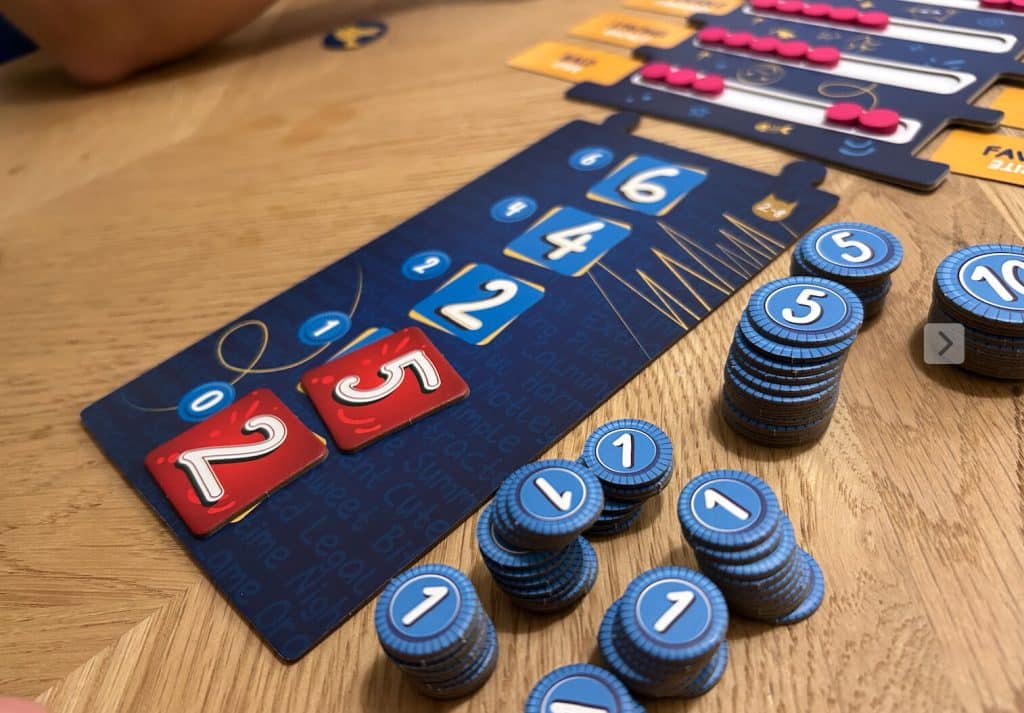
Once you’ve done this for all five slots, you must now stay poker-faced whilst the other players discuss what they think you’re trying to say, placing their Voting tokens on the Voting board to show which words they favour over others: basically, ranking their guesses from first to sixth, and the more accurate they are, the more points you collectively get. After a set number of rounds the game ends, and the rulebook tells you how well you’ve done based on your points haul.
The competitive game plays similarly except everyone gets a single guess and there’s a real-time element: as soon as you think you know the word, place your voting token on the board. In this version voting sooner is – if you’re correct – worth more points. But if you’re wrong you score nothing: your token is removed from the board and any tokens beneath it slide up. So if for example you placed your token last but you were the only person to guess correctly, you’d score maximum points! And the player with the most points at the end of the game is the winner.
Sam says
This is quite bonkers, which I like: is a plough more late or forgotten? Is a hat more honest or confident? For some this assigning of random qualities may be too opaque, inscrutable, or unwieldy. There are quite a few games that explore this space really well – Wavelength and Just One come to mind – and they’re undeniably more accessible. But I enjoy Perfect Mismatch for its slightly deranged embrace of this weird brainspace, where the clue-giver has to use the least-likely words to describe a thing, and the guessers have a decoding job that would have baffled Turing.
-

Take That!
None
-

Fidget Factor!
Very low
-

Brain Burn!
Whilst the rules are simple, the game's puzzle is really about how to correlate words that don't appear to have any correlation at all. Is a banana loyal? Does bread inspire? Are schools purple?
-

Again Again!
There's a big stack of double-sided attribute cards, and an even bigger deck of Task cards. The chances of a similar same set-up are astronomically unlikely.


