
QE
Designed by: Gavin Birnbaum

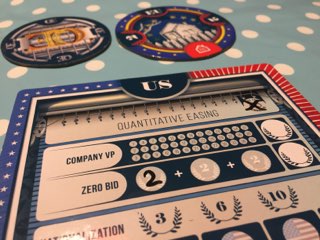

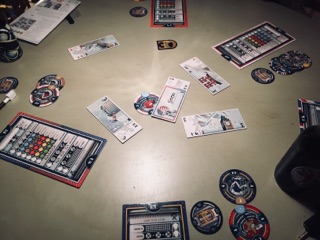

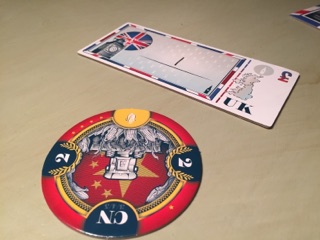
Quantitative easing doesn’t sound like the greatest premise for a game (maybe that’s why they went with the snappier QE) but then neither does monopolisation, and that’s done okay for itself.
Here the players represent central banks, willing to print money (for that is essentially what quantitative easing is) in order to save industries that will otherwise go bust. In each turn, an industry tile is flipped over and the current player is the auctioneer. They set the starting bid; writing it down and showing everybody. Then all the other players bid too, writing their own bid secretly and handing it to the auctioneer, who looks at all the bids (again, secretly) and announces the winner – but not the bid itself. That gets written down on the industry tile itself for later reference, and then the auctioneer role goes to the next player clockwise, and the process starts again. Bear in mind, you can bid lower than the starting bid if you don’t want the tile, and in fact can even earn points by doing so, as while not printing money won’t get you the industry up for auction, it doesn’t actively weaken your economy either.
The industry tiles have three different values: a straightforward point value between 2-4, a type of industry and a country they belong to. At the end of the game you’ll score points for industries that match your country and additional points for having either diversified or specialised in a particular industry: the more diverse/specialised the better, so if you start to diversify it doesn’t pay to change strategy midway through the game!
The gigantic catch with quantitive easing – and indeed this game – is that if you print too much money and flood your country’s economy, the currency is devalued to the point where the economy collapses. So while you can print as much cash as you like – literally; there is no ceiling at all – if you end the game having spent the most, your point score is irrelevant: you’ve gone bust and are in last place. What results is a curious game where a big-hitting industry might go for 80 money, and a less-alluring one go for several thousand or even million come the final round of the game.
Sam says
A game that’s easy to learn but nigh-on impossible to master thanks to how much the players bring to the table. Originally only available as a handmade, wooden object, it’s now had a more accessible (and more affordable) print run on card, and I’m glad. It’s oddball, tricksy, nasty and funny all at the same time.
-

Take That!
There's the potential for a lot of table talk and semi-threats of high bids as bluffs, but outside of that sense of hustle there's nothing to force your hand or steal your hard-won industries.
-

Fidget Factor!
Low. Sometimes somebody might need to think about their bid or even if they want to bid at all. But it's the type of game where hassling them to get on with it feels like a bona fide part of the experience.
-

Brain Burn!
Rules-wise QE is light. In terms of implementation, it's about hitting that mark of spending just enough not to be the most-profligate player, but not going over the top. A balance of caution and nerve.
-

Again Again!
Once you've played QE once you pretty much know its intricacies, but what you cannot predict is how the game will play out from game to game: shaping that experience falls to the players themselves.


