
Quorum
Designed by: Fran Martínez Rosa, Raul Franco Jiménez
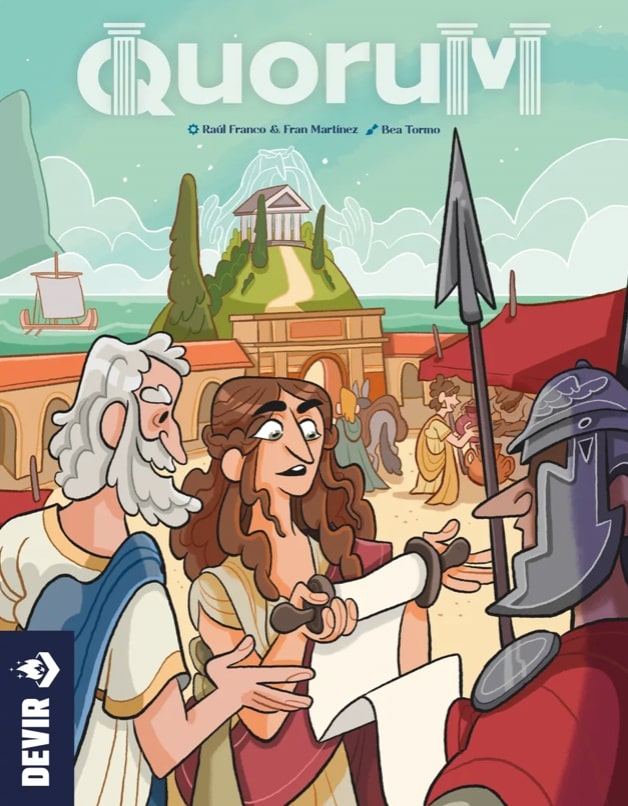
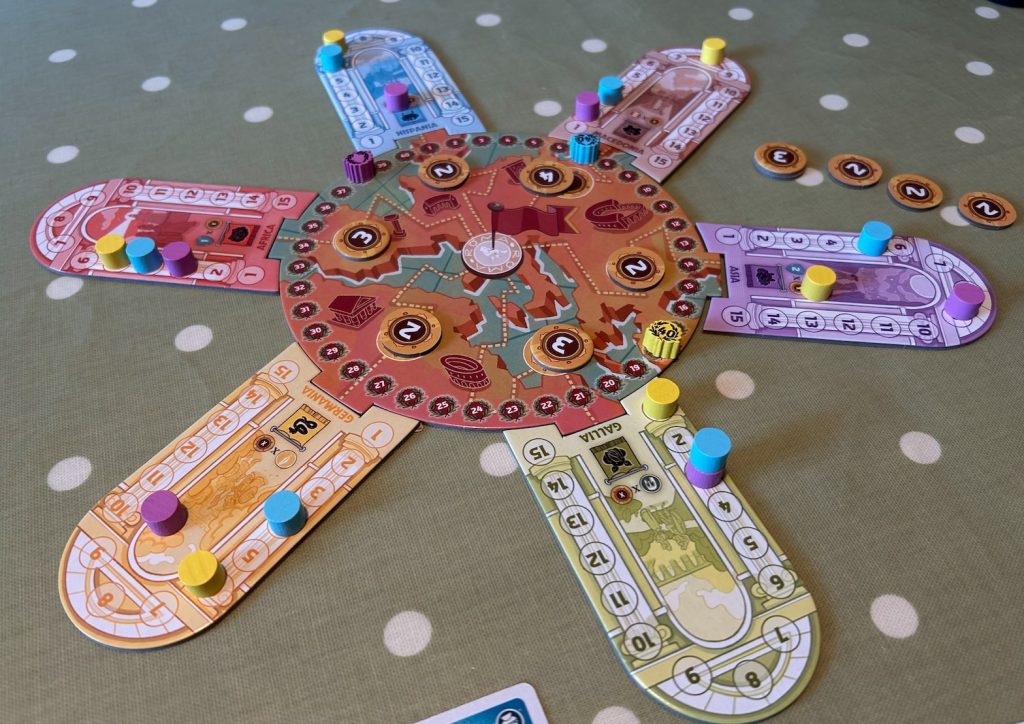
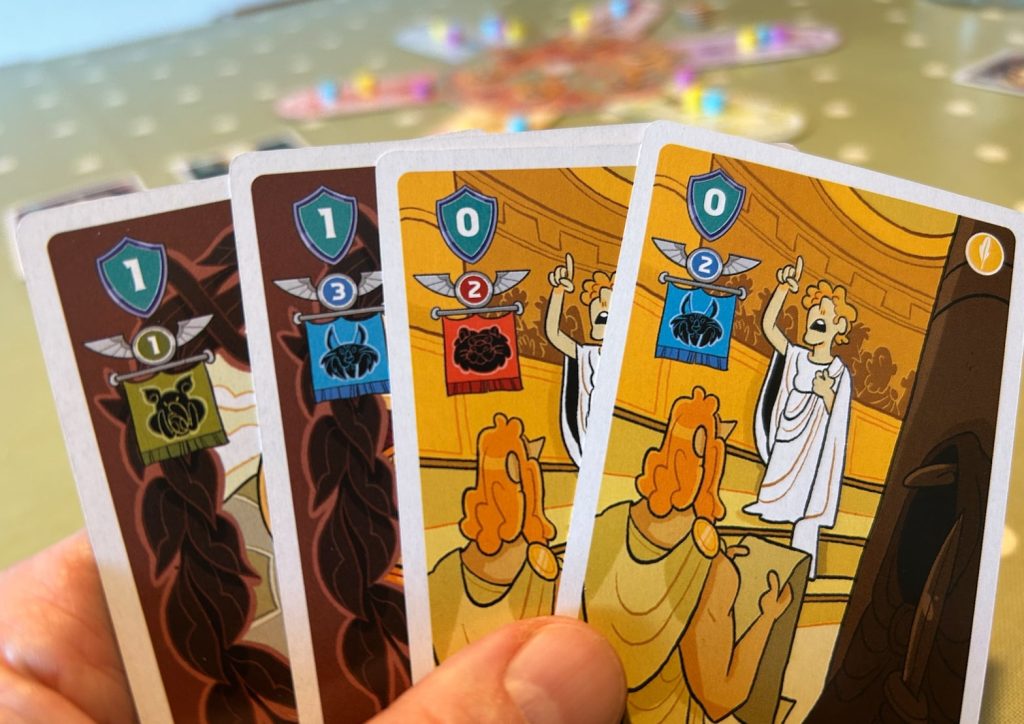
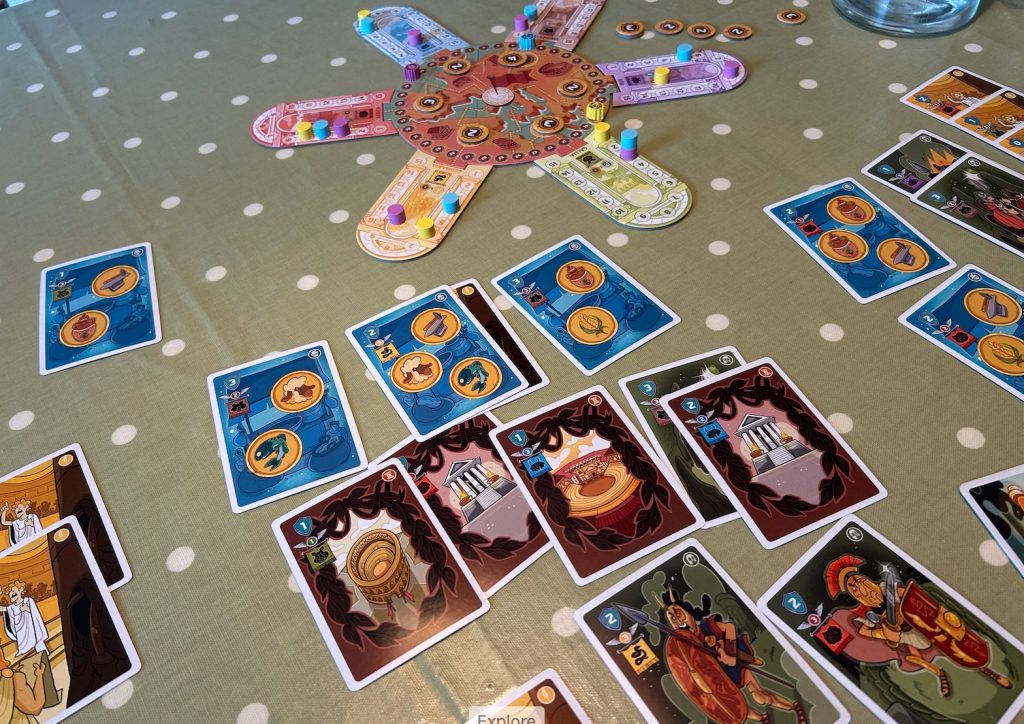
In Quorum, players are Senators fighting for influence over the Roman empire. Over the course of just 12 turns, you must propagate your power in the various aspects of empire, both home and abroad.
The board is set up in the middle of the table with the six Regions – basically a series of tracks – assigned to it randomly, each with a starting value of 2. Players put a token in each region and are dealt four cards each, before five are dealt face-up into a communal display, and the game begins. (Note: 14 God cards are shuffled into the deck after set-up)
Each of the twelve turns consist simply of taking a card from the display, and then playing a card to the table in front of you. Each card has a region value that will push your marker up one of the six tracks representing regions, and being first in a region is – potentially at least – good, for reasons that will become clear. But the value of each region – starting at two – can be manipulated down as low as one, but up as high as four. How to do that?
Nestled amidst the deck are the fourteen God cards. If you take a God card from the display it’s always activated immediately, allowing you to shuffle up the track on a region of your choice, and then manipulate the values of the two regions either side of it. The downside of God cards is they don’t leave your hand, and narrow down your choices as a result.
When the game ends – after the twelfth round – players score each region track dependent on both their position on it, and the 12 cards they have in front of them:
Each region will multiply its attendant value (1-4) by the number of a certain type of card you have: for example, Asia will multiply the number of cards you have with a power of 2, Gallia will multiply your green military cards, Germania will multiply your yellow Intrigue cards, and so on. For the second-placed player on the track, it’s the same process, but the region value decreased by one, for the third-placed player it decreases again, and so on.
But cards, with a Power value between 0 and 3, score in other ways too, independent of the regions. Military cards score in sets and runs, Trade for matching articles of the same type, Architecture for different types, Intrigue cards score their number multiplied by the number of Power 3 cards you have. After all the scoring is totted up, the player with the most points is the winner.
Sam says
In isolation neither the region scoring nor the set-scoring are too onerous, but put together they do give players quite a lot of possibilities to hold in their heads. I think I understand why Quorum has done this – depth, variability, replayability, whatever you want to call it, as well as the possibility that a surprise winner can come from behind after doing poorly on the tracks – but there are so many overlapping ways to score that I feel the pace of play suffers as a result. It looks and feels like a half-hour game, but if anyone is striving to play optimally, it may run around twice that length, most of which will be spent scrutinising and calculating. I certainly get the sense that the more I would play it, the slower it would go, and I’m never going to be able to hold all the ramifications of each card, set of cards, set of symbols, track placings etc in my head in a way that feels closer to playful than administrative.
-

Take That!
The only interaction that gets close to direct is on the tracks, but these are races, not fights: no-one will be moving your marker but yourself.
-

Fidget Factor!
Manageable with two, but ramping up for every player you add.
-

Brain Burn!
The core challenge is keeping in mind the multiple ways to score and selecting the best availble option.
-

Again Again!
While Quorum isn’t a game that appeals to me, I can see from its intricacy how it will sustain itself to those who enjoy its spidery scoretrack tendrils.


