
Qwinto
Designed by: Bernhard Lach, Uwe Rapp
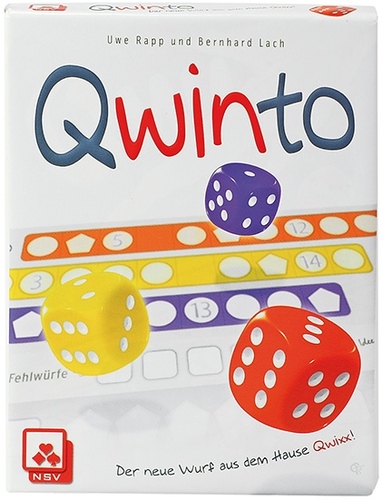

Qwinto is a game of rolling dice and pushing your luck.
Each player has a sheet of paper with three rows – orange, yellow, purple – you’ll be filling in with numbers by rolling the three dice: orange, yellow and purple! On everyone else’s turn you can choose to add a number or ignore it. On your own turn you must add a number somewhere (though you may reroll all the dice once if you don’t like the result) and if you can’t legally do so, you mark up a forfeit instead.
You can add a number anywhere you like in the rows, as long as you follow some basic rules: each row must have numbers in ascending order, from left to right. When a number is added to any row, it cannot match any number directly above or beneath it in the other rows. The pentagonal spaces (there are only a few) will score their face value at the end of the game if the column they’re in is complete, whereas the rows themselves score in the following ways: if a row is complete, then you score the number value of the space furthest right. If it’s incomplete, you score a point per space you’ve filled in that row.
You can allow for filling in the left-most (i.e. lowest) spaces by rolling just two, or only one, dice, but if you do so you can only add a number into a colour row that matches the colour of the die/dice you just rolled. As the game goes by, it gets harder and harder to fill your spaces!
As soon as at least one player has either completed two entire rows or taken four forfeits, the game will end. Beware those forfeits – each one is -5 points!
Sam says
Qwinto’s rules are very accessible, but it’s not a completely mindless luck-based thing. To be sure, there’s a wide seam of chance running through it, and your control over it is rapidly dwindling, but that’s kind of the point. It’s 15 minutes of fun, and that kind of timeframe suits it.
-

Take That!
It's certainly possible to peer around the table, see what the other players desperately need, and choose dice to minimise their success. But to be honest it's far more likely you're caught in the closing net of your own circumstances.
-

Fidget Factor!
None - play is simultaneous and pretty simple.
-

Brain Burn!
Rules-wise the brain-burning is all but non-existent. The only thinking time here is about how safe or risky you want to play.
-

Again Again!
It's kind of a one-note game, but a fun one all the same. The dice are obviously random but there's some decision-making too, and the real juice in the game is the tension of hoping you'll roll what you need when your carefully laid plans begin to unravel.


