
Ra and Write
Designed by: Reiner Knizia
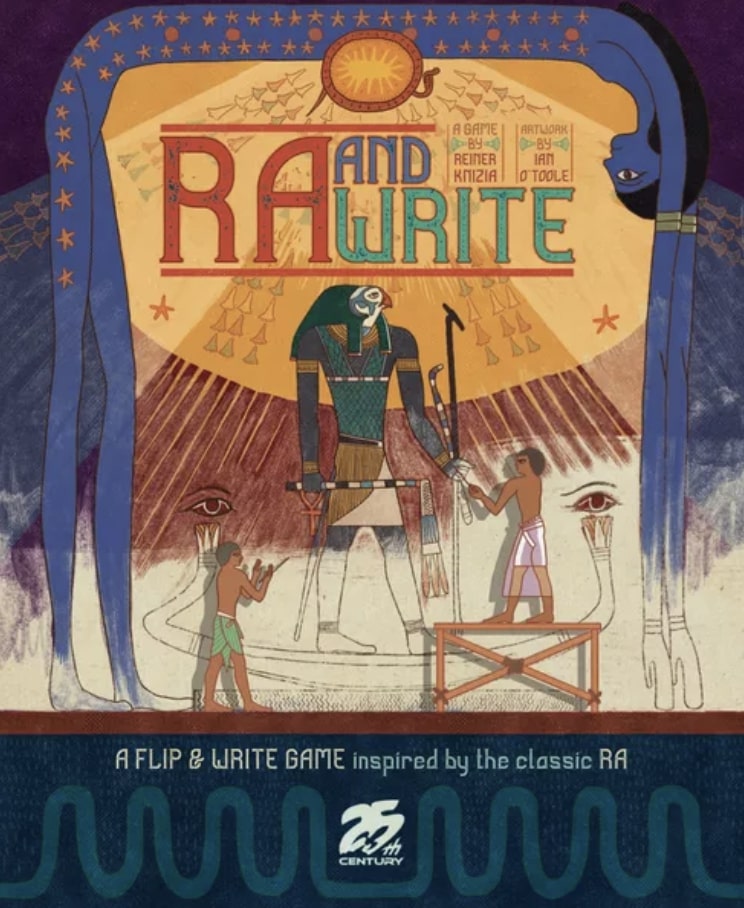
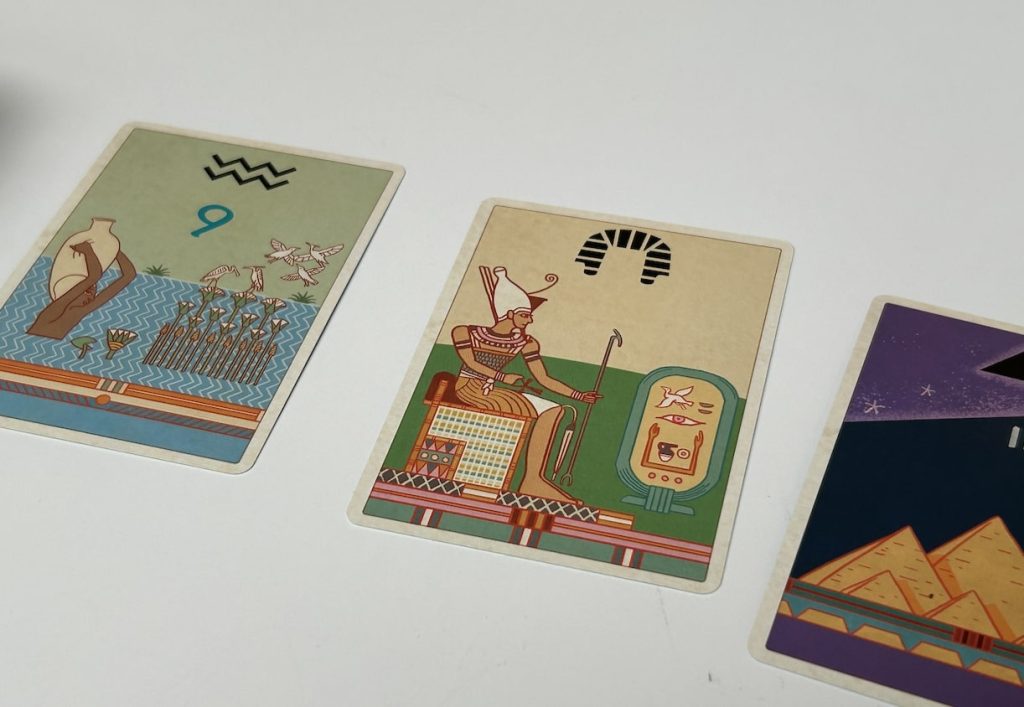
Ra and Write is so-named because it’s a spin-off from big sibling Ra. But whereas the original was completely driven by auctions, Ra and Write is a simpler beast, where you flip cards, collect things, and hope to trigger a cascade of bonuses…
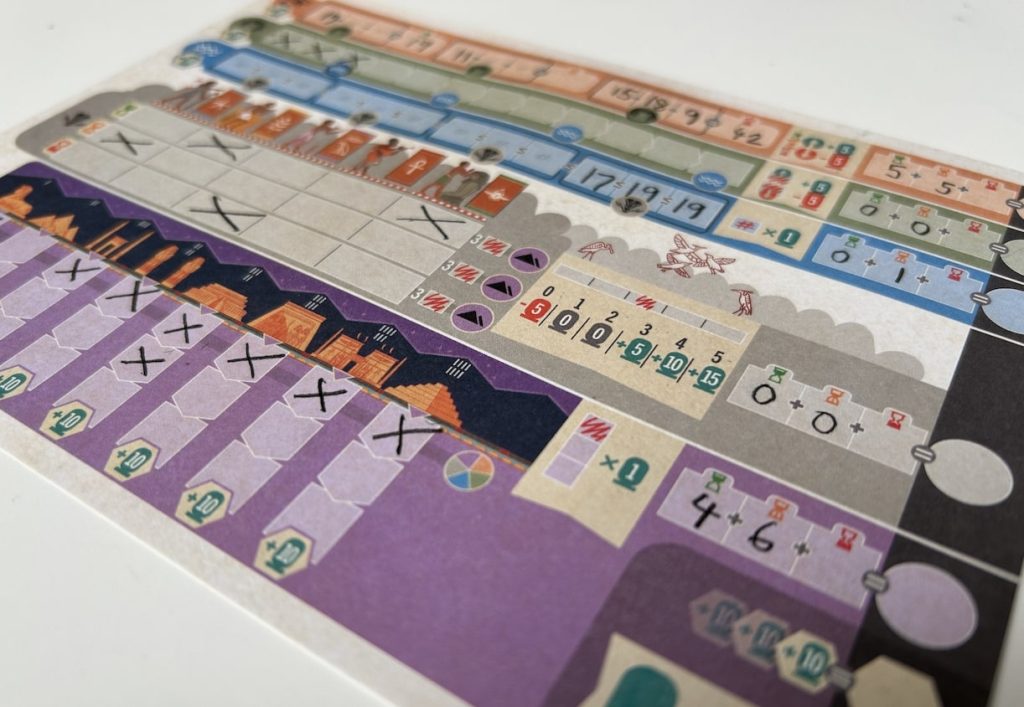
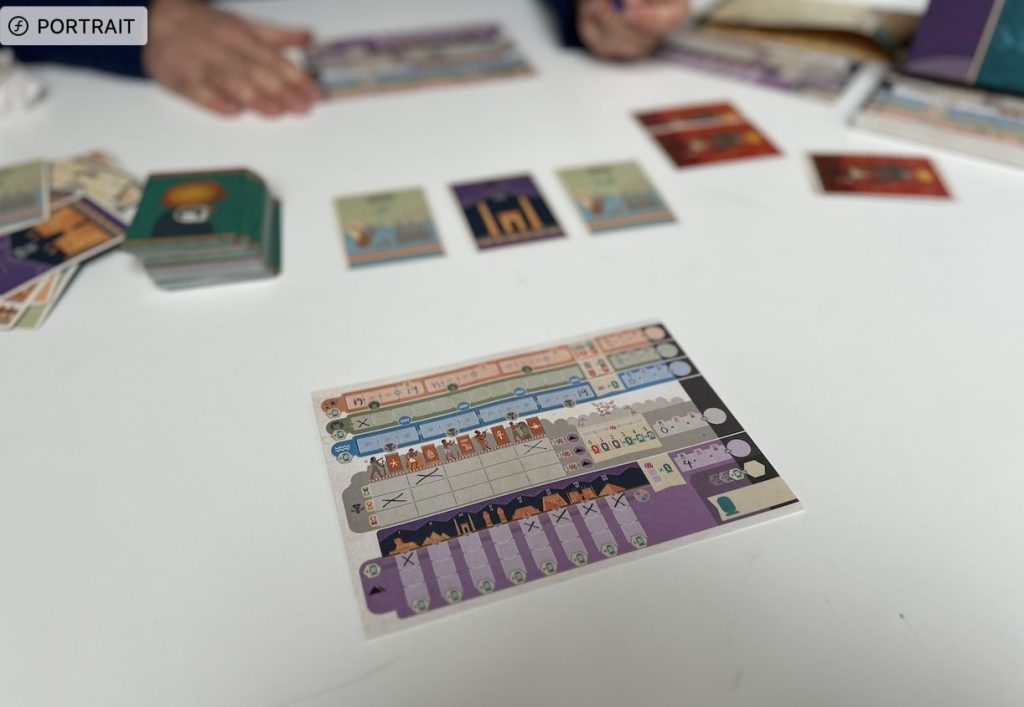
Each player is given a sheet and pencil with which to fill it in. The sheet is broken into sections: Gods, Pharaohs, Niles, Civilisations, and Monuments, and during the game you’ll be filling these sections up, box by box. You won’t get everything though, and that’s where Ra and Write becomes interesting: do you try and specialise in one or two things, with their big rewards? Or diversify and try and trigger the aforementioned bonuses?
The game’s rhythm is very simple. There’s a big deck of cards (shuffle before you start playing!) and the active player flips the top three cards over. The cards match the sections on your sheet (-Gods, Pharaohs, etc) and the active player gets first choice on which card to take, crossing off a matching box on their sheet. Then everyone else can choose either of the remaining cards – multiple players can choose the same one – to cross off one of their boxes as well. Once everyone’s done this, the next player clockwise is the active player for the next turn, and will draw three new cards, choose one and so on.
But you’re not only crossing off boxes – you’re also working towards particular bonuses. Three of any particular subsection rewards a bonus box-crossing for the next section down: so your third, sixth and ninth God will let you cross off a Pharaoh, which will do the same for Niles, which will do the same for Civilisations, which will do the same for Monuments. Monuments have no such bonus, but collecting every type of monument – there are 8 – or three of one kind, is worth ten bonus points.
Nestled into the deck are nine Ra cards. When a third Ra card is revealed, that is the end of the first round. The sixth card is the end of the second round and the ninth Ra is the (instant) end of the game. Note that each section of your sheet also provides round-by-round scoring, bringing an element of interactiveness to the game: whilst you’re generally allowed to fill any box as long as it matches the card, outscoring your competitors can be a strategic option early on, where having the highest-numbered Gods or the most Pharaohs gives you bonus points – and having the fewest costs you them!
After that ninth Ra card is revealed, players score for the third round, then total up their points for all three rotund. Most points wins.
Sam says
Ra and Write is the kind of game you can easily damn with faint, generic-feeling praise: it looks nice, it’s a decent puzzle, there’s tactics but also a little strategy. Lots of games do these things. And these x-and-write games (originally it was always dice, but cards and bag-draws have come into the genre too) where players choose from shared resources for their own business generally just feel okay: they are fun, but don’t hit the high spots of others for me in terms of drama, story, laughter, and just overall experience. What they do well, however, is that puzzle-scratching itch, and of that largely vanilla genre of games, Ra and Write is a solid entry, with a risk/reward factor in not knowing when the game will end… until it does. I don’t think it gets near the heights of its older sibling, but it’s a fun enough diversion for the time it takes.
-

Take That!
None to speak of. Some elements of the game are races, of a sort, but it's very much about doing the best at something rather than sabotage
-

Fidget Factor!
Fairly low
-

Brain Burn!
We've only briefly touched on it here, but the different ways each section score across the three rounds give you enough to think about
-

Again Again!
It's not high on drama, but its puzzling enough to be a solid diversion, and the bonus-triggering is always fun


