
Race to the Raft
Designed by: Frank West
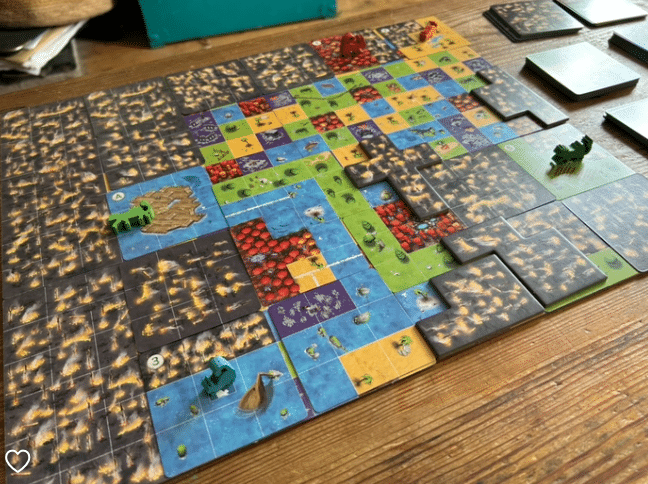
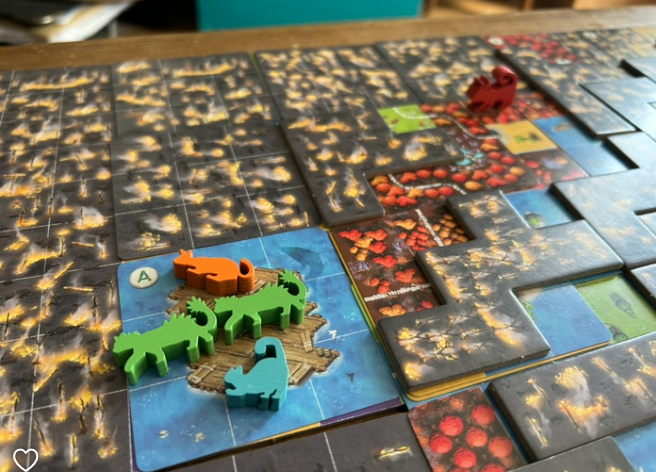
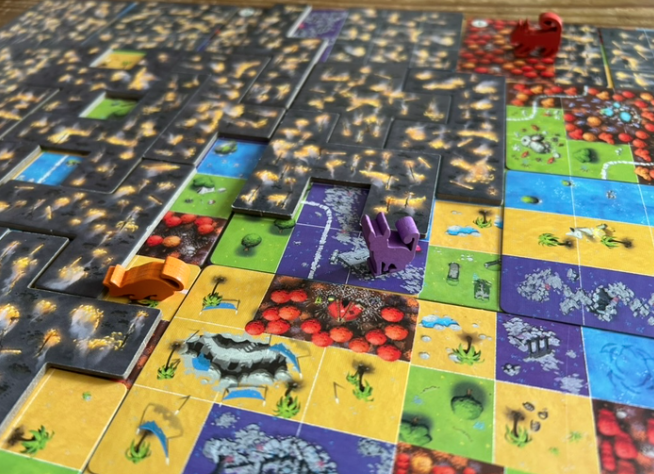
Race to the Raft is a game of navigating cats from a burning island to a raft waiting at the shore. It’s both a spatial puzzle and a co-operative game – that is played partly in silence!
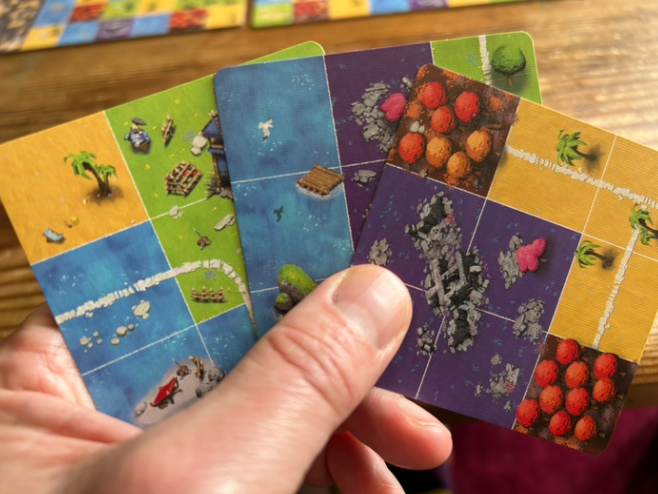
There are numerous ways to set up the modular board – the game comes with a campaign book – but in each one the challenge is the same: get the various-coloured cats to safety before fire consumes the island. Following the set-up – where boards and cards combine to establish which cats are where and the location of the raft – in each round all players pick up three pathway cards before play begins. Although the game is co-operative, you can’t show your cards to any of the other players or describe what’s on them. You are allowed to give vague clues (for example, my cards are good for the orange cat) but never enough information that anyone has perfect knowledge of what to do. Players can talk before taking cards, and after, but not during!
Race to the Raft foregoes turn order. You can all discuss what might be a good idea to do next, and collectively decide who should play a card next, but once that card is revealed there is, once more, no talking until it is played!
Playing a card does one of two things. Each cat follows a specific-coloured trail on the board (see pictures) to the raft, so you can either lie the card on the board to extend one of these paths, or you can discard it to move a cat along one of the paths. If you lie the card on the board, you must also pull a random fire tile from a bag and place that on the board as well, spreading the fire. If players collectively discard 4 cards for movement, they must also draw a fire tile as well!
There are a few additional wrinkles around placement and movement and communication – including tokens you can spend to talk or even remove a fire tile from the board – but basically, that’s the game: get all the cats to safety to win, but if one of them perishes in the flames, you lose!
Sam says
Race to the Raft comes into its own when the puzzle gets a bit harder. The tutorials and practice puzzles all feel a little too easy to make the game feel compelling, but as the campaign mounts up things get tricker with tense finales and more of a challenge to complete them. I don’t pine to play the game 60+ times, but I’ve certainly had quite a bit of fun exploring the puzzle it offers: so many games use these polyomino pieces now, but the overlapping angle feels fresh and interesting.
-

Take That!
None from each other.
-

Fidget Factor!
Most of the time you're involved, as discussion is a key part of the game.
-

Brain Burn!
Mostly it's the spatial puzzling, with a side-order of timing on when best to spend precious tokens...
-

Again Again!
There are numerous puzzles in the book, and more available online. You can even set your own.


