
Rebuilding Chicago
Designed by: Quinn Brander
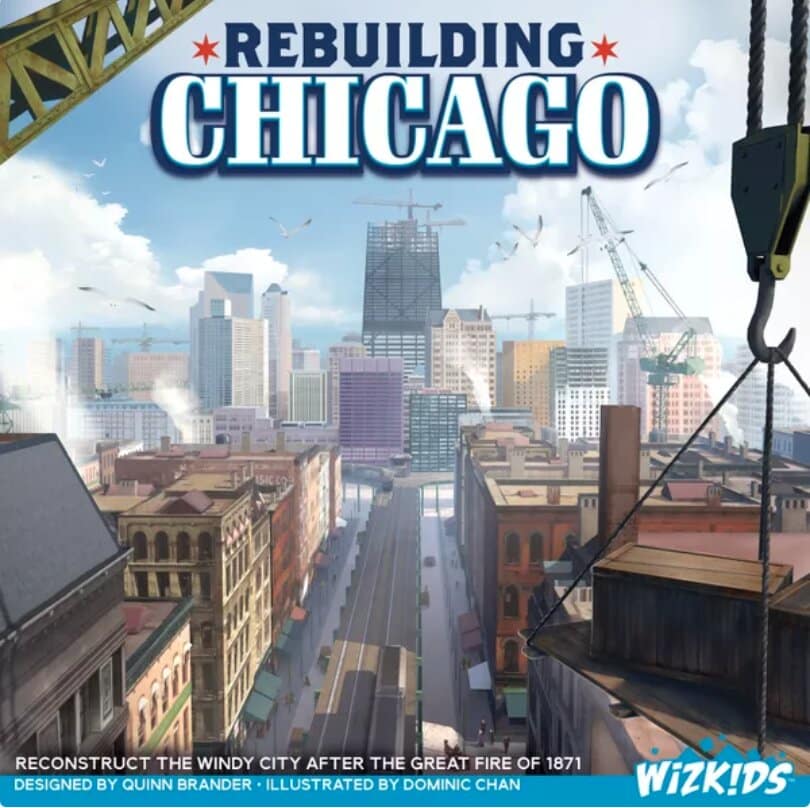


In Rebuilding Chicago, each player is responsible for the regeneration of a particular district of the titular city, after the great fire of 1871. In essence, this is about buying polyomino-shaped building tiles, and placing them strategically on your player board. But there’s more going on than that, with suburbs and income… and an unhappy populace to think about. Chicago is windy.
Each player has their own District board with a few buildings pre-printed onto it. Three of these building types – blue, orange and pink – represent the amenities of shopping, dining and nightlife. The three other buildings have different purposes: green is income (-cash each round) black is education (-helping your population become more content) and yellow is expansion. You’ll notice room for more buildings at the start of the game is fairly limited – one cannot build buildings on buildings! – but the more yellow buildings you have the more Suburb tiles you can place around your board; expanding the district’s footprint and giving you space to construct. Every district – and every new suburb tile – has both symbols that you ideally want to avoid building over – because they bring in cash or money – and the red Rubble symbols, which you very much do want to cover. The populace hates rubble.
Crucially, your Unhappy Population are also tracked on your board with that tiny wooden meeple. At certain junctures in the game their position will be critical, so keeping it as low as you can on the track is healthy.
All players start with some cash and the game lasts three rounds. On your turn you have three options: the most basic one is to buy a card from the Building Market, which begins each round with nine cards available. You can instantly cash it in for the rewards: these are building tiles you add to your district, single-space Statue tiles, or possibly improving the Quality of your amenities: each amenity building pushes your matching-coloured marker up a track on your board – we’ll return to those soon. Instead of cashing the card in, however, you can take engage its other use: these are mostly end-of-round profits or end-game points.
The second option is enacting a Law. You have three possible laws on your board, and can enact one of them once per round. We won’t list them here as they’re all distinct, but they’re also all helpful in some way: gaining cash or points or some other advantage.
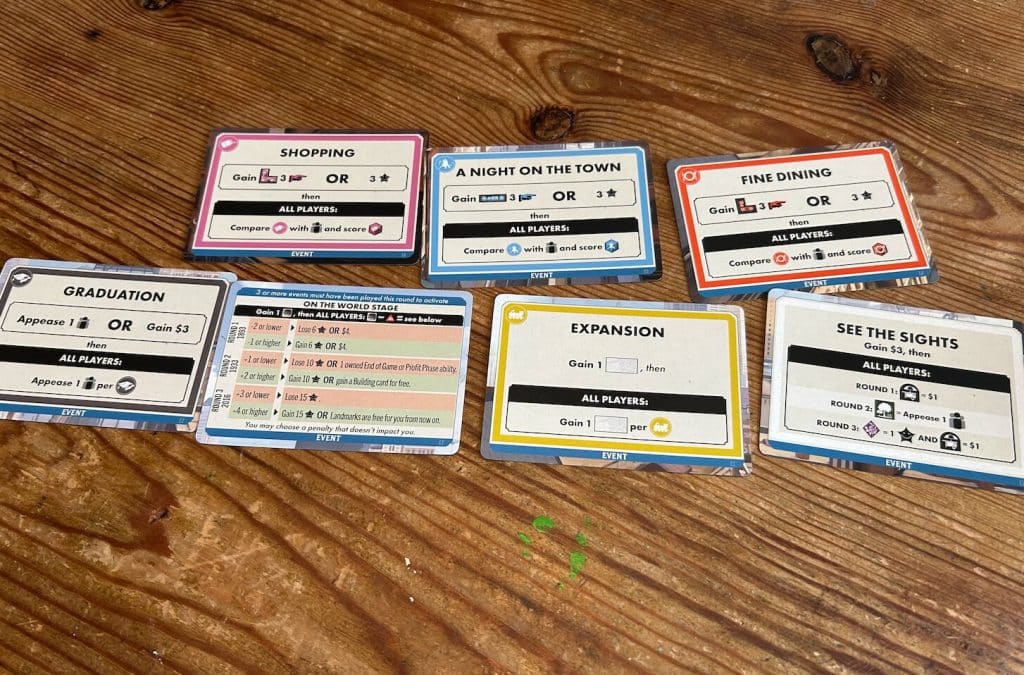
The last option is critical to the pace, scoring, and interaction of Rebuilding Chicago, and it’s to trigger an Event. There are seven such events, represented by cards, and they affect all players no matter who chooses to activate them (although the active player does get a small reward for doing so). Three involve comparing players’ Unhappy Population with the current position of their amenity markers, and – potentially – getting rewards. How much you get – if any – depends on both the difference between your markers and your Unhappy Population, and also the quality of each amenity, which defines how big this difference can be. The other events let players expand with suburb tiles, appease their unhappy population, gain rewards for the pre-printed symbols on their boards (-assuming they haven’t been built over) and finally, with the On The World Stage event, compare their number of statues with their number of still-exposed rubble symbols: each round has an escalating minimum of what you want this sum to be, and doing so gets increasingly better rewards. Not doing so gets increasingly punitive.
When all events have been activated the round will instantly end – players get cash income for their green buildings (and any end-of-round profit cards). After the third round, players’ money is worth a point per $5, and they will score any end-of-game cards they have, as well as any Landmarks they’ve built. Oh yes, landmarks! Everyone starts with two landmark buildings, and each scores in very different ways. You can take a turn building one of your landmarks into your district – if you have the money. They tend to be expensive.
Sam says
I haven’t played the designer’s previous game Rebuilding Seattle – allegedly a simpler version of this game – but I really enjoy this one. So many tile-laying games tend to rest their laurels on the puzzle element – and people enjoy that, so why not. But it does mean many have a slightly inert feel to them where everyone’s busy with their own little activity before we compare scores at the end. That’s not an inherently bad thing, but the way Rebuilding Chicago’s pace relies on the events, and the events are determined by player choices, make it much more interesting to me: we may not be building the same district, but we’re in the same playspace. If you see me expanding, that means I’m taking on more rubble: maybe now’s a good time to activate the On The World Stage event. Or perhaps you’re clearly trying to build up your Dining amenities, so I could activate that event before you maximise your potential. It’s not a spiteful interaction – not to me, anyway: there’s no bulldozing, theft or direct sabotage – but an inherently tactical one, that lends more weight to your decisions than simply ‘take one shape or another’. We don’t do scores on GNG but for me, this is – at 2 or 3 players – high marks.
-

Take That!
There's no direct interaction here, but the timing of events can be critical, both positively and negatively. There is a potentially high level of passive brutality!
-

Fidget Factor!
Pretty low with two, but with the maximum of five players be prepared for some serious down-time. We'd say it's best with 2-3.
-

Brain Burn!
There's the spatial puzzle of the board, the managing of the economies, and most pivotal the timing of the events. Whilst the rulebook is refreshingly light - just a few pages - the implications of what's going on are what give the game its appeal
-

Again Again!
Each distract has a different geography and a different set of laws. But you don't even need that asymmetry to sense there is a lot of replay value here, due to the variety of cards and the different strategic approaches


