
Revive
Designed by: Anna Wermlund, Eilif Svensson, Helge Meissner, Kristian Amundsen Østby

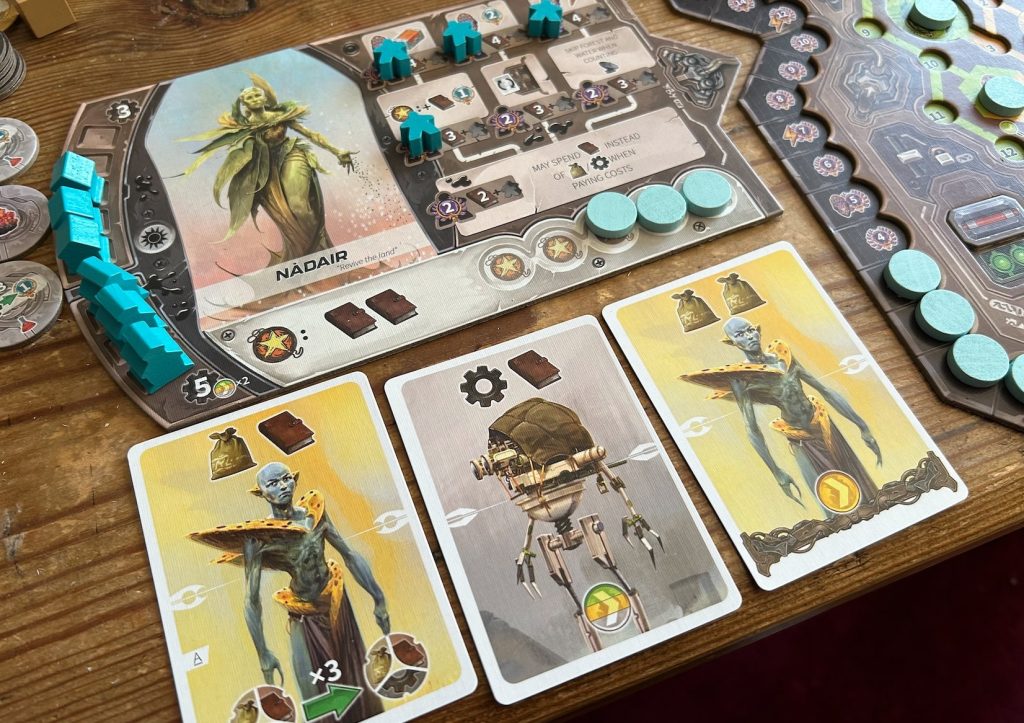
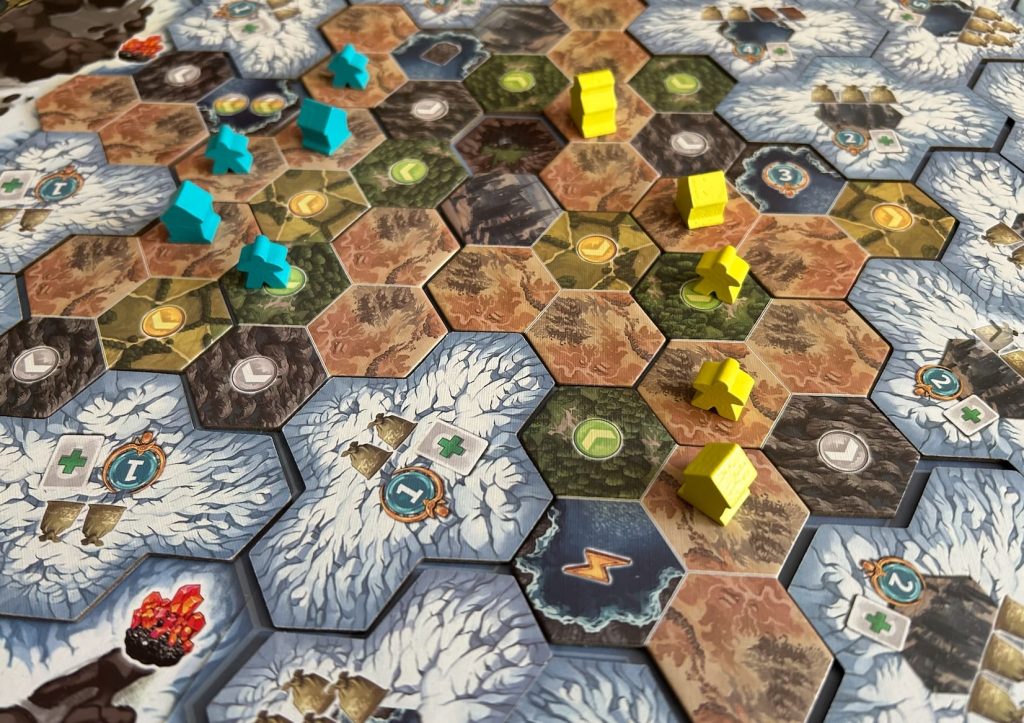
The theme of Revive is a rewilding of a post-apocalyptic world, where the players collaborate – after a fashion – in turning an icy wilderness into a thriving rural landscape. But we win or lose individually.
The board represents the landscape in question and is seeded with a bunch of Landscape tiles before play begins; most of them face-down. Each player has their own starting cards and player boards: giving you a special ability and tracking your resources and technologies. During play, you spend each turn either taking up to two actions, or hibernating. As your progress is mostly made via actions, let’s look at those first.
There are five actions you can take (you’re allowed to take the same action twice). A simple one is playing a card – cards are multi-purpose and you can play one to the slots in your player board, activating either the top of the card in one of the top slots, or the bottom of the card in one of bottom slots. Many of these simply give you more resources; others might trigger your special ability or do something else beneficial. A second action is activating a switch on your player board: you can use this once between each hibernation, and it simply gives you a basic resource of your choice. Both of these are about getting stuff. Out on the board is where you’ll be doing stuff.
The three main-board actions are explore, build, and populate. Each of them costs you resources: food to explore, cogs to build and books to populate. Exploring simply means paying the cost and flipping over one of the face-down landscape tiles, gaining points in the process. You can build or populate on any previously-revealed tile, paying the resources to place a person or building from your player board there. The benefit of building is that the location of your buildings will trigger movement up your technology tracks depending on where it is: if you’re next to two forest tiles, for example, your green tech track will move twice. And the benefit of the tech tracks is as you move your marker up them, they uncover additional abilities you can use immediately, or in future turns.
Populating doesn’t give immediate benefits but ongoing ones: making building cheaper, for example, or opening up a fifth card slot on your player board. Populate enough and you also uncover extra ways to score points at the end of the game. But beware: exploring, populating and building also have range cost: doing anything adjacent to where your buildings and people are is free, but anything further afield costs you in food to reach it.
If you feel you don’t have a productive move to make, then it’s time to hibernate: this frees up all your card slots, resets your switch and pushes you up the hibernation track (which also gets you a juicy little reward). The cards you used in slots become unavailable until your next hibernation, but your previously unavailable cards are now available again.
As players score points, they move up the scoretrack which also, at certain junctures, trigger bonuses to you for reaching them. One of these bonuses are taking artifacts (worth points) and it’s the taking of the last artifact that will signal the end of the game, giving all other players one final turn before points are tallied to determine the winner. As well as points from your population and possibly from techs as well, each player has a hidden Artifact card that defines what you score additional points for – it might be cards, or resources, or crates, or other things.
There is also a campaign game in the box for players who want to explore it.
Sam says
I suppose the first thing to say about Revive is it looks, even to a hobbyist gamer, utterly bananas. There is no opportunity for simplicity that hasn’t been foregone for intricacy; no track that might have been straight but instead weaves around like an excited robot puppy. The challenge for the first time you play Revive is to see past this passion for visual complexity to the actual nuts and bolts of what you’re meant to be doing. And largely that’s trying to establish yourself as a presence on the board, where some building spots are rather more alluring than others. And don’t forget your artifact card because in a game that feels quite tactical, it gives you some strategic direction.
Whilst I’m not exactly in love with Revive’s visual aesthetic, I can’t deny it’s a clever game, one where there is a joyous moment as the seeming multitude of options palpably change from I have no idea to sensing what a good move will be and knowing you’re about to pull one off. For the friends I generally play with Revive is a little too long and little too puzzly to be a home run, but whilst I largely share that opinion, I did enjoy my few plays of it.
-

Take That!
There’s some passive interaction on the map as players can slightly get in each other’s way. But it’s marginal enough that you could describe Revive as a non-interactive game without feeling dishonest. The core thing is the puzzle.
-

Fidget Factor!
I’d say the game is best with 2 or 3 players. The full complement of four can get a bit draggy.
-

Brain Burn!
It’s a combination of spatial puzzle and ‘engine-building’ – finding synergies in the cards, slots, map-placements that drive you towards the goals on your artifact cards.
-

Again Again!
Even without the campaign game, there’s so much variance in the basic offering that it will stand up to multiple visits.


