
River of Gold
Designed by: Keith Piggott
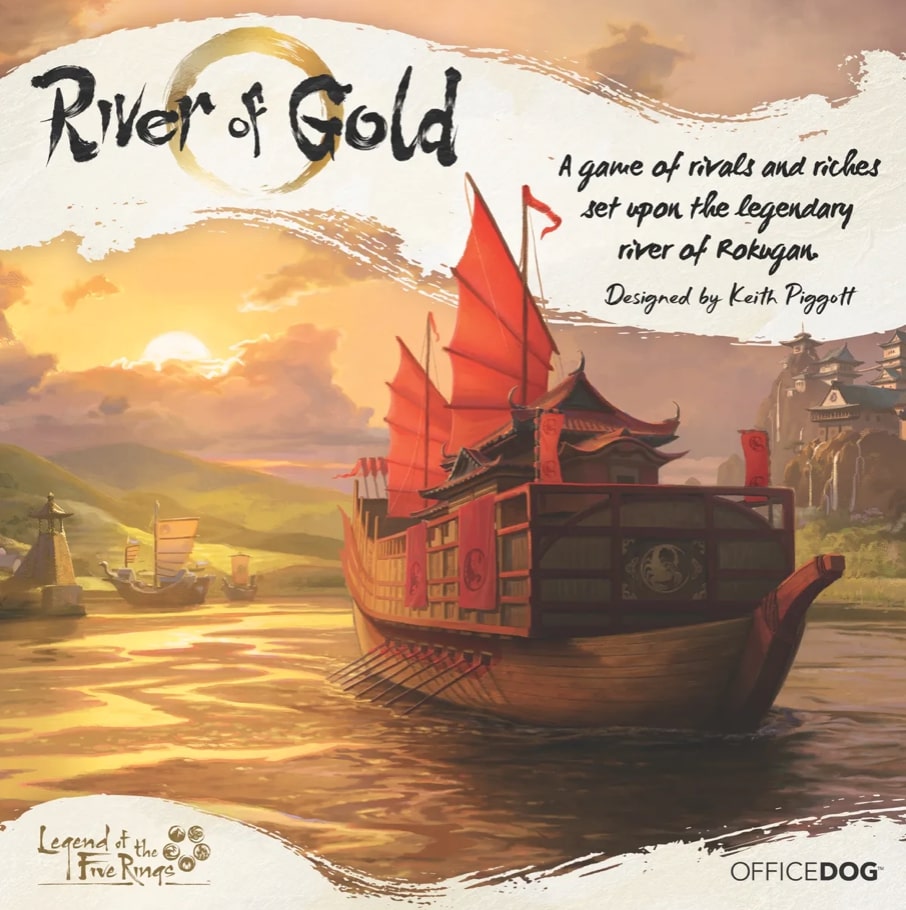
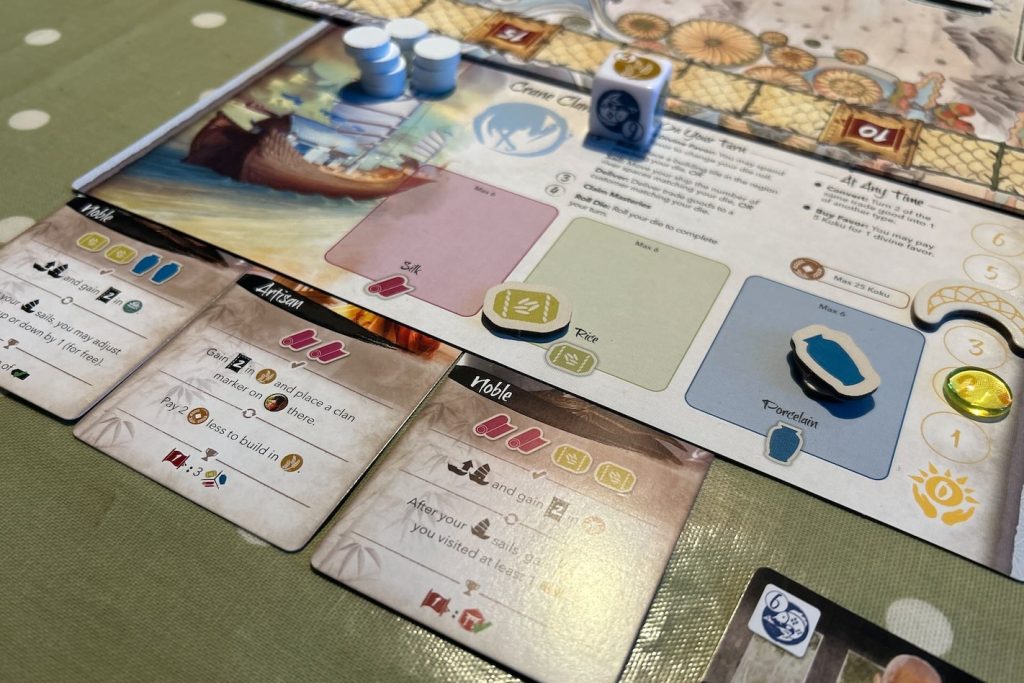
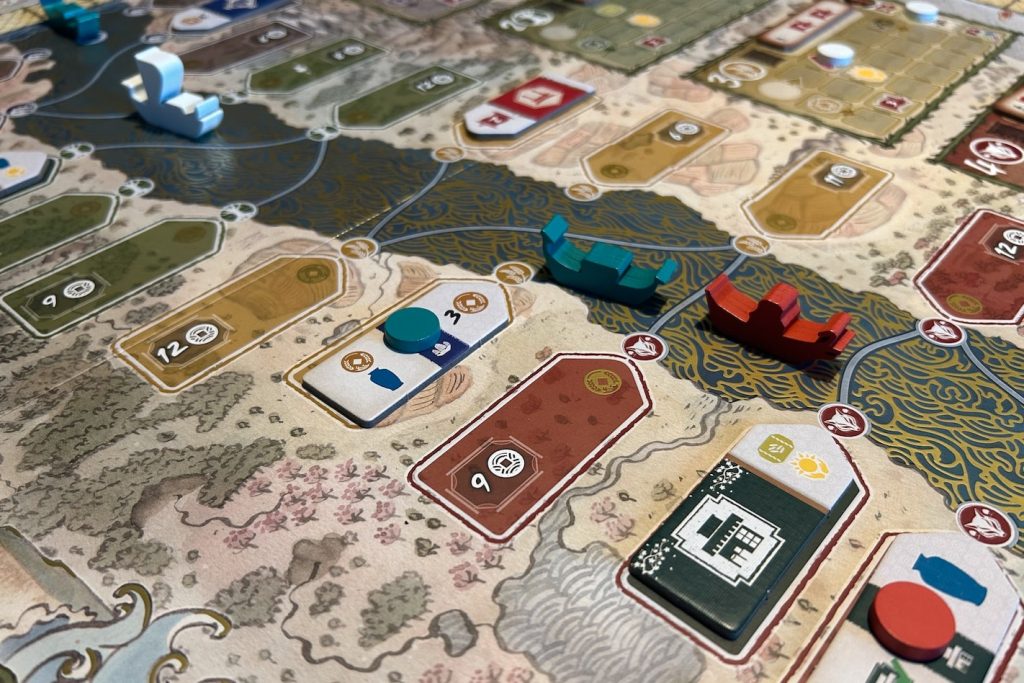
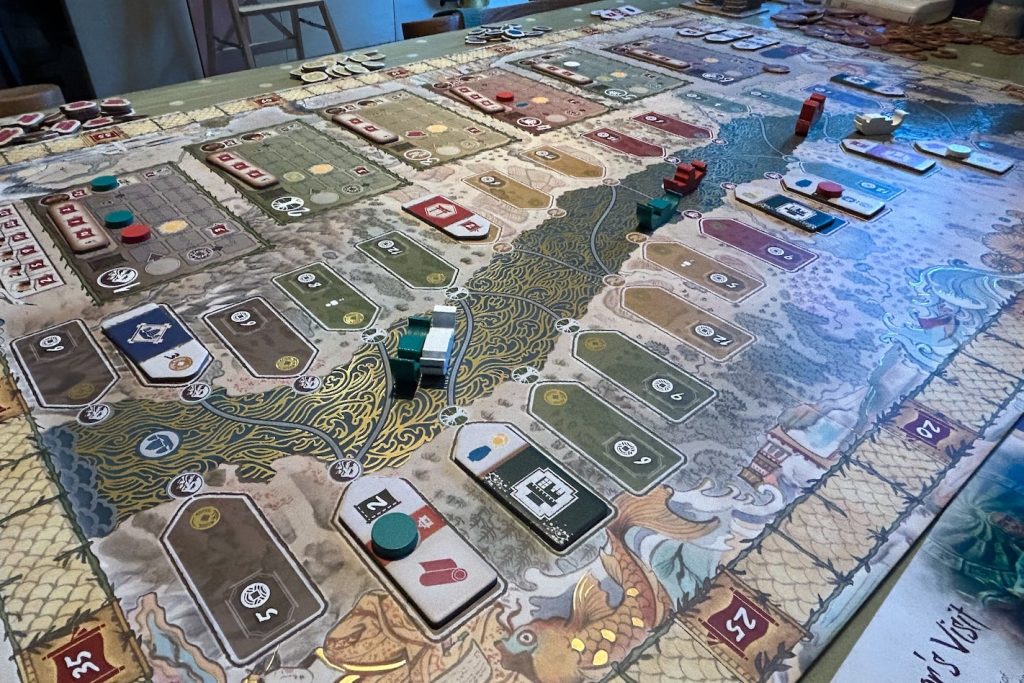
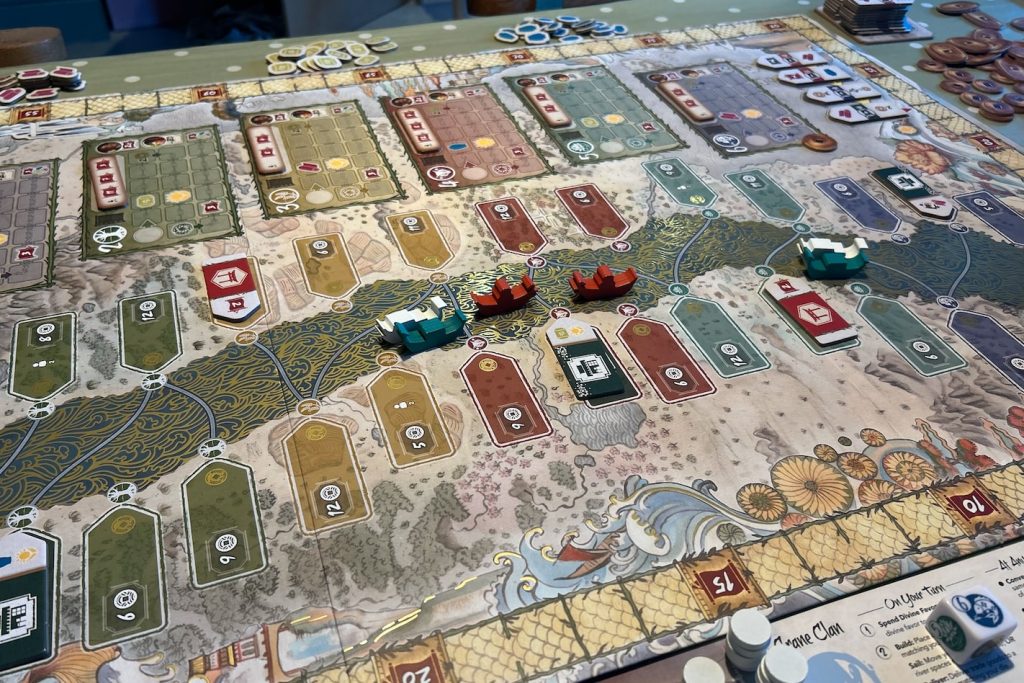
In River of Gold we are rival traders, sailing the fictional Rokugan river and hoping to establish ourselves as the best – read richest – make-believe captain of industry.
The board itself shows the river and the various shore spaces – basically, building sites – along its banks, which begin the game vacant. Players each start the game with a bit of cash, and two boats on the river somewhere. Despite the ornate appearance of the board, the rhythm of the game is relatively simple: on your turn, you roll a die and choose one of three ways to use it. You can move your boat along the river, and gain rewards from each of the shore spaces you stop beside (there will be at least three, possibly as many as five). Empty shore spaces give you money, shore spaces with buildings in them give other rewards, such as Silk, Rice, and Porcelain tokens, or money, victory points, or the all-important Influence. We’ll come to influence shortly.
A second action you can choose is to construct a building. As long as the symbol on your die matches a shore space next to one of your boats, you can construct there, paying the required cash shown on that space to add one of the four available buildings to it. You’ll get an instant reward – usually Influence – and your building will now give a benefit of some kind to anyone who moves their boat adjacent. As the owner of the building, you get a special benefit of your own when someone visits – even if it’s one of your own boats.
The last action is to Deliver to a Customer. You always have two Customer cards in your hand and they want a particular combination of the previously-mentioned silk, rice and porcelain. If you have their demands in your supplies, you ‘deliver’ by revealing the card and taking the rewards on it: all of them have some instant/ongoing reward, and many also give you points at the end of the game.
So those are the three actions, and as you take them – especially building – you’ll be pushing markers up six different Influence tracks. These are important not only because reaching certain spots gives you a benefit, but because the player or players with the most influence in them will score points at the end of the game. You can lag behind during play and then bound into contention in final scoring if you’ve spread your influence well.
The last thing to bear in mind is the Divine Favor – tracked on your player board – which lets you manipulate dice rolls up or down: keeping some ‘favor’ in your pocket is always a good thing, as having some flexibility in what the dice let you do can be critical. Everything else in the game revolves around this die-roll/action-selection, with the positions of your boats obviously important as well. The number of buildings is limited, and when you reach the bottom of the pile the endgame is triggered: whoever triggered it gets 5 points, and then every other player gets one last turn. You’ll then score the six influence tracks (first and second places, sometimes third as well) and any Customer cards that you delivered to. Most points is the winner.
There is also a Patrons mini-expansion included in the box you can mix in, giving each player their own special ability.
Sam says
Lovingly produced, the board could almost do with framing and hanging on the wall. Is that ornate and detailed aesthetic making up for some uninspiring gameplay? Thankfully not – River of Gold takes a position somewhere between the everything-scores-points puzzles of a designer like Stefan Feld and something a little more interactive, because those Influence tracks are each a miniature race, and you neglect them at your peril. For the gamer who wants absolute control, maybe the Customer cards and die rolls can frustrate, adding in as they do elements of chance. But personally I like that, and I feel River of Gold gives you enough control to navigate a few slings and arrows, and enough avenues of opportunity to explore even when your ‘divine favor’ battery runs dry. It’s not a hall-of-famer for me, but it does what it does very well.
-

Take That!
There aren't really any aspects of the game that are openly aggressive, so the interaction is limited to control of the Influence tracks
-

Fidget Factor!
Starts creeping in with 4 players. With 2-3 people on the the river, turns tend to sail around reasonably quickly
-

Brain Burn!
Generally after the first play - or even halfway through it - you'll find you've transitioned from befuddlement to 'Well maybe I should do X' and this engagement only speeds up more as you play. Certainly there may be times where there are pauses for thought, it's the player who maximises these rewards best that will win. But because but River of Gold's approach is to make pretty much everything you do rewarding, it's an enjoyable space to explore these tactical options.
-

Again Again!
There's some variety both in set-up and how the geography of the board pans out during play.


