
Rome in a Day
Designed by: Evgeny Petrov
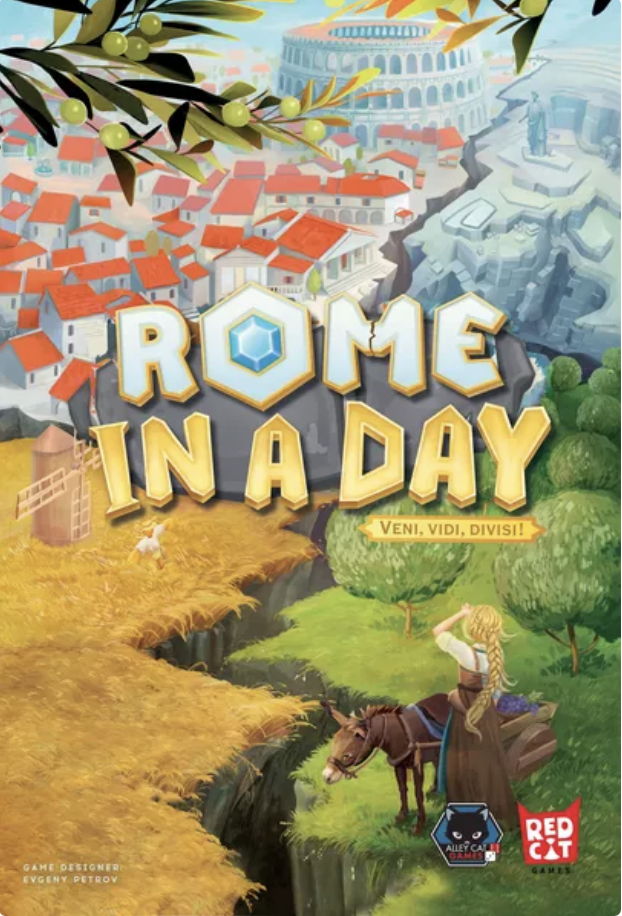
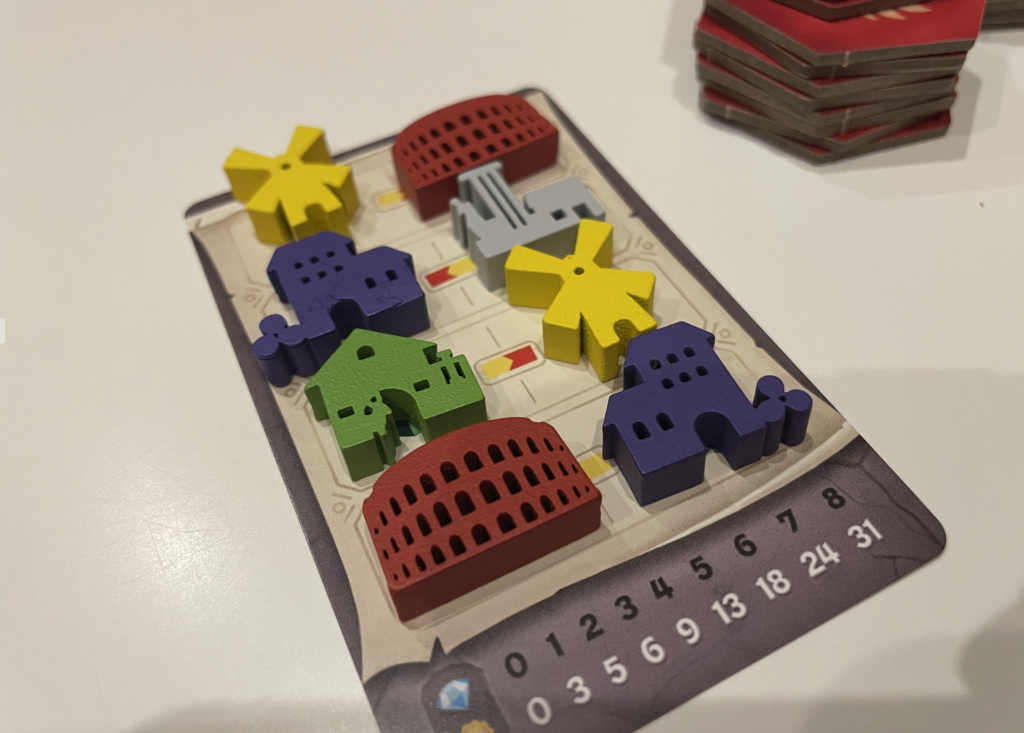
Rome wasn’t built in a day, as John Heywood once said, but now you can build five Romes in half an hour – or less.
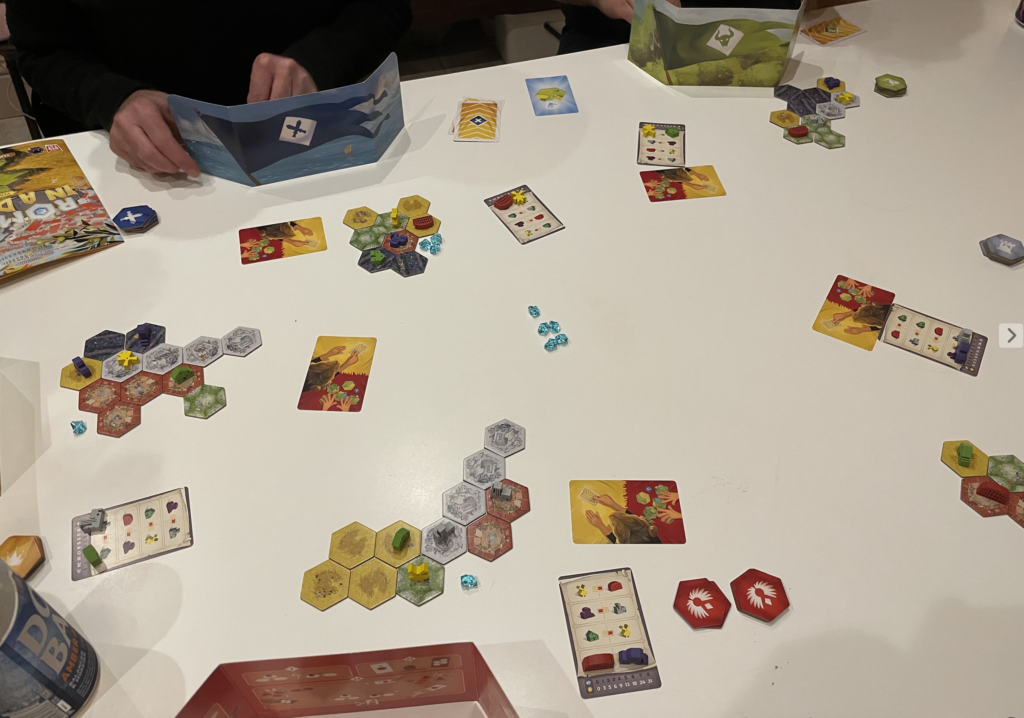
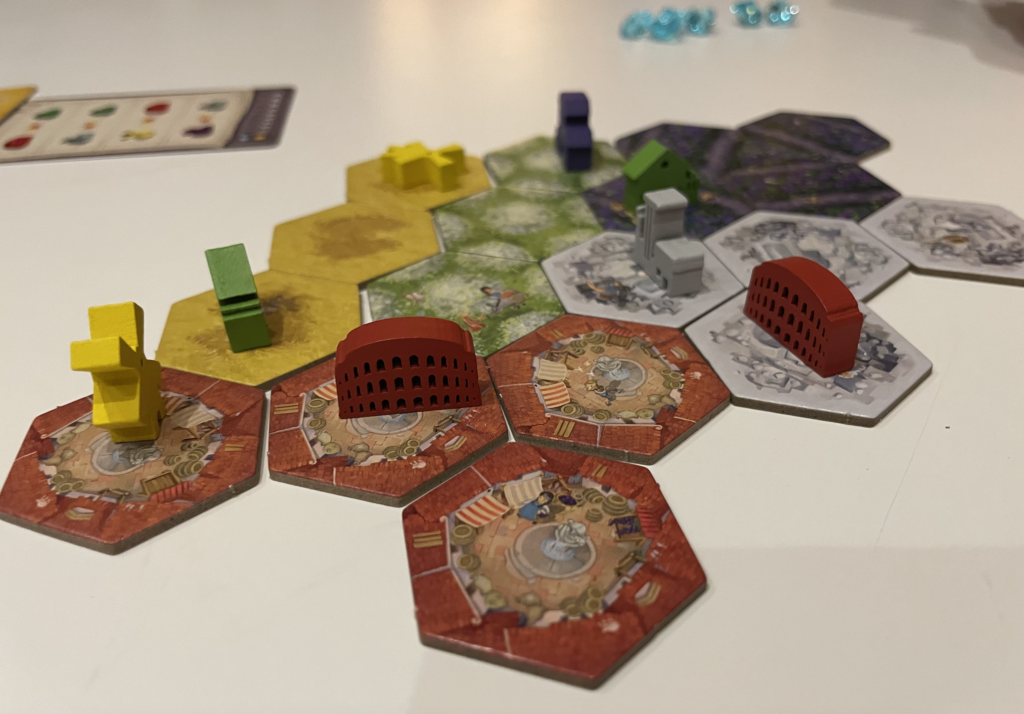
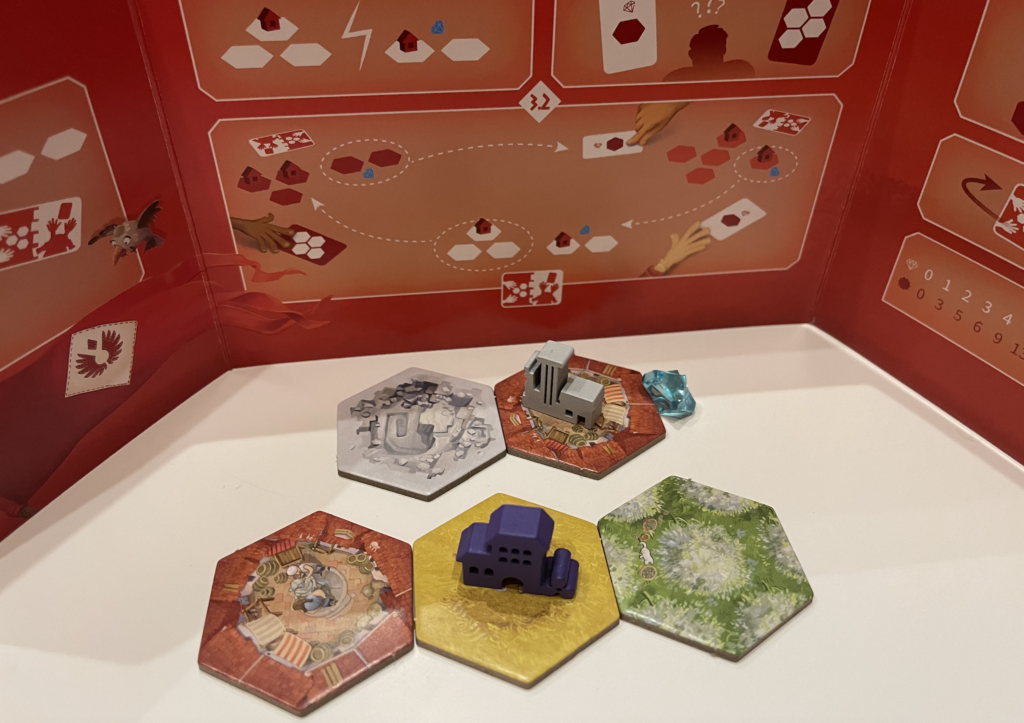
In Rome in a Day each player is building their own little landscape from the hexagonal tiles. At the end of the game, you’ll score points for each group of tiles multiplied by each matching building either on or adjacent to that group. But the catch is how these tiles are selected, which entails a series of I-cut-you-choose deals around the table.
Each player starts with a set of tiles which are shuffled face-down, and before play begins three are placed face-up in front of you as the start of your own personal ‘Rome’. At the start of each round, five are laid face-up in a row and two buildings from your building cards are placed on the first two buildings of the row: so far, so random. Now players take control, as they split the five tiles (including the buildings on them) into two groups of 2 and 3 or 1 and 4: your choice. The only rule here is you can’t move the building off the tile it was dealt to. Once everyone has done their splitting, players choose a group from their neighbour (-which neighbour exactly alternates between rounds). So in round one, for example, the player to your right is choosing which group to take from your selection, and you’ll be taking your choice from the player on your left. There’s another catch here in that these choices are made secretly (using cards) before being simultaneously revealed.
Once everyone’s gathered their tiles, you add them to your Rome in whatever way you like, with the caveats that you can’t move any tiles that were already placed in previous rounds, and buildings can never move from one tile to another.
Before we forget, there’s another way to score points which is the collection of gems. Players begin with four gems in their supply and you always add a gem to your smallest group of tiles when you’re splitting them. You may get the gem back, of course, depending on what your neighbour takes from you, and the more gems you have, the more they score. Other than that, the game continues for four rounds and after the fourth round all areas are scored, plus gems, and the player with the most points is the winner.
Sam says
There’s nothing ground-breaking about Rome in a Day from a design perspective: we’ve seen the tile-laying and city-building in Carcassonne and the split-and-choose mechanic in Mammut and New York Slice, amongst others. But while the logic of choosing from the left/sacrificing the right (and vice versa!) is a little unintuitive at first, Rome in a Day just puts it all together in a nice little package, with quirky little wooden buildings, no plastics and sweet, puzzly play that always makes for a pleasant half-hour. I like it.
-

Take That!
The only control you have is splitting your tiles and claiming tiles from someone beside you, so the most combative it'll ever feel is someone taking tiles you wanted for yourself. The crux of the game is the splitting though, and sacrificing enough to tempt them the other way.
-

Fidget Factor!
Very low. Play is largely simultaneous, so the only pauses are while someone works out how to divide their tiles in a way that satisfies them.
-

Brain Burn!
The puzzle of Rome itself isn't complex: get buildings on or next to matching groups of tiles. The canny bit is making sure your Rome is the best one, and that's where the cut/choose mechanic comes to the fore.
-

Again Again!
Inbuilt variety rests on the tiles - and of course the player decisions. Other than that, Rome in a Day isn't a wildly different ride each time, but it plays fast and doesn't take long, and there's something satisfying about your little city at the end, adorned by the miniature buildings.


