
Stroganov
Designed by: Andreas Steding
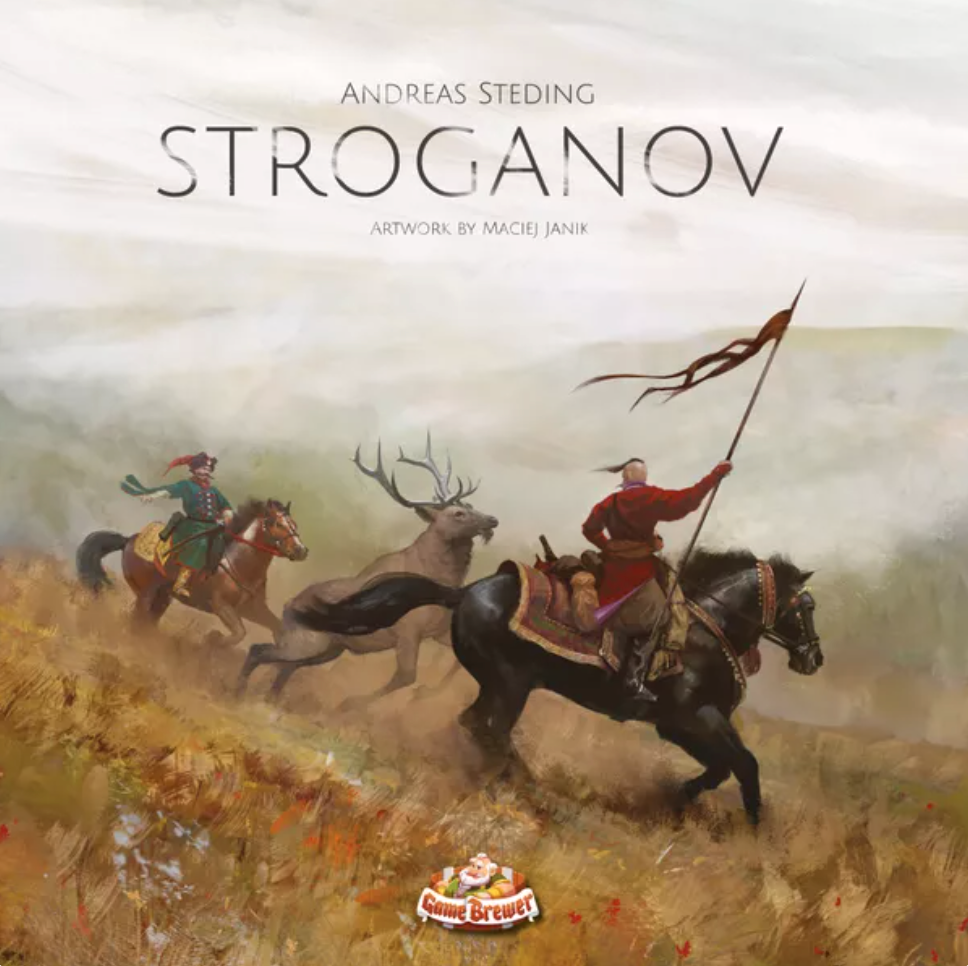
In Stroganov, the players are cossacks, travelling west-to-east across the frozen lands of Siberia. As you travel, you trade at markets, set up outposts, and – the survivalist heart of the game – hunt the wildlife for the furs needed to keep the people warm.
The board shows the direction players will travel, starting on the left and then in each of the game’s 12 rounds (representing the navigable seasons of four years: the winter season plays differently), moving 1-2 steps to the right and taking actions at the landscape tile you stop in. The actions are fairly numerous and we don’t have room to be exhaustive here, but essentially you get one basic action and one main action. The basic actions allow you to collect money or horses, move again, trade (furs for other things) or hunt. Hunting is really the key component of the game, as only by gathering fur can you take some of the main actions, which are either another basic action, or an advanced action: visit villages or yurts (both offer rewards) take an order from the Tsar (demanding you collect certain furs) build an outpost or even claim a landscape tile, for the rewards it offers. Bonus actions are available too, but taking them costs you furs – often a specific type of fur (there are many) but you can add a coin to the deal to pay any type instead.
In short, it’s move and hunt to fulfil the Tsar’s wishes. But there’s quite enough smaller wheels spinning around that to ensure the game can be won in many ways. Outposts allow you to take an action where the outpost is, instead of where you are. Pushing yourself up the story track ensures songs will be sung of your great deeds – you can cash these points in for more bonuses in winter.
Winter comes at the end of each of the game’s four ‘years’, where players cash in story points, receive horses and maybe some additional benefits from orders they completed for the Tsar’s pleasure. At the end of the game there are several ways to score points, from orders to landscape tiles claimed to the resources you still have at your disposal – and the player with the most points wins.
If you enjoy the standard Stroganov challenge, player boards can be flipped over to give each player a specific advantage and the game itself further variety.
Sam says
It’s clever, it looks stunning, it has in-built variety, and puzzling, cognitive-loading gamers will appreciate it. As a fan of designer Andreas Steding’s previous games – many linked to here on the right – I was predisposed to like it, but I found it quite hard going. All the actions – basic, main, advanced, bonus – and the marginal mathiness to proceedings made it feel overly procedural to me, and even though I don’t object to a hunting theme (there are a bazillion games with more offensive themes than hunting to stay alive) I didn’t really feel like a cossack, travelling the wild interior and doing what I had to do to survive. I felt like a marginally inept mathematician who had to keep reminding myself how many actions I’d taken, and which of them were advanced. It seems to lack the accessibility of previous titles, and the sneaky, interactive fun of them.
-

Take That!
Not a huge amount, although it's not entirely absent either. Players can see what each other have in the way of furs and what orders they hope to fulfil. Reaching a tile first and grabbing something someone else clearly wants is definitely an option; deliberately or otherwise.
-

Fidget Factor!
High on a first play as the various moving parts of Stroganov whirl mysteriously. When you settle on a strategy, decisions come much easier.
-

Brain Burn!
There's plenty to chew on here, from how-far-to-move to what-to-do when you get there. With multiple choices at every juncture, only the fast-disappearing wildlife may make you hurry...
-

Again Again!
Lots of randomization in how the game sets up, and player decisions and tactics can vary a lot as well


