
Stupor Mundi
Designed by: Nestore Mangone
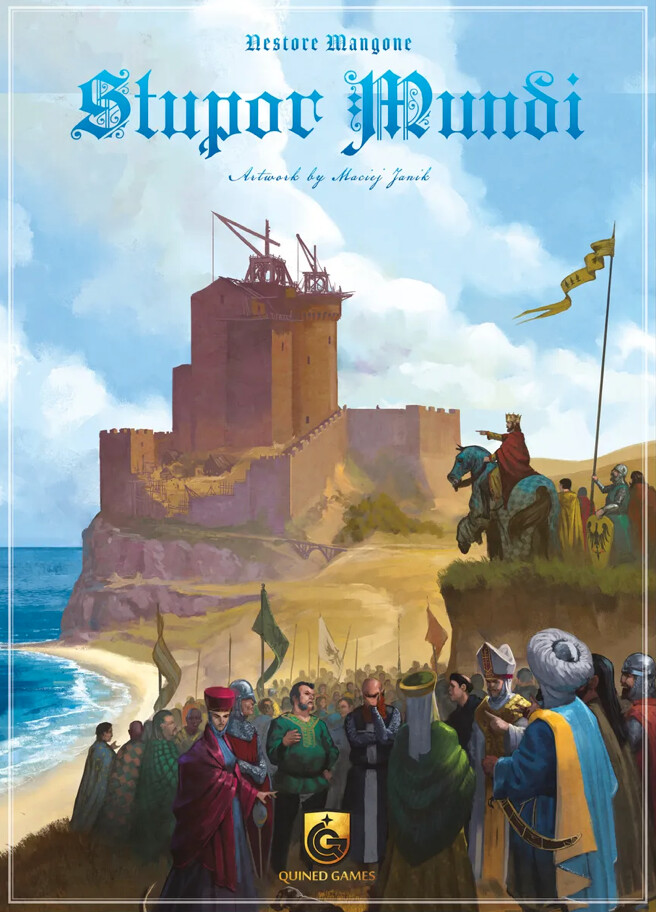
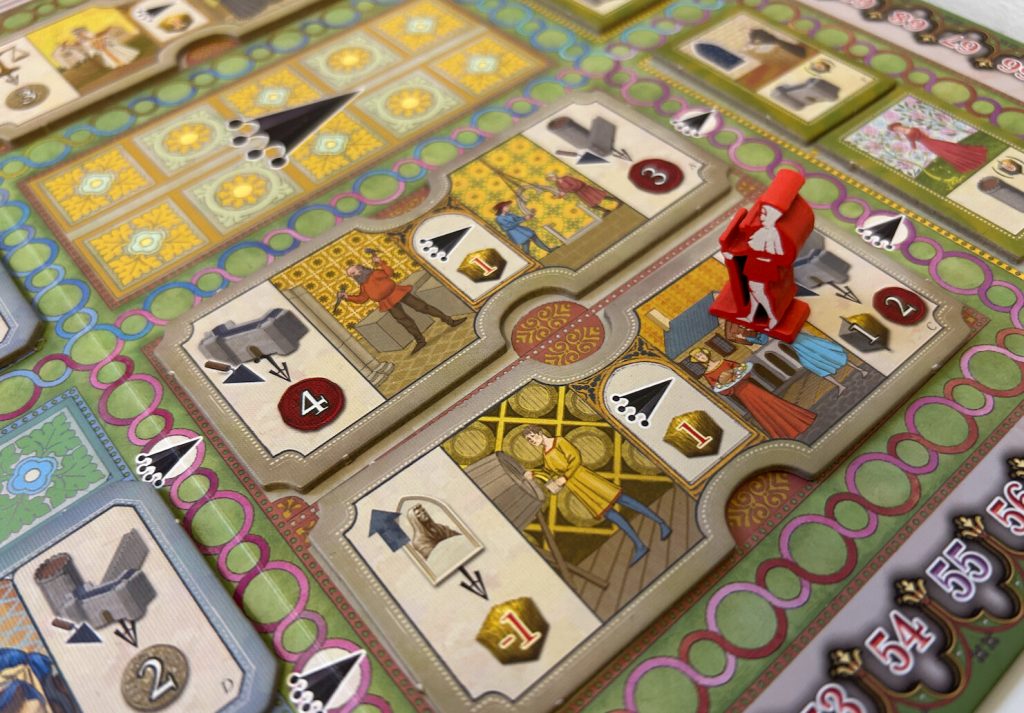
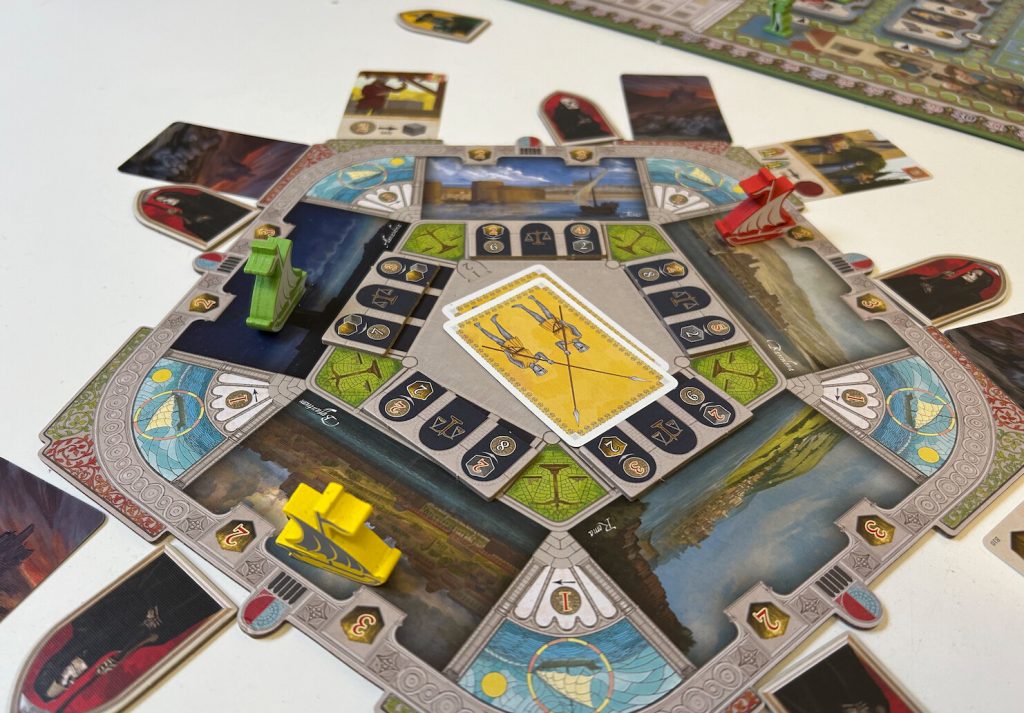
Set in southern Italy a thousand years ago, Stupor Mundi sees the players as noble servants of Frederick II, the Holy Roman Emperor (Stupor Mundi translates as Wonder of the World, which was how impressed contemporaries referred to him). The goal is to basically serve him the best, although you are in a sort of competition with Frederick himself as well, as we shall see.
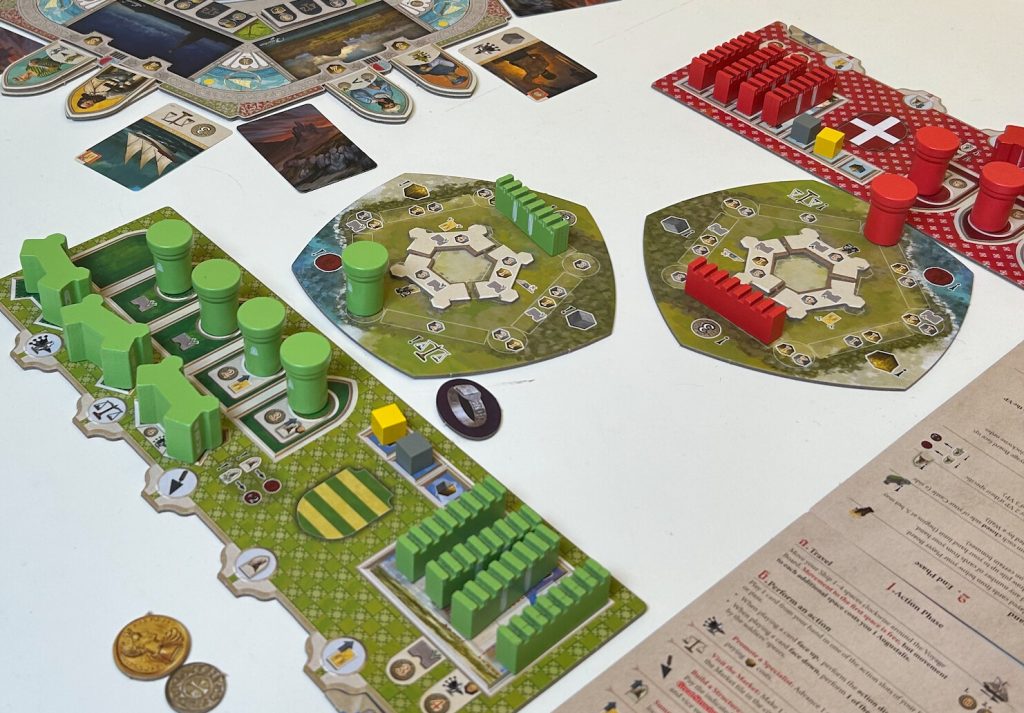
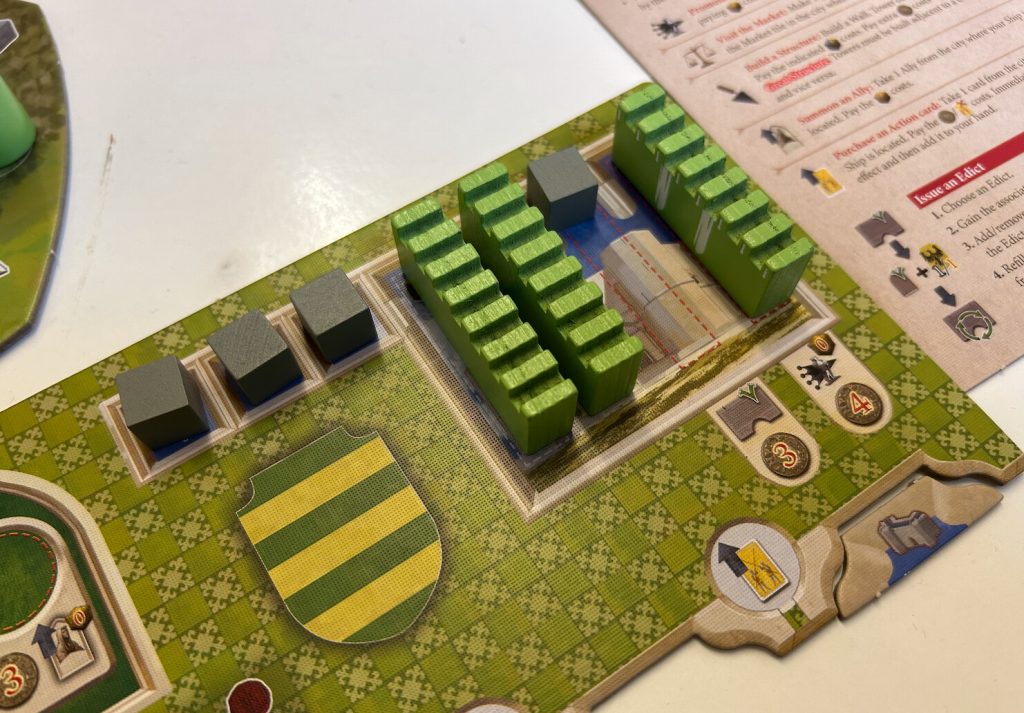
There are several boards in our pictures so let’s take a tour around them first. The big board with the yellow castle pieces is Frederick’s: here his castle will be built – and sometimes knocked down – by players in a mix of collaboration and sabotage. On the same board is the Workplace area, where you may move your Specialists during the game to grease the wheels of progress – more on those later. Next to the main board is the pentagonal Voyage board, where your boats sail around the Mediterranean, forming alliances with distant lands. Finally, everyone has their own Player board and Castle board. The latter begins with a single Tower and Wall on it: construction has started, and during the game you aim to complete it.
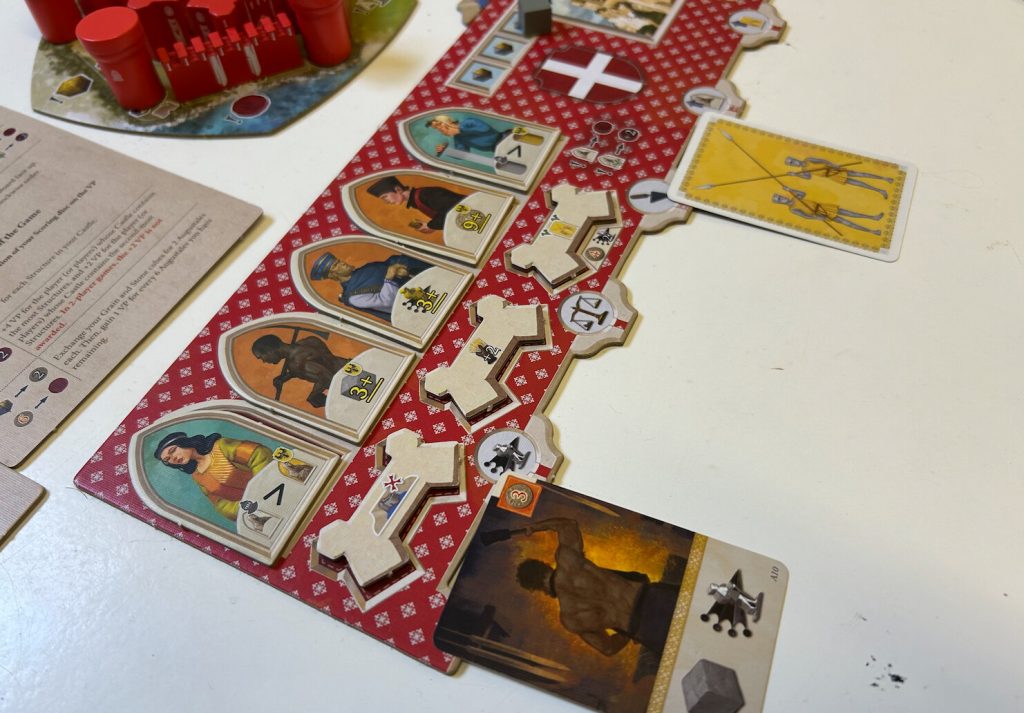
Over a number of rounds – how many will vary – players take turns clockwise around the table. In each turn, you first (optionally) move your boat on the Voyage board, and then play a card from your hands to any empty slot beneath your player board. You can play a card face-up and take the action on it, or you can place it face-down and choose one of the two actions marked on your board either side of the slot (see pics). The actions themselves are pretty simple; the complexity in the game comes from figuring a productive path through them. You can move a specialist up the aforementioned Workplace area – the further one goes on each track, the better each ability will be, making things easier or cheaper for you to achieve. You can Trade at the current location of your ship, turning goods (stone/wheat) into cash, or vice versa. You can build a part of your castle, spending the required stone/wheat as marked on your castle board to place the Wall, Tower or Keep in position. You can Summon an ally, moving one of the ally tokens where your ship is over to your player board, or you can Purchase an action card – again, at the location of your ship – which will help improve your deck of cards: each player has a fairly simple starting deck, and the cards you add will be more powerful.
It first glance it seems like the goal of the game is to build your castle, and certainly that’s a key aspect. Doing so costs you stone and wheat but hands you advantages in return: building Walls gives you more storage space for the stone and wheat on your player board. Building Keeps gives you ongoing in-game powers: a larger hand-size of cards, an extra slot on your board, and the ability to take two actions instead of one. And building Towers opens up space for more allies. And allies are absolutely critical to victory, because at the end of each round – when all slots have been filled – each ally you have made will score you a at least a point… but potentially more depending on the comparison between your little kingdom, and Frederick’s.
Like all the players, Frederick is building a castle too and managing finances of cash, wheat and stone along with allies of his own. Your allies will get you extra points when certain criteria are met: for example, Frederick’s castle contains at least two keeps, he has at least three wheat, or less cash or less allies than you. And how his fortunes fluctuate will be determined by the players issuing Edicts.
An edict is issued at various junctures in the game, when players add pieces to their castle. There are always three to choose from, and basically they allow you to manipulate Frederick’s fortunes for good or ill. This is where the game gets its juice, as you want to devalue opponents’ allies whilst pushing your own. During the game, things will keep changing, and timing becomes important because if you’re last in turn order and able to issue an edict, that can be perfect timing when circumstances are right.
Attendant to the basic rhythms and building and issuing edicts is the Workplace area. As your specialists move up it (Frederick has a specialist too) their current position defines what special abilities you currently have, from making a Purchase action cheaper to giving you money back for building. None of them are game-breaking; they are simply extra advantages to factor into your thinking. When someone completes their castle (or the game runs out of edicts/action cards) the final round is played to its conclusion, scored as per normal, and then there is a little end-game scoring as well. The player with the most points is the winner.
Sam says
As with many games of this cognitive weight, I approach them with a little trepidation, spying from far off the chunky rulebook and excess of iconography. As always (-almost always) once you play a few rounds that forbidding facade drops away and, whilst Stupor Mundi could not be accused of frivolousness, turns become speedier. I think it’s helped by the fact that it feels more situational than anything. It’s not really about long-term planning and if you try to make it so, the edicts your opponents are activating will make short work of that idea. But there is some strategy, of course: the allies you gain during the game set your goals, whilst the individual turns are how you go about achieving them. Some resources here, some coins there, a bit of building and – oh, and edict. Do I focus on my own allies, or devalue someone else’s? Ideally, both. It’s all very intriguing and, if you don’t mind the sedate pace (I think it’s best with 3) and fairly lengthy playtime, an interesting, deceptively interactive game.
-

Take That!
It's present. Players cannot block each other on the workspace tracks or Voyage board, but the claiming of allies (and better cards) are effectively a series of mini-races. And off the back of that, edicts are where the interaction comes in more strongly..
-

Fidget Factor!
You're probably not playing a game like Stupor Mundi for the fireworks. It suits a leisurely approach, with players allowed time to consider their options...
-

Brain Burn!
...and those options are plenty, with (at the start of the round) at least five slots available, at least five cards to play into them, face-up or face-down, and numerous possibilities to consider
-

Again Again!
Lots of variety here, both in the randomised set-up and how the game geography is affected by player decisions


