
Tacta
Designed by: Jason Tremblay
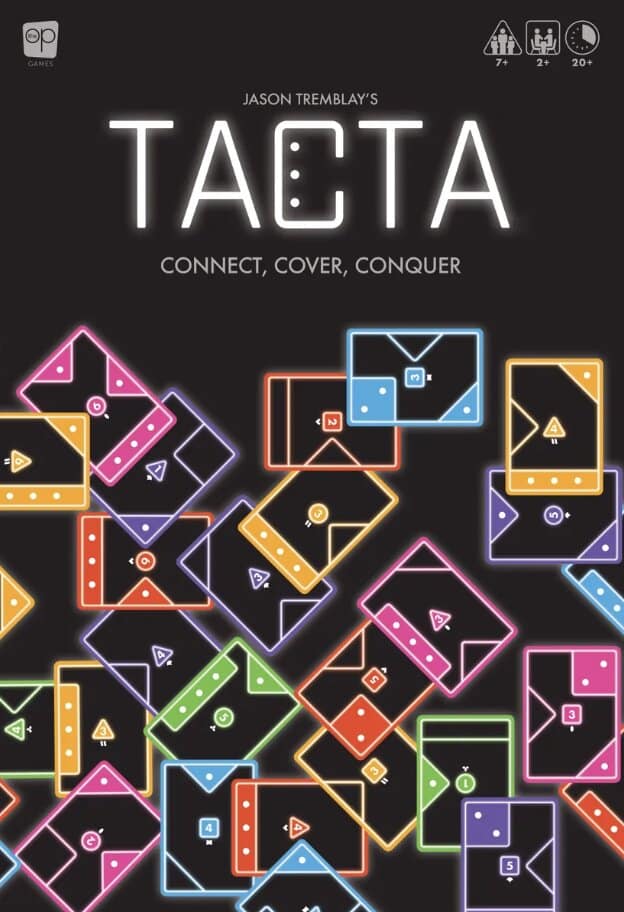
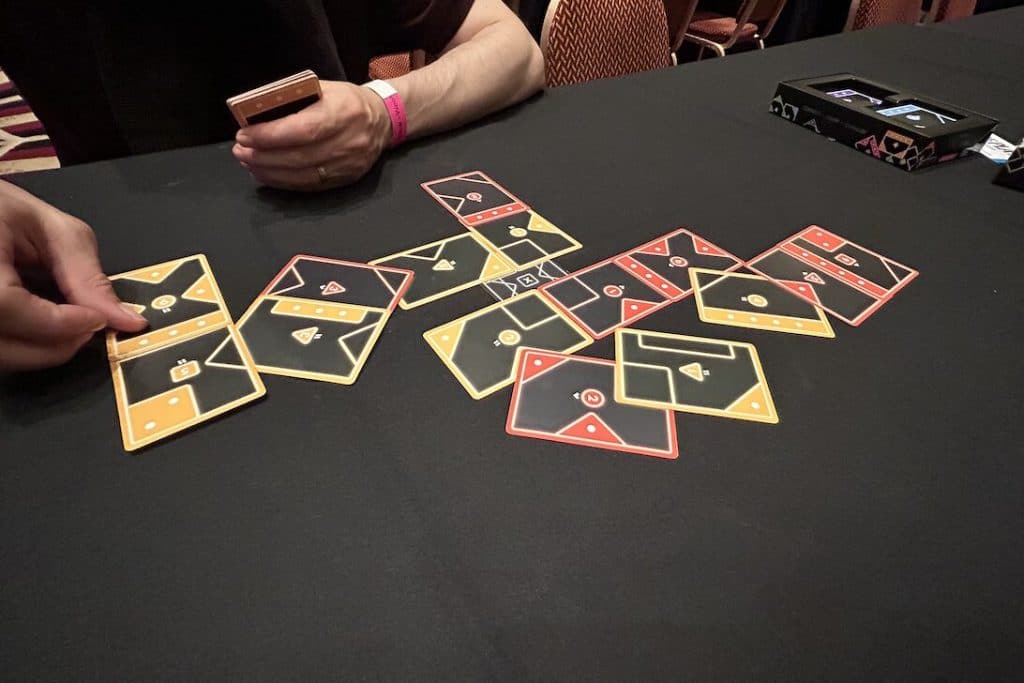
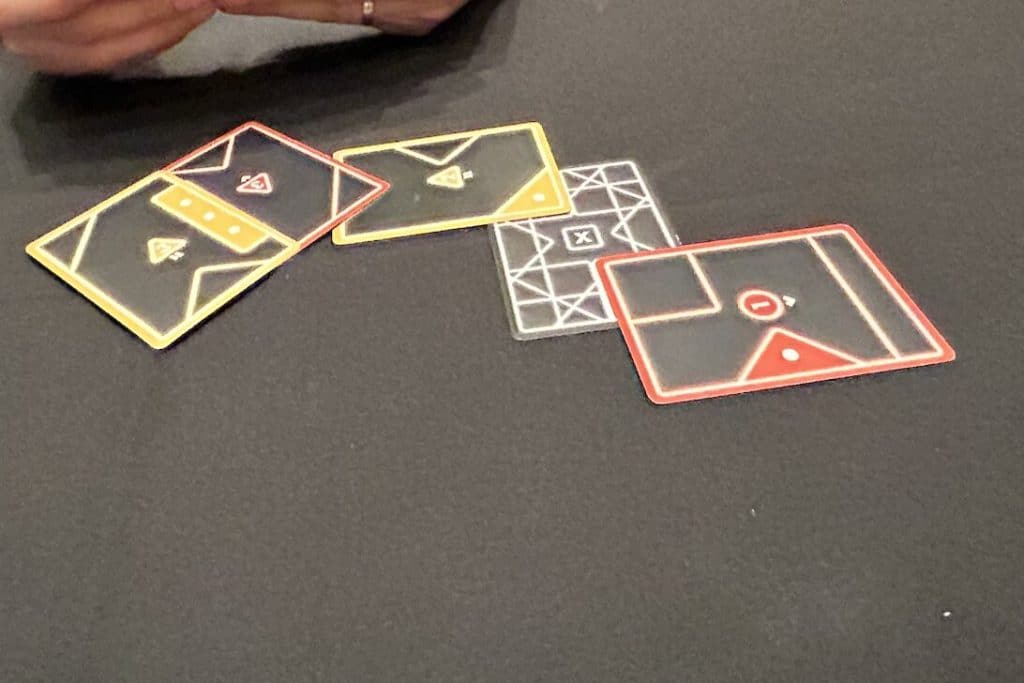
Tacta is a simple game of playing cards. However playing in this instance is about where, precisely, you place them on the playing area – because all players between them are making a map of sorts – one they are trying to dominate.
Each player takes all the cards of a chosen colour and shuffles them into a deck. The ‘start’ card is placed in the middle of the play area, and all players should agree exactly how big that area is: if you’re using a whole table, that’s pretty straightforward, although decide now if cards are allowed to overhang the edges!
You hold your deck in your hand and each turn can play from either the top or the bottom, with the option of flipping your chosen card. When you play you must overlap your card with precisely one other card in the play area, no more and no less, exactly matching one of the shapes on the card – squares, triangles, rectangles – with each another (see pics above). The goal is to try and make sure the coloured areas on your cards are still uncovered at the end of the game, as these areas have points values on them between 1 and 4. Tactically, you’re looking for places to play cards where the geography of their position means your coloured areas cannot subsequently be covered. But you also want to be on the lookout for opportunities to cover your opponents cards where possible, especially their high-scoring ones. You are free to cover your own cards as well, and this can be a way of locking down some points!
As soon as the last cards are placed, the game will end and each player scores a point for the dots on their visible coloured areas. Most points is the winner!
The rules do not specify whether each players ‘next cards’ are public information. For the sake of expediency, we play it that your deck is hidden, and hold the decks beneath the table if necessary.
Sam says
I enjoyed my plays of Tacta okay without really falling for it. The spatial thing is interesting without being compelling, and the puzzle vibes don’t feel as dramatic or funny as I feel the best gaming experiences can be. If that sounds like damning with faint praise, this is obviously very much about taste, not a design flaw. But whilst I’m more a tactical gamer than a long-planning strategic one, there is something one-note about the experience it offers, which is why I’d suggest it’s a much better game for 3 than it is for 6. More players makes the game last longer – and you also need a much bigger table! – and with a game that’s this simple and situational, it can end up feeling draggy. My takeaway is that it’s an interesting concept but – all other things being equal – it seems to come down to who gets the right cards at the right time. Not a dud by any means, but not one we get hugely excited about either.
-

Take That!
Lots. Players are in a constant battle for dominance
-

Fidget Factor!
Moderate, potentially high with the full count of 6 players. It's a rare moment someone knows exactly what to do when their turn arrives
-

Brain Burn!
Largely spatial
-

Again Again!
It's a puzzly, abstract game, and quite visually striking. Things are impossible to predict so it's also highly tactical


