
Tales of the Arthurian Knights
Designed by: Andrew Parks, Eric Goldberg
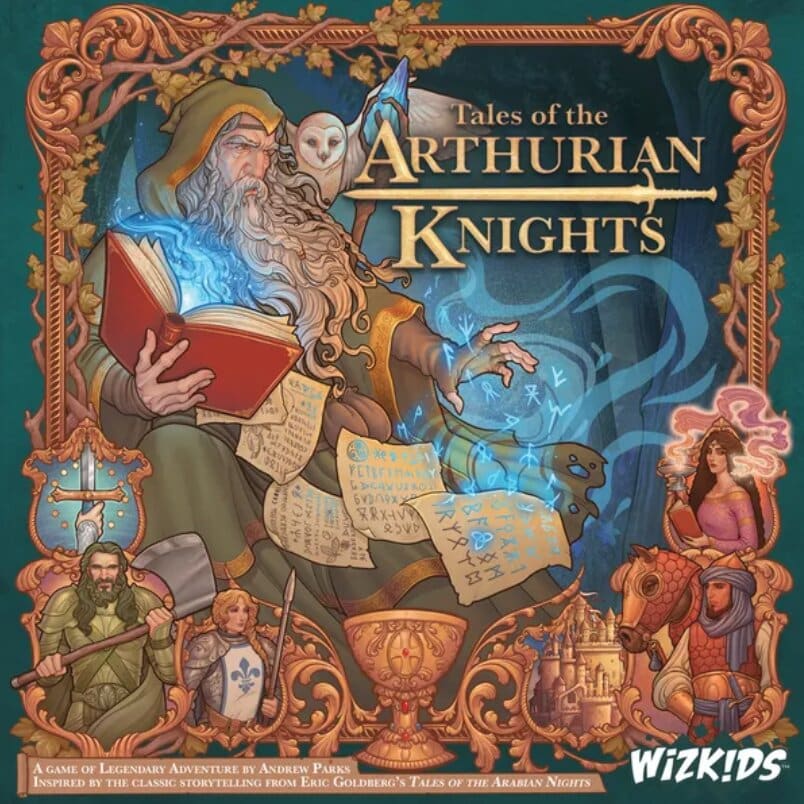


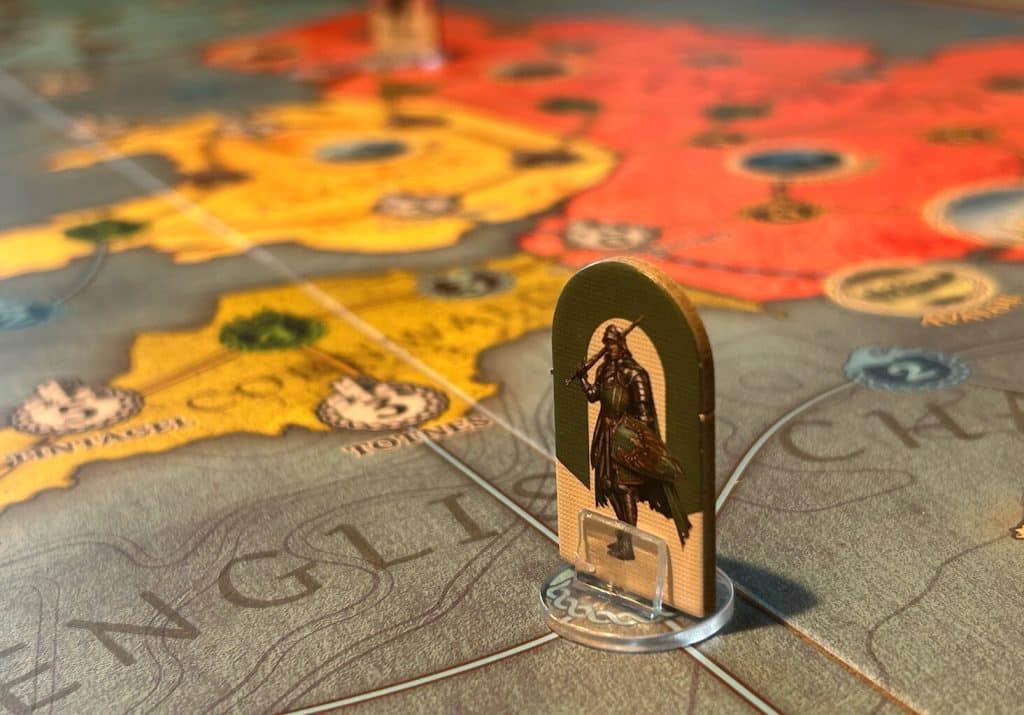
In Tales of the Arthurian Knights, 1-4 players represent the knights of the title (-or dames), sent far and wide by Arthur across his kingdom to rattle sabres and buckle swashes. Who will find the most honour, is the big question. But as with it’s predecessor Tales of the Arabian Nights, the game is best experienced as more adventure than quest: though you do a fair bit of questing in the game, the winning or losing here is very much secondary to the tales of the title.
The board shows the extent of Arthur’s kingdom: most of Great Britain and northern France. The players are knights or dames, who begin the game in Camelot on the south coast of England, but during play will gallop off with their retinues to encounter all manner of things, mythical and otherwise. Encountering is, in fact, the core of the game: on your turn, you move across predetermined routes and wherever you stop, you draw an Encounter card and go about resolving it.
The encounters can be a character, a location, or some other element such as a storm. In each instance, you’ll be directed to an entry in the huge Book of Tales that comes with the game: another player reads the entry aloud and gives you choices as to how to proceed. In essence then, it’s like a choose-your-own-adventure book, but structured to give you more freedom than the strictly-defined paths in a book – thanks to the map and how the encounters vary depending on circumstance. The game is broken into three ‘ages’ and encounters will be different across each age (alternatively you can play a shorter game of just one or two ages). Also affecting your progress – positively – are the Skills tracked on your player board. There are a dozen such skills, which you can bring to bear when an encounter asks for a test to be passed. For example, you meet a Giant and he’s hostile: the book offers you the choices of fighting or trying to talk your way out of it, and the success of either depends on the roll of a die. Your Warfare skill is still at zero, but your Diplomacy and Cunning skills are both +2 to that roll: it seems like talking your way through this one might be the better bet. Crucially however, you don’t actually know which of your skills will be tested until you’ve chosen your path – only the player reading to you has that information. So you’re basically making educated guesses.
Passing a test is generally better than failing one, for obvious reasons, but even in failure your knight will learn something – even if it’s just improving your Endure Hardship skill. Thanks to encounters, your personal circumstances will change too. Each player has 27 Status cards, and you may be instructed to activate one and find yourself Blessed, Cursed or, who knows, maybe even a Monarch. Status cards have a limited lifespan however, and after a few turns the status is lost: it’s like the Arthurian equivalent to a meme, as the novelty wears off and attention is turned by other things, such as another player becoming enslaved or something like that.
Throughout the game you’re slowly gathering a Destiny tokens, which are rewarded after encounters. Sometimes it might be one or two, but at others you might manifest more impressively. After the final age, the game will end and the player with the most Destiny is the winner!
Sam says
I’m a fan of both this and the inspiration, Tales of the Arabian Nights. To compare the two, Arabian Nights is my favourite because the sprawling absurdity and rich humour that the madcap system of encounters throws up are my favourite aspects of the game. I’ve seen someone spend several turns imprisoned and ensorcelled, only to finally escape and instantly get married to someone they’ve just met: the silliness can be off the charts. Arthurian Knights feels more coherent as a set of narratives, but also slightly more… sensible. I can see why many would prefer it: not only does it feel more robust, it’s also more concise, with the variable game-lengths adding to the sense that this is a refined version of the game – even playing all three ages can be shorter than a game of Arabian Nights. For me that refinement comes at a slight cost, but it’s still great fun, particularly for families where kids are keen to game with parents: there’s a friendly vibe to the whole thing, and a constant sense of progression.
-

Take That!
Players don't really interact with each other at all, the fun here is in the shared stories
-

Fidget Factor!
Low with 2, climbing a little as you add more players
-

Brain Burn!
Extremely low. The rules are straightforward and turns are pretty much a set of choices that aren't so much right and wrong, but differing degrees of right
-

Again Again!
Whilst the Book of Tales is huge, if you play the game a lot in a short space of time you will start to recognise some of the encounters. Not a serious flaw, but something to bear in mind if the discovering is your favourite aspect


