
Tetrarchia
Designed by: Miguel Marqués
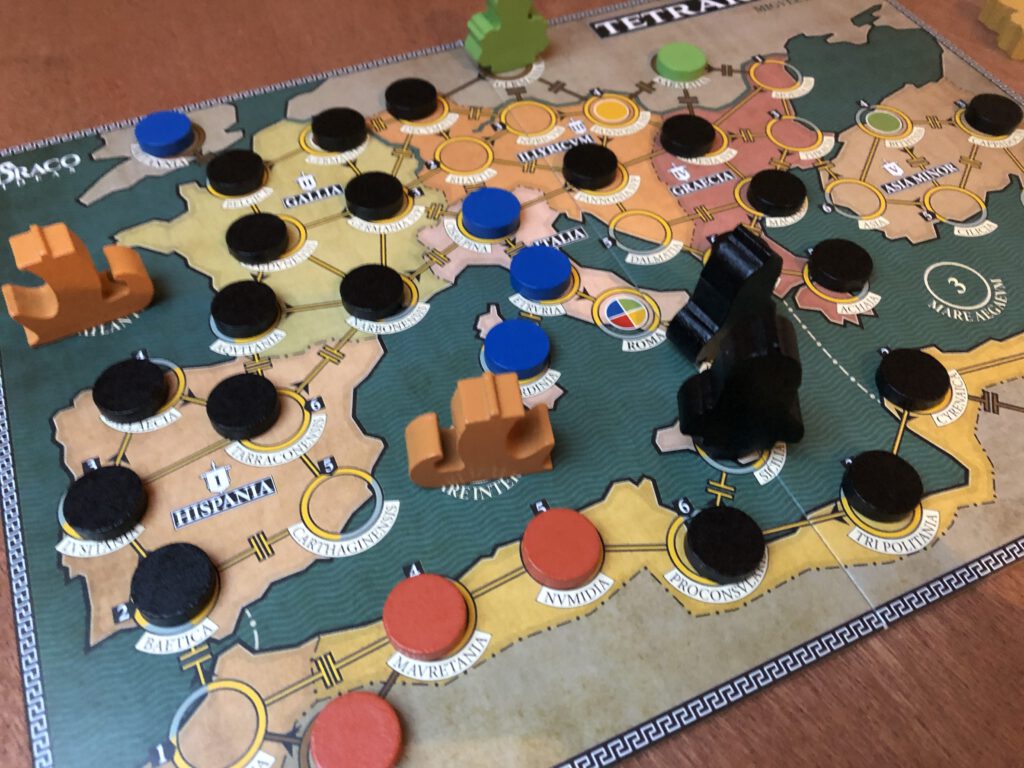
Tetrarchia is a solo or co-operative game that is played in around 30 minutes, or possibly less if you are overrun by barbarians!
The game conceit is that players (or one player) control a Roman empire no longer operating under the auspices of a single ruler – instead, four would-be emperors make up a tetrarchy – and have agreed to work together to hold off threats at the empire’s borders, and pacify – or subjugate – unrest at home.
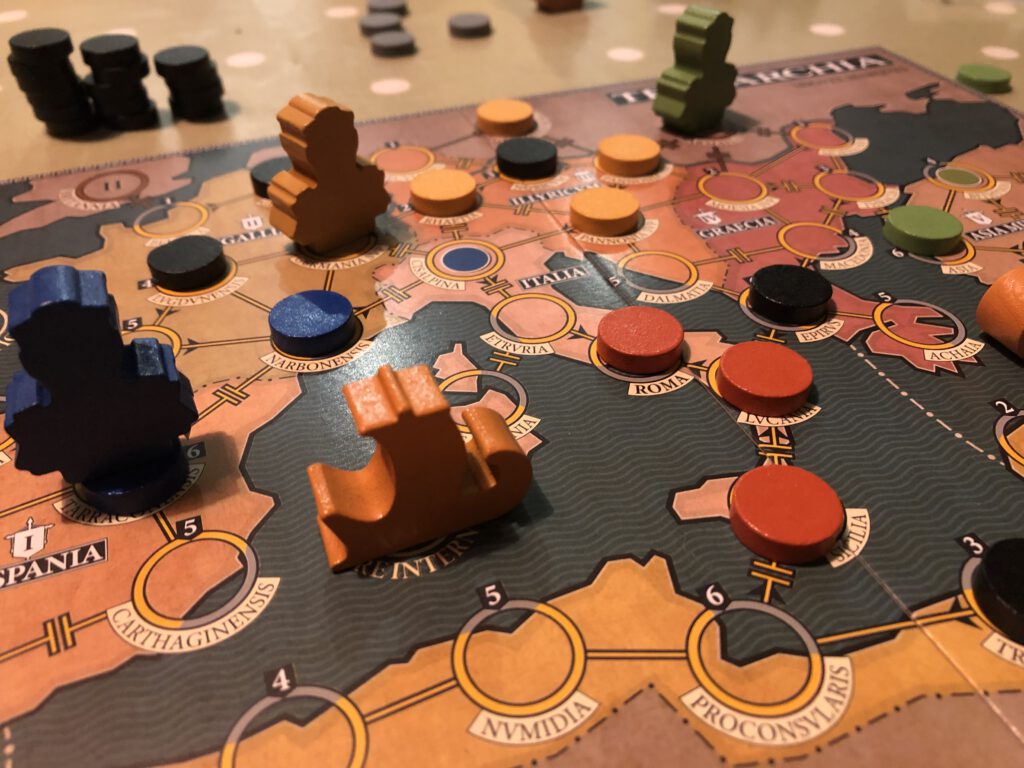
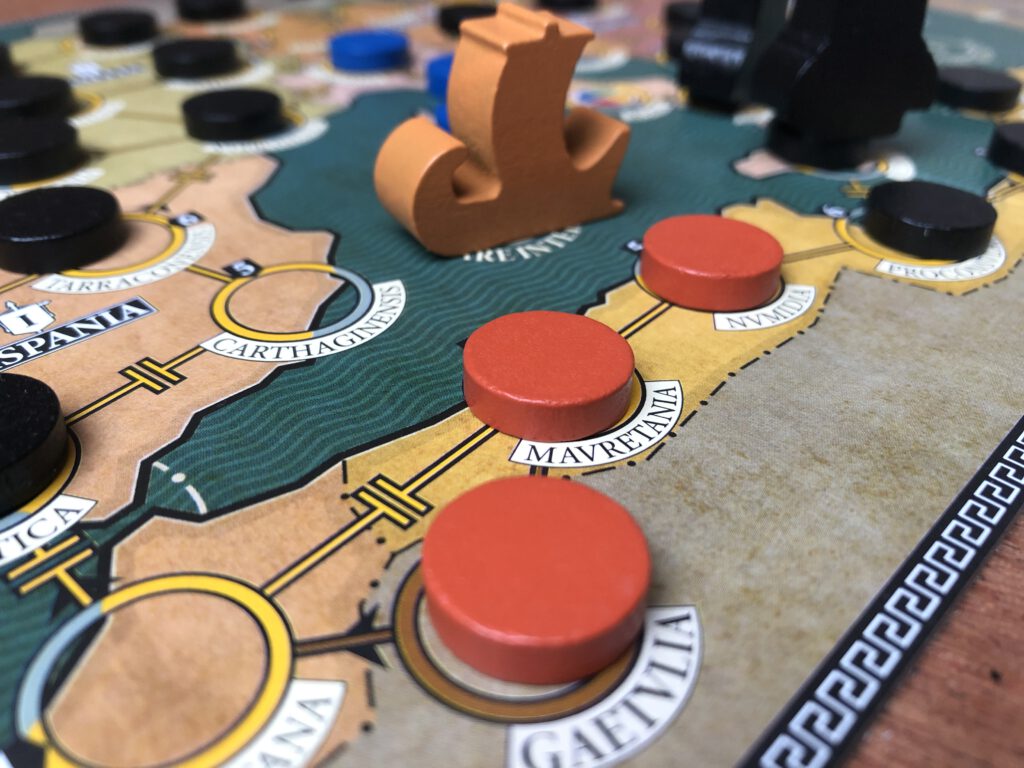
The small board shows a map of the empire split into six regions, and during set-up each region receives one revolt marker, represented by a black disc. Play proceeds with each of the Roman rulers taking turns, followed in each instance by the barbarians (controlled by the game) activating. Let’s say you’re playing Diocletian (green): on your first turn you place your emperor either in his home city or Rome. You then, like all emperors, have 6 action points to spend: you can use them to move your emperor (along the roads to a neighbouring city, or across the seas), to sail (moving the Roman fleets, which allow you to move across water) build garrisons – we’ll come to those shortly – subdue unrest or revolt, or attack.
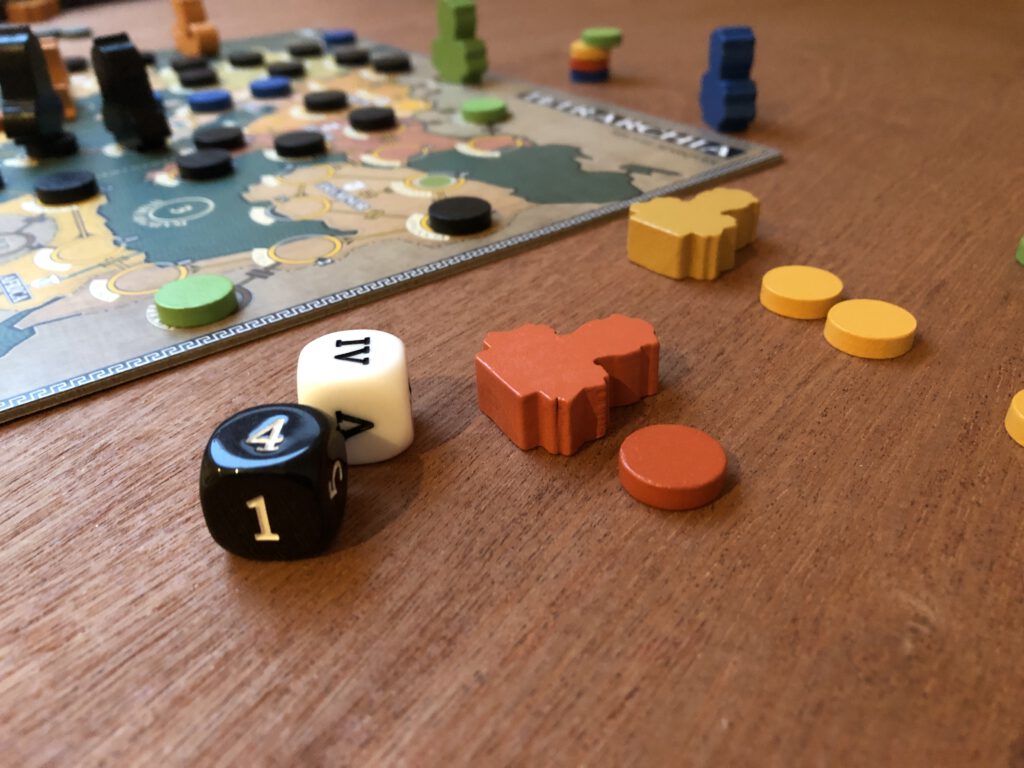
When the barbarians activate, they may trigger the arrival of a barbarian army, which is intent on marching to Rome. To attack the army you simply attempt to move to its location from an adjacent one, and follow a simple combat system of rolling a die for either side. But this is where your garrisons come in handy, as however many garrisons (of your own colour) you are currently linked to on the map will be added to your roll, and then multiplied by any other emperors who are also adjacent to the army you’re attacking, if there are any. In turn, the barbarian gets any revolts the army is linked to added to their roll, and multiplied by any linked barbarian armies. A bit long-winded to describe, but very simple in action.
The goal for the Romans is to build garrisons in the six border locations at the edge of each region, securing the empire. But they can lose if a barbarian army reaches Rome in the meantime – and after each emperor’s turn the barbarians get busy! Dice are rolled that may conjure unrest (grey disc) or even open revolt (black disc) at home, and these can quickly proliferate if not subdued by the emperors – and as they do, their presence make the barbarian armies stronger! These enemy armies also march on Rome, following the arrows on the board – if they reach Rome before the borders have been secured, all is lost!
Tetrarchia has baked-in variety with it’s difficulty levels in how the game is set-up, going from relatively easy to extraordinarily difficult! The rulebook also comes with additional scenarios to explore.
Sam says
Considering the fairly tiny box it arrives in, I’ve been very impressed with the size of game experience that emerges from Tetrarchia: it feels like a classic design that’s married a fairly abstract gaming system with a setting very successfully: sure, there are random elements and you can be harpooned by ill fortune – but I imagine having enemies on all fronts can feel very much like being harpooned by ill fortune in unpredictable ways. The map anchors it in reality and if the geography of it feels slightly mechanical – barbarians always follow the same routes to Rome – the design throws up enough tactical surprises to keep you on your toes. For me it hasn’t become a go-to game, but that’s not to say anything critical beyond my own preferences and tastes: I think this is a miniature gem that will give enormous replay value to those who enjoy it.
-

Take That!
None from the other players - everyone is on the same side, with the barbarians 'automated' by the game system.
-

Fidget Factor!
With four players there's some time spent waiting for your turn, but you're both invested and hopefully interested in what's happening while you wait. Having said that, Tetrarchia is best for one, or two players at most, we feel.
-

Brain Burn!
It's mostly a tactical challenge of reacting to how the barbarian threat develops, but with the end objective forming a kind of strategic underpinning to each round. The emperors operate in isolation, but team up to attack (and defend against) barbarians, so the co-operative aspect isn't just in theory.
-

Again Again!
Part of Tetrarchia's appeal is the enormous amount of variation that set-up allows, and more scenarios can be found by the designer online.


