
The Court of Miracles
Designed by: Guilhem Gautrand, Vincent Brugeas
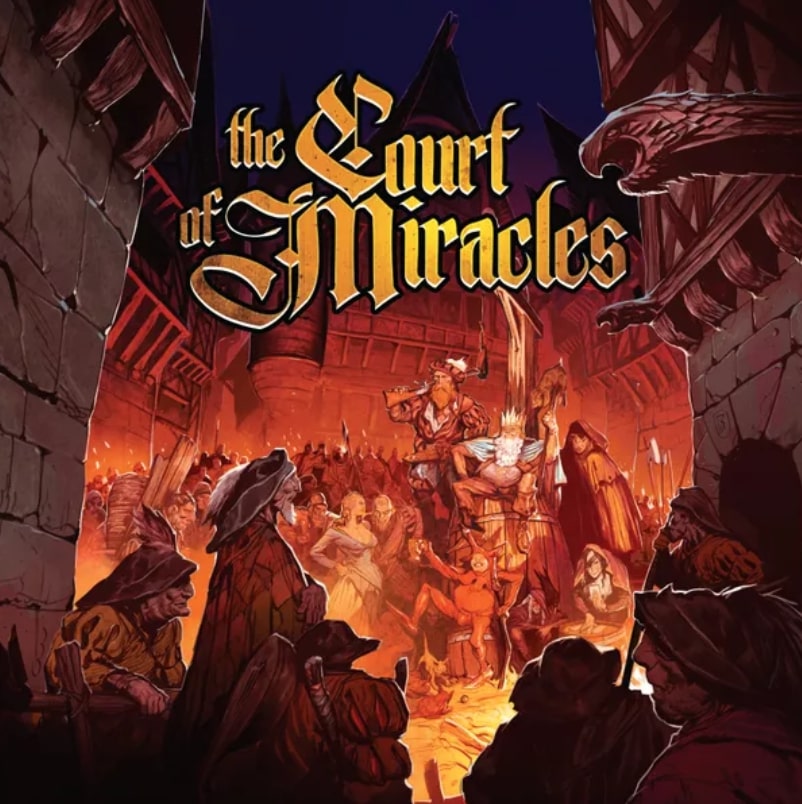
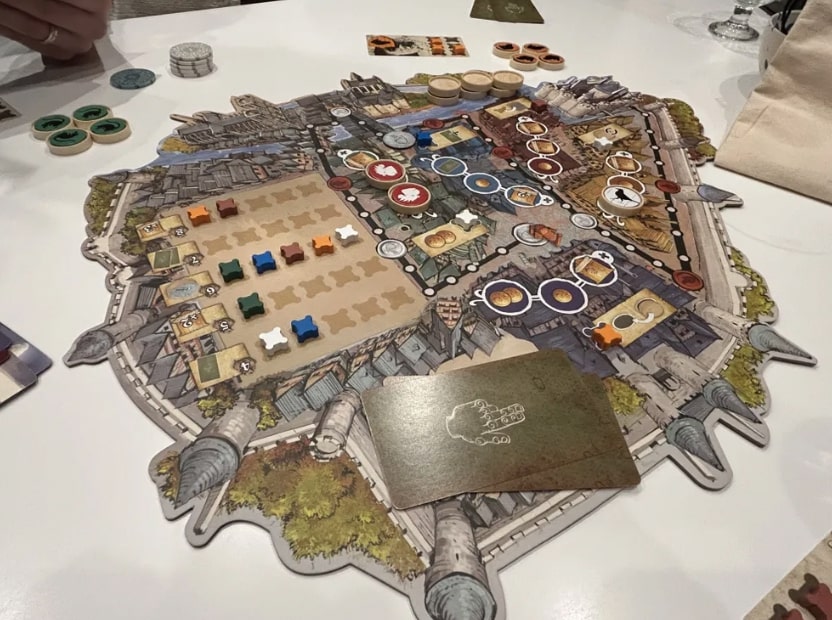
The setting is Paris, in some unspecified past. While the Penniless King rules – after a fashion – the players represent the conniving nobles, sending their rogues out to control the various neighbourhoods of the capital… and extort their way to victory. This… is the Court of Miracles.
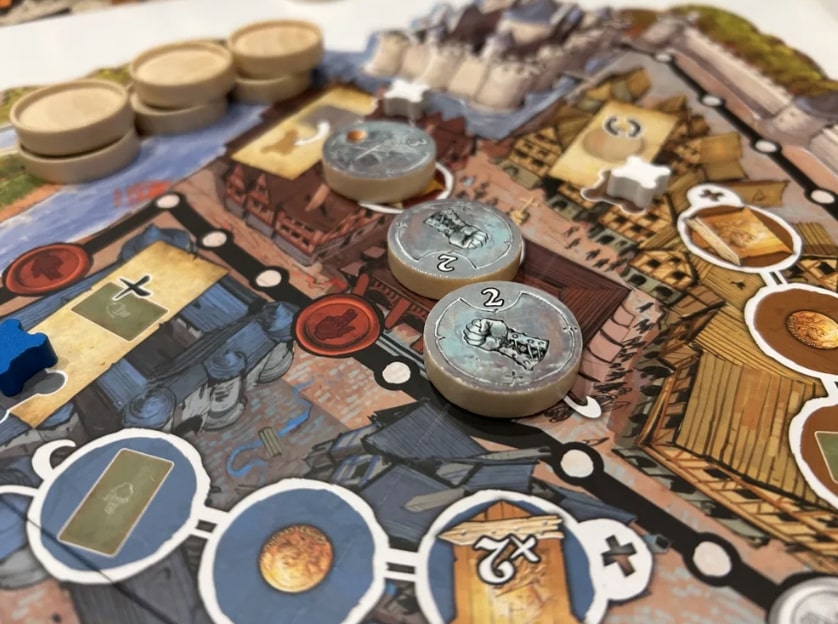
The board shows the city, broken into six neighbourhoods. The players begin with a little cash and three rogue pieces, with a strength of 1, 1, and zero. Each neighbourhood has three spots where you can send one of your rogues face-down to claim the reward of the spot (often money, or special cards) and, optionally, the reward of the neighbourhood as well. Whenever the third and final spot of a neighbourhood is filled, a stand-off is triggered: all the rogues are flipped over and revealed, and the player with the strongest value now has control of that neighbourhood: they place a renownmarker there to show it and the rogues all return to their respective players.
Renown in a neighbourhood is desirable for two reasons: firstly, whenever anyone takes the neighbourhood reward for placing a rogue there, the controlling player gets a coin from the bank. Secondly, getting all your renown markers out on the board is what wins you the game!
There’s another way you can get a renown token out, however, and that is buying your way to notoriety – also the reason that cash is crucial. One of the neighbourhoods allows you to spend money placing a renown token on the ‘renown square’ – and getting the instant reward: for instance, a new and powerful strength 2 rogue, or more special cards. While your renown may be kicked out of the neighbourhoods by subsequent stand-offs, they are safely ensconced here in the square.
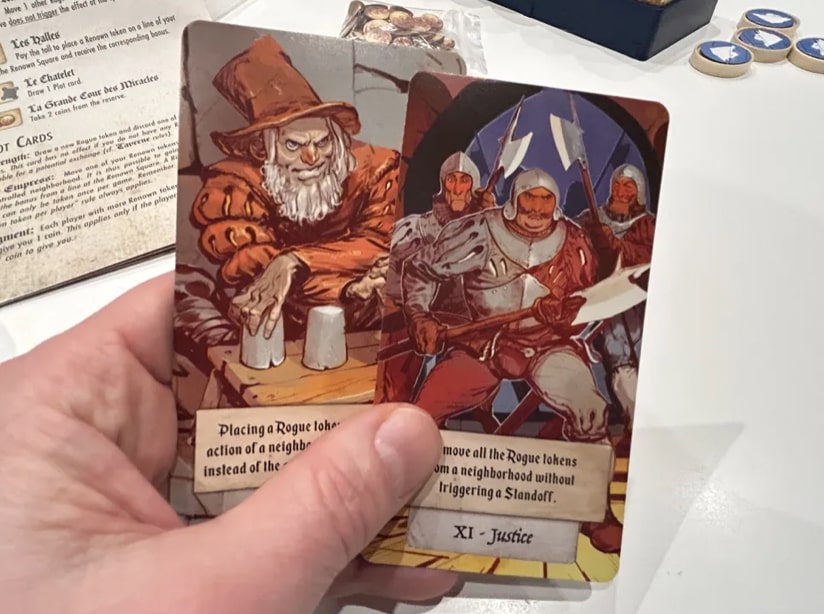
The special cards are a one-per-turn maximum little – or occasionally large – hand-grenades thrown in to the ongoing shenanigans. They’ll gain your coins, or cause a little chaos out on the board, or allow you some kind of tactical quirk that, when timed adroitly, can swing things your way.
And finally there is the penniless king himself, who plods mournfully through the city, triggered by certain rogue spots. He serves two purposes: firstly, when he passes by a neighbourhood he will trigger an instant stand-off, regardless of how many rogues are present. He also serves as a game timer of sorts, because (if nobody has gotten their sixth renown marker down) when he reaches the end of the track the game will finish, and the winner is determined by majority.
Sam says
The Court of Miracles steers perilously close to chaotic, but stays – I think – just the right side of the line. It can be hard to predict what will happen between turns, because with so much hidden information (cards hidden, rogues face-down, player decisions) the state of things in penniless Paris changes fast. With five players you can end up kind of shrugging slightly at the sense of bunfight and lack of control. With two the game doesn’t feel like it hits the notes it’s intending to. But with 3 or 4 players, The Court of Miracles is a blast to play for those who like spicy, feisty interaction and general shenanigans: like being slapped across the face with a velvet glove.
-

Take That!
In a game where the term ‘stand-off’ plays such a central role, there is a palpable sense of take-that-ing.
-

Fidget Factor!
It’s pretty speedy in the main, usually wrapping up in an hour even with five.
-

Brain Burn!
It’s a game of shifting sands and grabbing opportunities as they happen, so not one for the deep-thinking strategists.
-

Again Again!
The broad brush-strokes of The Court if Miracles do not vary much across multiple plays, but the micro-dramas and dastardly beats of the story are there to be seen and felt.


