
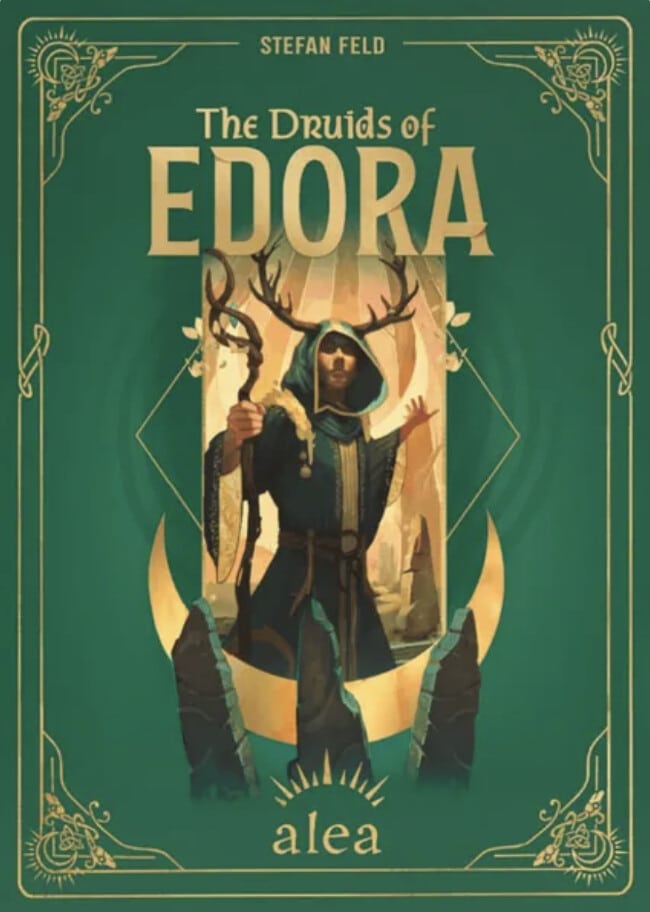
The Druids of Edora
Designed by: Stefan Feld
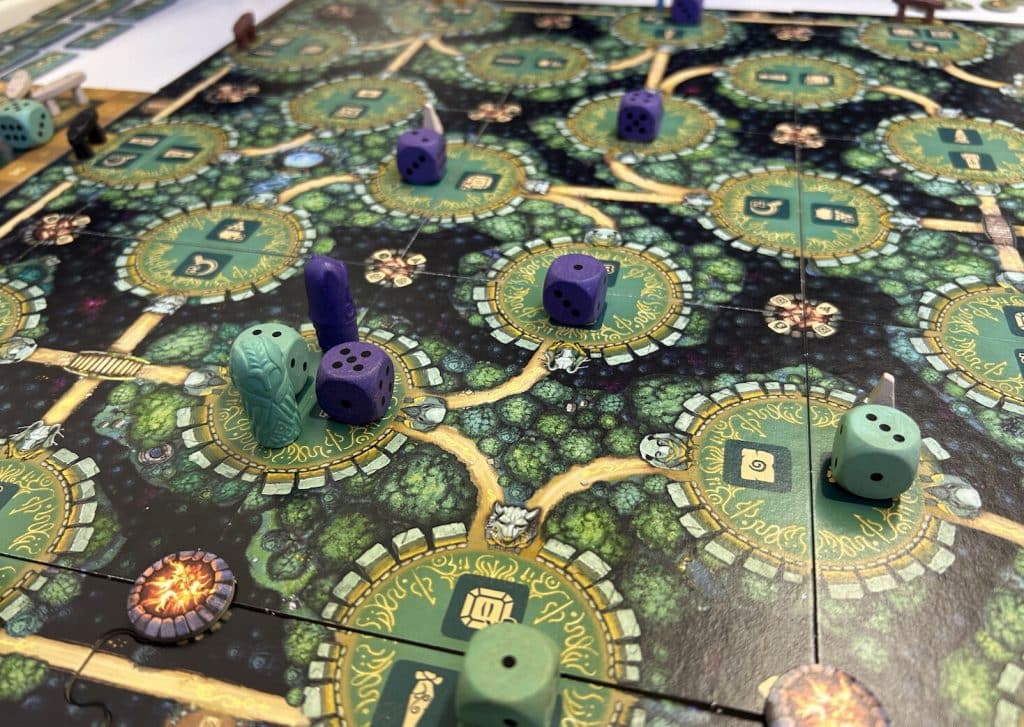
When playing The Druids of Edora you, the players, are the druids in question, wandering an enchanted forest and hoping to endow your learning and wisdom. In terms of narrative, this is about as detailed and immersive as the game gets: Edora is less a story, more a maximising of returns on the placement of dice.
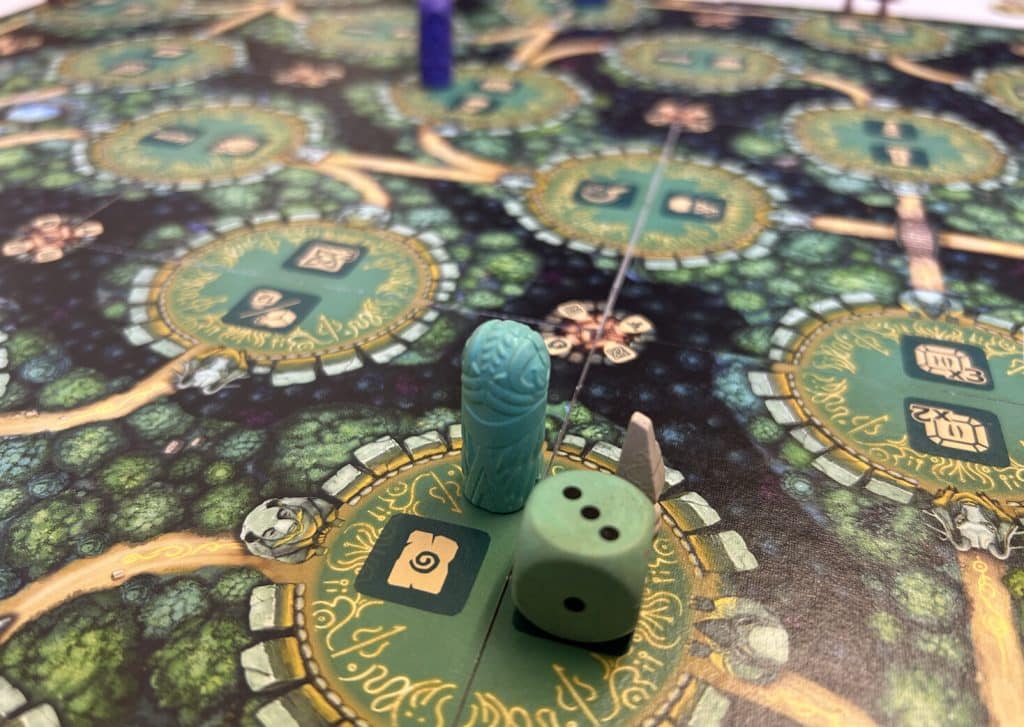
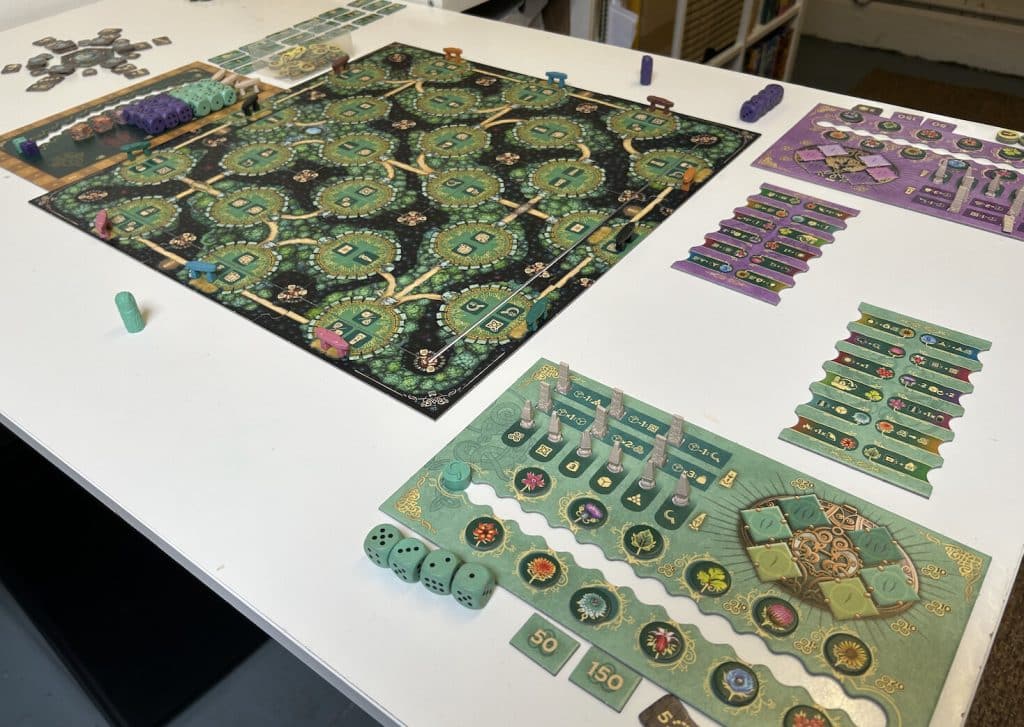
The board shows the forest itself, with the lighter circles on it representing shrines that the players will visit. On each turn you first move your druid piece – you must always move – and pay provisions depending on the length of the journey. Then you place one of your dice in any empty slot on the shrine (paying provisions equal to the die value) and take the action printed there. In short, low numbers are better for almost every action: they’re cheaper to place, and for most actions the number on the die is irrelevant. For end-game scoring however, as we’ll see later, higher numbers are a lot more valuable.
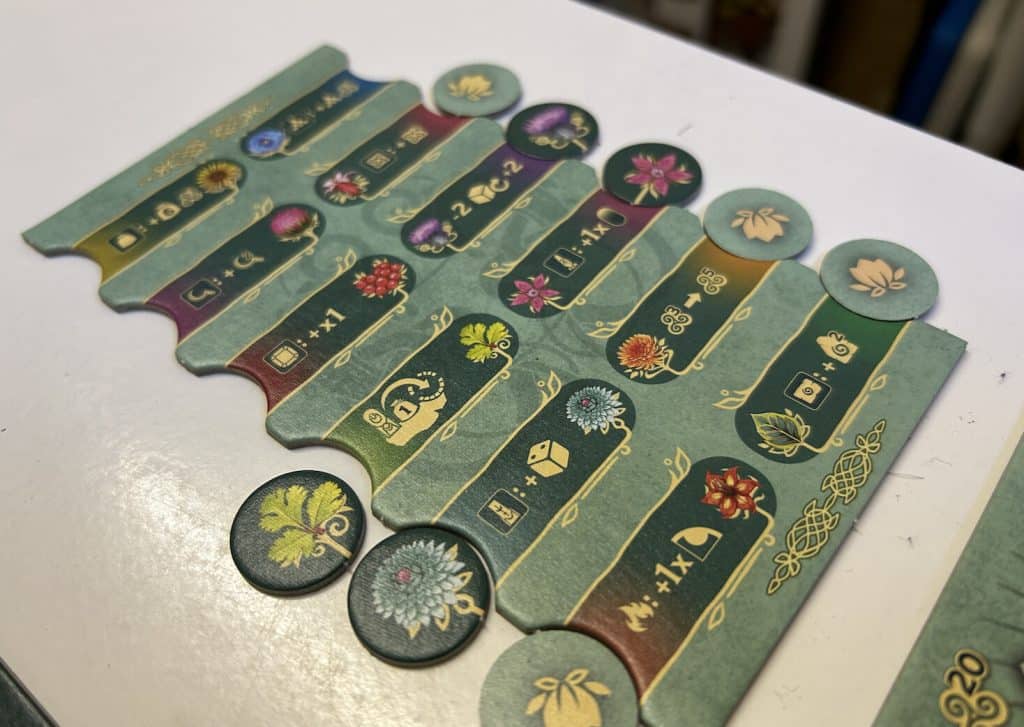
What are the actions? One allows you to take more provisions or dice: both are in limited supply and you ideally need at least one die at your disposal for every turn, plus the provisions to move your druid and place it. Another lets you move your marker up the Knowledge track: this is good for the endgame bonuses mentioned above. Each player has their own personal player board and four actions relate to three things on it: adding Amulets to your board give you one-off bonuses, moving the Sickle up your herb track gives ongoing abilities via the herbs, and erecting Standing Stones or Runestones also gives you bonuses. The Runestone action is the only one where the number on the die you placed is immediately relevant to the action: higher numbers make it more powerful. All of these things improve your capacity in the game to travel, get provisions, make actions more powerful and generate Prestige points. Listing them here would be exhaustive, but it’s safe to say there are strategic directions to be explored and within them a multitude of tactical decisions… Finally, you can take mistletoe and either use to it brew a Potion straight away, or save it for a more powerful Potion later. There are eighteen potions in the game, and the most powerful ones are extremely juicy: turning six of your previously-placed dice to their 6 side facing up, for example, or just scoring a bunch of points.
On the board itself are further incentives: the most highest-numbered die instantly scores two points when a new die is added to any shrine. Being first to establish a path (with your dice) between the Dolmen pieces around the outside of the board generates prestige points, and surrounding a Bonfire spot on the board with your dice triggers a bunch of rewards: points, provisions, dice, sickles, and so on. If you find yourself unable to take an action – either because you have no dice or not enough provisions to pay for things – you’re now a Druid in Distress: you miss a turn but do get a free die and six provisions from the supply.
The moment someone places their final die and takes their last turn, the current round is played to the end – so everyone gets an equal number of turns – and then scores are totalled based on whatever resources you have left, how far your sickle has moved and the number of amulets on your player board. Each of these can be extremely rewarding, but it can be very difficult to maximise all of them. When all of that scoring is completed, the board itself is scored: players have Stone Tablets that are each worth ten points if the objective on them is completed: for example, have four potions or have at least four of your standing stones erected. Then all but the highest-scoring die in each shrine are removed from the board and each player will score whatever is left of their own colour (plus any stones in the same shrine) multipled by a value shown on the Knowledge track – which again, will depend on how much knowledge they gained during the game!
After all that, the player with the most prestige points is the winner.
Sam says
If the logic of it all is slightly woolly, it does make a loose sense. Are you the sort of druid who brews potions, or builds stones? Do you develop knowledge or gather tablets? One cannot be all druids, all of the time. What’s nice about this is that whilst you might fail in being the ‘best’ druid, everything you do – bar running out of dice or provisions – has a reward built into it. You’re constantly improving, generating, accelerating, empowering yourself, and whilst interaction isn’t high on the list of descriptors for the game, it’s notably present. Each shrine has limited space (at least one for each player) so arriving early gives you the best choices. If you’ve found a way to keep your provisions high, you might want to try outranking others in the shrines with your dice and pushing up that knowledge track for a huge endgame swing in your favour. But this would probably mean neglecting herbs, potions, amulets and stones, all of which bring their own come-hither rewards. It’s more puzzle than story for sure, and more complex than simple. But the way it’s structured means you can explore that complexity reasonably quickly. Even the herb powers – which you need to remember, as they are ongoing and not one-off! – are limited to default maximum of six. I’ve only played this three of times so far, but it was just over an hour with two of us and a hair under 90 with three. Each play was very intriguing, in a game that knows not to outstay its welcome. Possibly my favourite of designer Stefan Feld’s work.
-

Take That!
Pretty minimal, although the highest die in each shrine representing a 'win' in the endgame scoring is definitely relevant.
-

Fidget Factor!
For a game of this idiosyncratic complexity, surprisingly low. It may sound like your choices are abundant, but the number of dice, amount of provisions and the geography of the board all bring in restrictions that mean options narrow, and as a result the game avoids disappearing into the black hole of one player's uncertainties.
-

Brain Burn!
There are three core things to bear in mind: the strategic direction you go in (herbs or knowledge? stones or potions? Your starting stone tablet may help you decide on that), the tactical decisions that push this plan along - hopefully - and managing the vital economies of dice and provisions that power it all.
-

Again Again!
Lots of variety here; not only in the randomised set-up and starting asymmetry (each player has their own stone tablet and herbs assigned randomly) but the board itself and the way you engage with it can change hugely from play to play.


