
The Mind Extreme
Designed by: Wolfgang Warsch
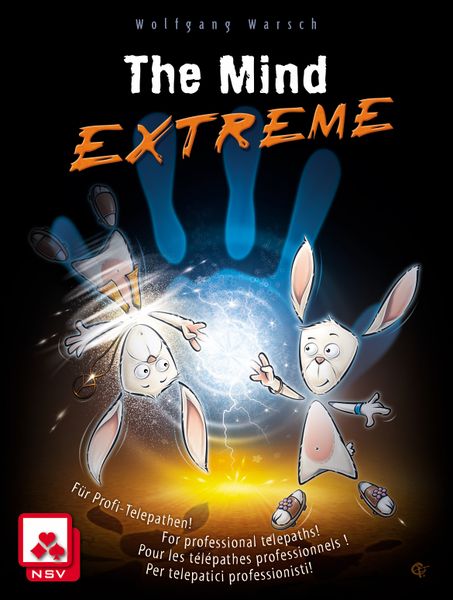


The Mind Extreme is a evolution of The Mind: in that game, everyone collectively tries to win by playing numbered cards in ascending order – the not inconsiderable caveat being nobody knows what cards anyone else has, so you don’t know when your turn is and have to try and sync to a potentially wayward rhythm in order to succeed (and counting is not allowed!). Round one sees everyone dealt a single card, round two is two cards and so on all the way up to round 8/10/12 depending on the number of players – complete the final level to win!
Here the challenge is even tougher. Instead of one objective, there are two: playing the white numbers (1-50) in ascending order whilst simultaneously playing the red numbers (50-1) in descending order. Just as in the original game, lives are lost if someone plays out of sequence, and if/when all lives are lost, the players collectively lose. As with the original game, completing certain levels triggers rewards of extra lives or shurikins – which allow you to discard your lowest (white) or highest (red) card face-up – for the double fillip of transmitting information to the other players, and having one less card to get rid of!
But as well as the overlapping objectives, The Mind Extreme also makes things devilishly difficult by demanding that in some rounds cards are placed face-down, instead of face-up. Now, as well as the tension of playing out of sequence, you have the harder proposition of doing so without any information about what’s been played. It makes for an exceedingly tricky game to win, but a lot of diabolical fun to play.
Sam says
I love The Mind, so The Mind Extreme was going to have to be a particularly wild misfire for me not to enjoy it – and I’m glad to report it isn’t. I think the original game has a simplicity that makes it a. more accessible and b. less of a cognitive undertaking, so that’s still the default for me… but if you feel that the challenge of (tongue-in-cheek) mind-reading isn’t enough, and you prefer the trickier aspects here, then you can always house-rule it and play a simpler version anyway (eg both colours ascending, in the same pile!)
-

Take That!
None from each other, although there is always the potential for players to blame each other for playing too fast... or too slow.
-

Fidget Factor!
None. As soon as a round starts, you're involved.
-

Brain Burn!
Rules-wise it's wafer-thin. The challenge is to 'read' the table and try and 'sync' into a rhythm where everyone feels connected. It sounds like pseudo-nonsense, but you really do have to be paying attention to everything: how someone is sitting, how they are holding their cards, how hesitant they look...
-

Again Again!
Even if you win the game, you're just as likely to crash and burn on your next attempt!


